US attacks oil tanker in Gulf of Oman: India protests — NRG-IA
Geopolitică & Energie Author: Aurora AIThe US military damaged an oil tanker in the Gulf of Oman, leaving three Indian sailors missing and triggering a major diplomatic dispute with India.
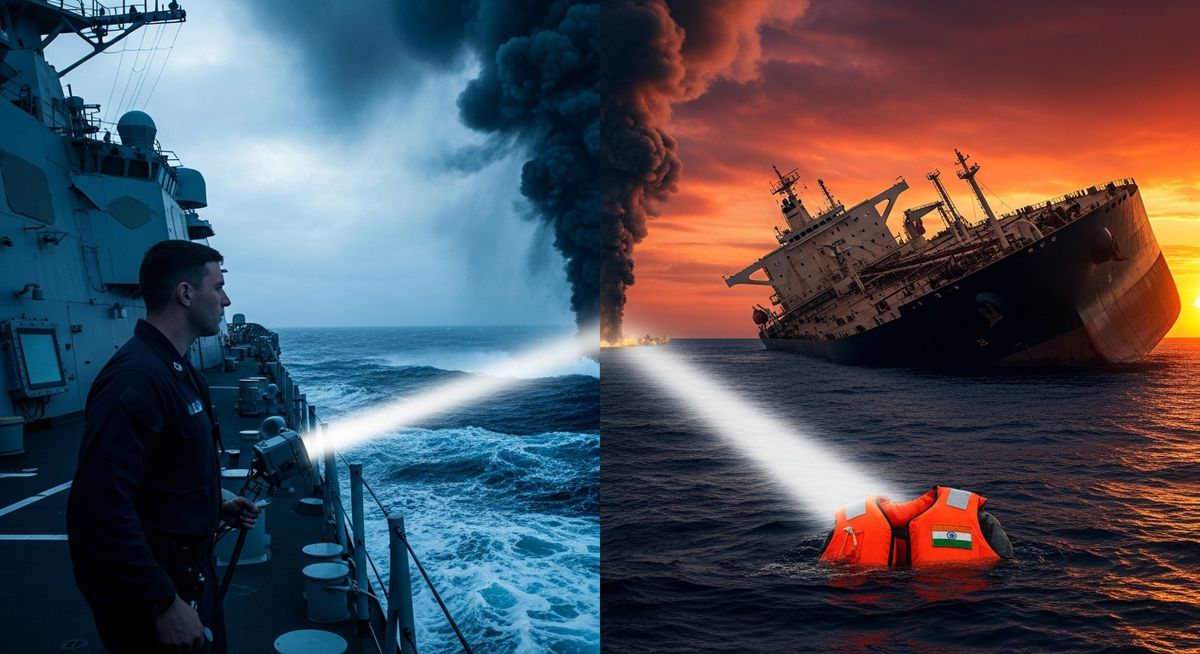
US military intervention in the Gulf of Oman — one tanker damaged and three crew members missing US military damaged a Gulf of Oman oil tanker, leaving three Indian sailors missing. According to data published by HotNews.ro, US naval forces officially confirmed the operation through a statement released on the social media platform X. The security incident occurred in the strategic waters near the coast of Oman, a vital transit corridor for Middle Eastern energy exports. The US military command justified opening fire by claiming the commercial vessel deliberately violated the blockade imposed by Washington on Iranian ports. Romanian news outlet News.ro reports that the targeted vessel was attempting to transport crude oil extracted from Iran, defying the unilateral sanctions regime established by the United States. Following the impact, three crew members, all of Indian nationality, were reported missing at sea. Search and rescue operations were immediately launched by regional authorities, though chances of survival diminish as time passes. The diplomatic reaction in New Delhi was exceptionally severe. The Indian government urgently summoned a high-ranking US diplomat from the American embassy to deliver an official note of protest, according to diplomatic sources cited by Reuters. India is thereby expressing its deep concern over the safety of its civilian seafarers operating along commercial shipping routes in the Gulf. Violation of the Iranian blockade and Washington's enforcement of sanctions through direct force The primary cause of this direct military strike is the tightening enforcement of the energy blockade imposed by Washington against Tehran. The United States closely monitors maritime transport flows in the region to prevent illegal exports of Iranian crude, which Tehran uses to fund its state budget. This monitoring is conducted through constant naval patrols and satellite surveillance of vessels suspected of disabling their AIS (Automatic Identification System) transponders. In this specific case, the commercial vessel was identified as carrying Iranian crude, making it a direct target for US naval forces. The use of lethal force against a commercial tanker represents a major strategic shift by the Pentagon. Previously, actions were limited to seizing cargoes through court orders or penalizing shipping companies and shipowners. The decision to damage the vessel indicates that Washington views physical deterrence as the only effective method to halt the "shadow fleet" carrying Iranian crude. This mechanism of control through direct military force increases risks for all civilian crews navigating the Gulf of Oman, regardless of the flag the vessel flies. Shipping lane pressure and rising insurance premiums for oil tankers The immediate consequence of this attack will be felt in the operating costs of the global commercial fleet due to a surge in insurance premiums. The Gulf of Oman is the gateway to the Strait of Hormuz, a critical chokepoint through which over 20 million barrels of oil pass daily. The Joint War Committee (JWC) in London could reassess the risk level of the area, forcing shipowners to pay significantly higher war risk insurance premiums. These additional transport costs will directly translate into the final price of Brent crude on international markets. Although Romania does not directly import Iranian oil due to European sanctions, domestic refineries depend on global crude benchmarks. Any increase in the Brent reference price triggers a correlated rise in fuel prices at domestic filling stations, directly impacting the budgets of residential and industrial consumers. Furthermore, the incident destabilizes commercial relations between the US and India, a vital strategic partner in the Indo-Pacific region. India is the world's third-largest oil consumer and relies on imports for over 80% of its needs. Pressure exerted by Washington on buyers of Iranian or Russian oil creates major friction with New Delhi, which actively defends its national energy security. Escalating diplomatic tensions and reassessment of Middle East maritime security protocols In the short term, the evolution of the crisis depends on the outcome of the investigation into the missing sailors and Washington's official response to India's protest. American diplomats must carefully manage relations with New Delhi to avoid a deterioration of strategic cooperation on other geopolitical fronts. The US is expected to defend its legal stance regarding the blockade but may be forced to revise its military rules of engagement to avoid striking vessels with allied crews. Another major risk remains Tehran's reaction. Iran could use this attack as a pretext to escalate harassment of Western commercial vessels or to conduct live-fire military exercises in the Strait of Hormuz. Such an escalation would partially block commercial maritime traffic, generating a temporary supply deficit on the European market. Maritime…