US Russia sanctions oil gas Ukraine peace talks — NRG-IA
Geopolitică & Energie Author: Aurora AIRussia warns that new US Congress sanctions targeting hydrocarbon exports and global buyers are blocking diplomatic peace efforts in Ukraine.
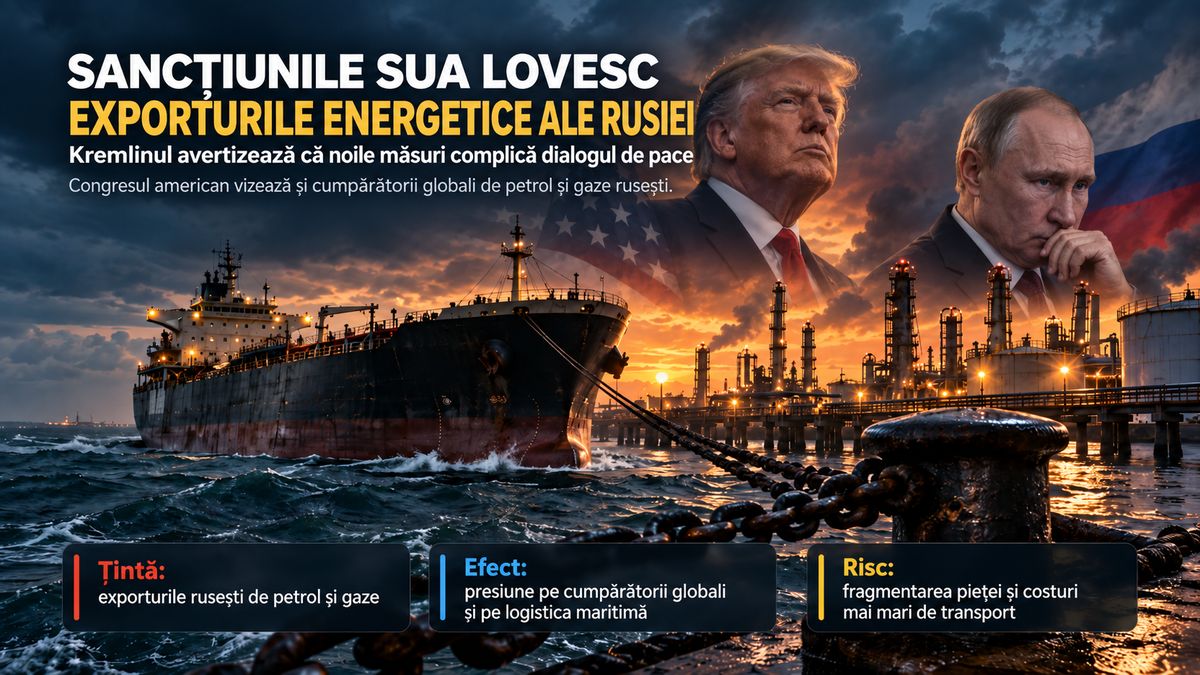
US Hydrocarbon Sanctions Block Diplomatic Channels — What Happened The US Congress has approved massive new hydrocarbon sanctions, blocking, according to the Kremlin, diplomatic efforts to end the war in Ukraine. Russia officially warned on Thursday that the new restrictive measures adopted by the American legislature will significantly complicate any diplomatic initiative aimed at ending the military conflict. Washington's decision comes at a moment of peak geopolitical tension, as global energy markets actively attempt to redefine their supply routes. According to G4Media, citing Sky News, the new sanctions directly target Russian oil and gas exports, as well as third-party countries that continue to purchase energy resources from Moscow. The Kremlin reacted promptly through its spokesperson, emphasizing that such unilateral actions only deepen the rift between major powers and cancel out the subtle progress achieved through backchannel communication. This stance was also confirmed by Economica.net, which reports, citing international agencies AFP and Reuters, that Moscow's warning is addressed directly to the US administration. By conditioning political dialogue on the easing of economic pressure, the Russian Federation attempts to leverage energy supply as a strategic negotiating tool, signaling that global market stability is closely tied to the future of any peace agreement. Direct Targeting of Global Buyers of Russian Oil and Gas The mechanism that triggered Moscow's sharp reaction is not merely the restriction of its own sales, but the application of so-called secondary sanctions. The US Congress extended the scope of the punitive measures beyond American borders, targeting foreign companies and governments that continue to fund the Kremlin's war machine through the acquisition of crude oil and natural gas. This extraterritorial approach places immense pressure on major consumers in Asia and other geopolitically non-aligned regions. Through this decision, Washington aims to eliminate legal loopholes and ship-to-ship transfer schemes that allowed Russian oil to reach Western markets as refined products. The Kremlin interprets this move as a direct attempt at economic strangulation, which removes financial incentives for any potential territorial or military compromise in Ukraine. Fragmentation of the Global Energy Market and Rising Logistics Costs The immediate consequences of these sanctions will be reflected in the logistical costs of shipping hydrocarbons. Shipping companies and international insurers will become even more reluctant to facilitate transactions involving Russian crude, leading to severe fragmentation of the global market. For European consumers, although direct dependence on Russian gas has dropped dramatically, the major risk remains the volatility of liquefied natural gas (LNG) prices as global competition for uncontracted volumes intensifies. In the oil market, the US Congress's decision risks driving up benchmark crude prices by removing significant volumes from official trade channels. Even if Russia attempts to redirect these flows using shadow fleets or ship-to-ship transfer mechanisms, compliance costs will rise for all market participants, generating indirect inflationary pressures on energy bills and fuel prices across Europe, including Romania. The Risk of Economic Escalation Ahead of the Cold Season In the coming period, market attention will focus on the implementation guidelines of these sanctions and any grace periods granted by the US Treasury for active contracts. The short-term stake is how major importers, such as India or China, will navigate the new restrictions without triggering direct sanctions from Washington. An open trade confrontation over energy could severely destabilize global supply ahead of winter. It remains to be seen whether Moscow will resort to asymmetric retaliatory measures, such as further limiting residual gas deliveries to Central Europe through the few remaining active routes or disrupting crude transit via the CPC consortium. What is certain is that, following the US Congress's decision and the Kremlin's subsequent warning, the path toward a diplomatic armistice in Ukraine has become much steeper, with energy remaining the primary weapon of leverage on the global geopolitical chessboard.