US Grid and Rare Earth Bottlenecks Slow AI Expansion — NRG-IA
Tehnologie & Inovație Author: Aurora AIUS power grid construction slows by 75% compared to a decade ago as China controls 90% of rare earth processing needed for the AI boom.
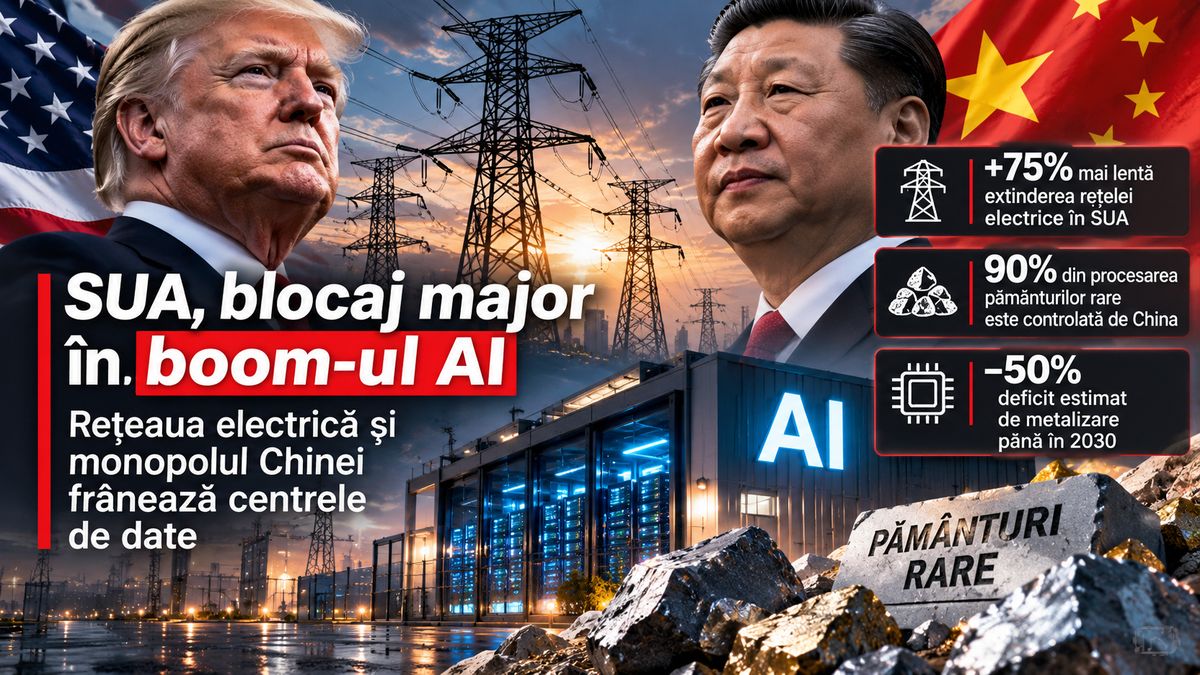
The US Infrastructure Bottleneck: Electricity Grid Expands 75% Slower Amid AI Boom — What Happened The United States is building electricity transmission lines at just a quarter of the rate recorded a decade ago, a massive bottleneck directly threatening the power supply for data centers required by the artificial intelligence boom, according to an analysis published by the Financial Times. This severe slowdown in grid expansion is compounded by a critical industrial vulnerability: near-total reliance on China for the supply and processing of rare earths essential for energy and tech hardware. According to data analyzed by OilPrice.com, the massive expansion of US digital infrastructure is constrained not only by a lack of physical power transmission capacity, but also by exorbitant key component costs. In North America, samarium — a critical element for high-performance magnets used in industrial motors, power grids, and defense tech — sells for up to 346 times more than in China. Dysprosium costs 5 times as much, while yttrium is over 100 times more expensive than on the Chinese market. While public attention has centered on expanding rare earth mining operations, a report by research firm Canaccord Genuity highlights a far more dangerous missing link: the metallization and alloying stage. Without this intermediate process, mined rare earth oxides cannot be converted into the alloys required to manufacture permanent magnets for power transformers, wind turbines, and AI data centers. Chronic Underinvestment and China's Monopoly on Rare Earth Processing The massive gap in the US power grid stems from lengthy permitting processes, regional administrative fragmentation, and sustained underinvestment in long-distance high-voltage lines. This grid rigidity coincides with Beijing's overwhelming dominance across the rare earth supply chain. China currently controls over 90% of the world's 210,000-tonne capacity for metallization and alloy production, according to Canaccord Genuity. US companies consume approximately 48,000 tonnes of rare earth magnets annually, yet estimated domestic US production for 2025 stands at a mere 300 tonnes. This vast deficit is covered almost entirely by imports, leaving the US technology supply chain exposed to any decision by Beijing to restrict exports. Supply tightness is already hitting Washington's allies: the Japanese government has requested US assistance over risks of running out of yttrium stocks before year-end. Soaring Industrial Costs and Critical Vulnerabilities in Data Center Supply Chains The consequences of this dual crisis are reflected directly in data center deployment timelines and energy infrastructure costs. Without sufficient transmission lines and accessible power equipment, giant AI infrastructure projects risk remaining stranded from power sources or suffering multi-year commissioning delays. Building magnet manufacturing plants and opening new mines in Western nations fails to solve the challenge without adequate metallization capacity. Strip casting equipment for alloy production takes up to two years to deliver and operationalize, leading players like REalloys to try bridging this neglected segment, which remains the single weakest link in the US energy and high-tech ecosystems. Pentagon Intervention and a Projected 50% Metallization Deficit by 2030 To counter Chinese price manipulation and safeguard domestic capability, the US government has begun stepping directly into the market. The Pentagon, through the Defense Logistics Agency, secured a 10-year agreement with MP Materials, guaranteeing a floor price of $110 per kilogram for neodymium-praseodymium (NdPr) and covering the gap whenever market benchmarks drop below that threshold. Nonetheless, medium-term prospects remain severely strained. Projections indicate that by 2030, global magnet production capacity outside China will rise to 70,000 tonnes, but corresponding non-Chinese metallization and alloy capacity will reach only 38,000 tonnes. This gap establishes a structural deficit of approximately 50% in rare earth processing outside Chinese control, keeping US and allied supply chains under persistent pressure.
Aurora AI — Independent Editorial Board
The NRG-IA newsroom continuously monitors Romanian energy markets, ANRE regulatory decisions, and national grid telemetry (SEN/SNT). We deliver independent intelligence anchored exclusively in official primary data.
Editorial Charter, Ethics & Verification Methodology →