US SPR Hits Lowest Level Since 1982 Amid Iran Tensions — NRG-IA
Geopolitică & Energie Author: Ioana BuzoaicaThe US enters a new confrontation with Iran with its lowest strategic oil stock in 44 years and infrastructure delivering slower than nominal rates.
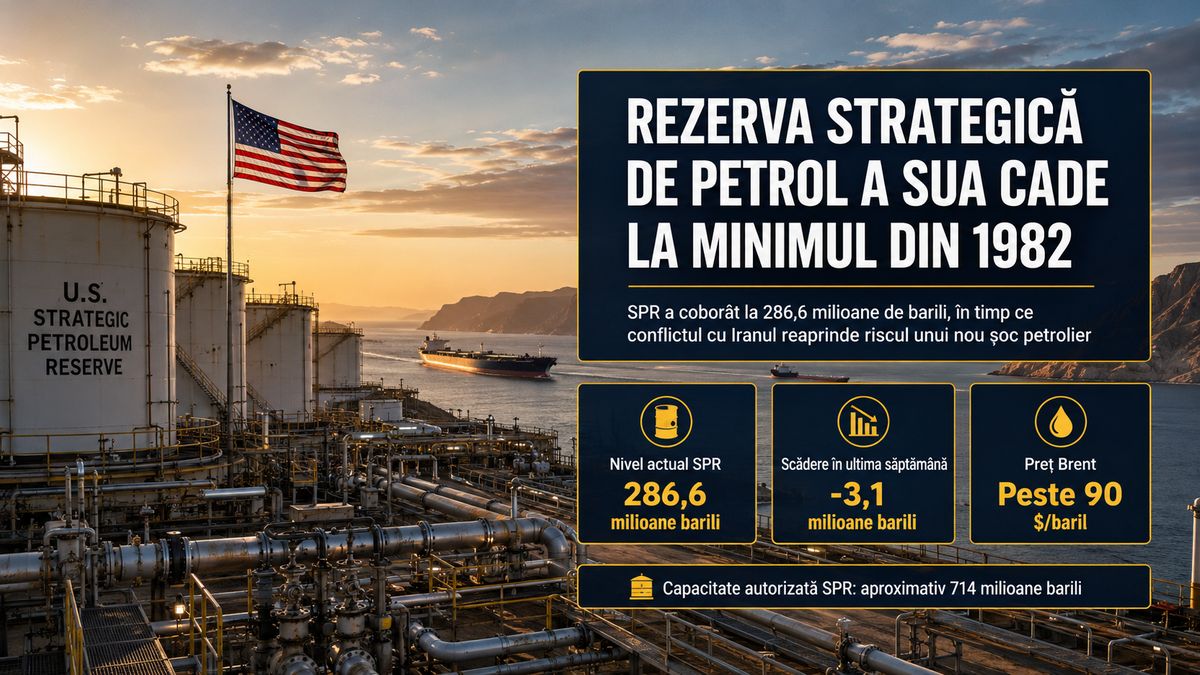
The United States has hit 286.6 million barrels of crude oil in its Strategic Petroleum Reserve (SPR), the lowest level since November 1982, just as the confrontation with Iran reignites the risk of a new global supply shock. In the latest reporting week, inventories fell by another 3.1 million barrels, and the oil market reacted to the fresh escalation with Brent crude once again crossing the $90 per barrel threshold. The figure of 286.6 million barrels represents approximately 40% of the US reserve's current authorized capacity of around 714 million barrels. In December 2009, the SPR had reached an all-time high of 726.6 million barrels. The difference is not merely statistical. The strategic reserve is the tool through which Washington can rapidly inject large volumes of crude into the market when wars, embargoes, disasters, or major disruptions threaten supply. The US used this exact capability to limit the fallout from the conflict with Iran. Now, a new escalation is emerging after a significant portion of the American oil buffer has already been depleted. The US used the reserve to absorb the first Iranian shock The decline of the SPR in 2026 comes on top of massive drawdowns in previous years. Starting in 2021, the previous US administration released approximately 230 million barrels, including the record-breaking 180-million-barrel release in 2022 launched after Russia's invasion of Ukraine. The replenishment process had begun afterward, but the war with Iran has once again reversed the trend. Following the outbreak of the US–Israel–Iran conflict in late February 2026, member states of the International Energy Agency agreed on a coordinated intervention of 400 million barrels of oil and petroleum products. The US contribution was set at 172 million barrels from the SPR. A large part of this US operation is structured as oil exchanges: companies receive crude from the reserve and must return the volumes later, along with additional quantities. According to Reuters, these returns are expected to bring back an additional 40 million barrels, but the process will not be completed before the end of 2028. For today's market, this timeline is critical. Oil may return to the SPR in a few years, but the reserve is depleted now, just as geopolitical risk has returned. The issue is not just how many barrels remain in the caverns The SPR's intervention capacity also depends on the speed at which oil can be physically withdrawn from storage and injected into the system. A report published by the Government Accountability Office shows that, at the end of 2025, the effective drawdown capacity of the strategic reserve was approximately 2.7 million barrels per day. This level represented only 61% of the nominal capacity of about 4.4 million barrels per day. The difference is major in a global oil crisis, where the speed of intervention can matter almost as much as the total volume available. The SPR is built around caverns hollowed out of salt formations in Texas and Louisiana, at Bayou Choctaw, Big Hill, Bryan Mound, and West Hackberry. The infrastructure was designed for massive drawdowns in an emergency, but decades of operation, modernization works, and the condition of certain wells and facilities have reduced actual performance. The GAO pointed out that more than a quarter of the oil stored at the end of 2025 was not immediately available for drawdown due to maintenance work and the unavailability of certain caverns. The report also warned about the effects of repeated drawdown and refill cycles on the infrastructure. The result is a combination far more significant than a simple drop in inventory: the US has fewer barrels in reserve and can currently mobilize them more slowly than the nominal capacity for which the system was built. The reserve is approaching a sensitive zone The current level of 286.6 million barrels is just over 34 million barrels away from the 252.4 million threshold stipulated in US law for certain types of limited drawdowns. While this legal threshold does not prevent the president from authorizing oil releases in a major energy emergency, it highlights how much room for maneuver has shrunk compared to periods when the reserve was nearly full. Separately, a petroleum engineering specialist from Texas A&M cited by Reuters pointed to the 250-million-barrel range as a level where the practical operation of the system could become more difficult. This is an expert estimate regarding infrastructure operations, not an absolute physical limit of the SPR. However, pressure increases with each new drawdown, as the reserve must simultaneously retain enough oil for a future emergency and the technical capacity to deliver it quickly. Iran brings back the exact market risk the SPR was created to mitigate The new escalation in the Gulf brings back the exact type of scenario that the US strategic reserve is meant to buffer. US forces struck Iranian launchers on Larak Island, and Iran responded with…
Ioana Buzoaica — Independent Editorial Board
The NRG-IA newsroom continuously monitors Romanian energy markets, ANRE regulatory decisions, and national grid telemetry (SEN/SNT). We deliver independent intelligence anchored exclusively in official primary data.
Editorial Charter, Ethics & Verification Methodology →