US Rebuilds Nuclear Fuel Sector: 93% of Uranium Imported — NRG-IA
Piața de Energie Author: Ioana BuzoaicaThe US aims to reduce dependence on foreign uranium and enrichment as it plans a major nuclear expansion. Federal investments mark a sector-wide rebuild.
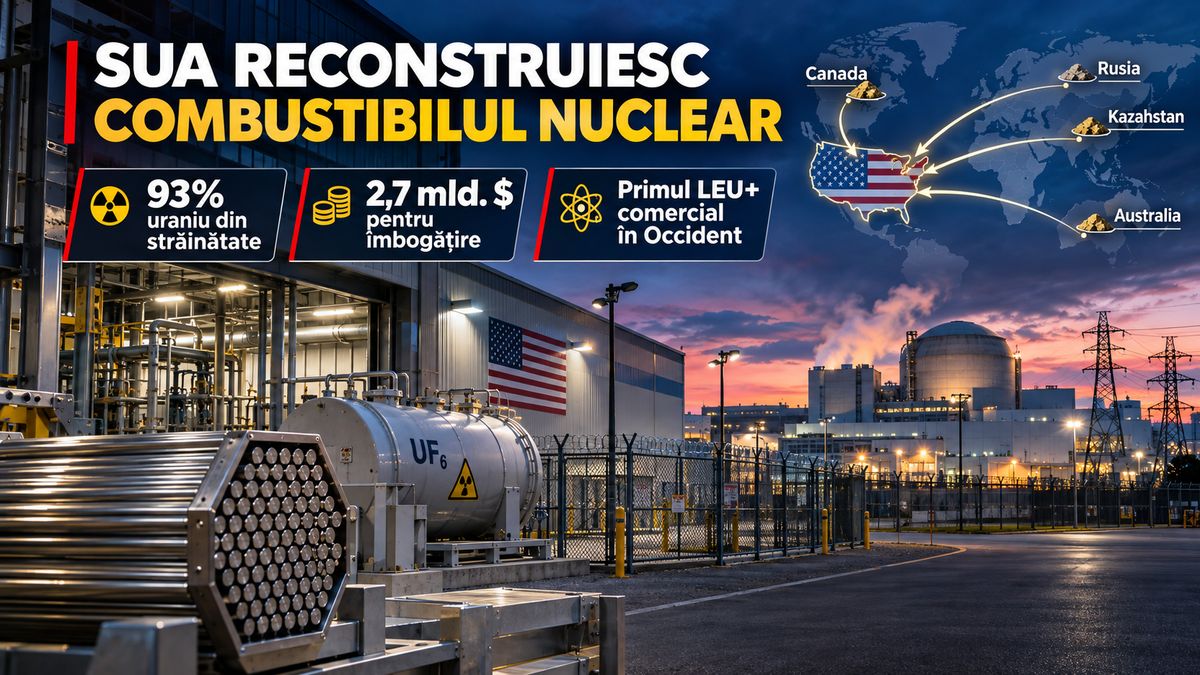
The United States has launched a program to rebuild its nuclear fuel industry following decades of heavy reliance on foreign suppliers for its power plants. In 2025, just 7% of the uranium delivered to US nuclear operators came from domestic sources, while 77% of purchased enrichment services were supplied from abroad. Official data highlights the extent of this vulnerability for the country holding the world's largest commercial nuclear reactor fleet. Washington is working to reverse this trend through investments and industrial contracts. In January 2026, the US Department of Energy awarded combined contracts worth $2.7 billion to expand domestic uranium enrichment capacity. Concurrently, companies such as Urenco, Centrus, and Westinghouse are expanding existing facilities, developing new technologies, and preparing fabrication plants for nuclear fuel required by current and future reactors. This shift is beginning to yield tangible results. On November 2, 2026, Urenco USA announced the production of the first Western commercial cylinder of LEU+ uranium—a fuel category with a higher enrichment level than that typically used by existing nuclear power plants. This milestone enables longer operating cycles for certain reactors and supports the supply chain development for advanced nuclear technologies. US imports 93% of uranium delivered to nuclear operators; Russia provides 26% of enrichment services According to the annual report published by the U.S. Energy Information Administration (EIA), US nuclear power plant operators received approximately 46.9 million pounds of uranium equivalent (U₃O₈) in 2025. Of this volume, only 7% was of US origin. The primary foreign sources were Canada, accounting for 32% of total deliveries, Kazakhstan at 28%, and Australia at 15%. External reliance is equally evident in a critical industrial phase: uranium enrichment. In 2025, US operators purchased enrichment services totaling approximately 13 million separative work units (SWU). Only 23% of these services originated within the United States, with the remainder supplied by facilities abroad. Russia accounted for 26% of the enrichment services purchased by US nuclear operators in 2025, followed by France at 18%, the United Kingdom at 14%, and the Netherlands at 8%. These figures reflect the origin of industrial enrichment services, which is distinct from the country where the uranium was originally mined. The average price paid for enrichment services rose to $108.70 per SWU, an 11% increase over 2024 levels. This trend reflects a market where industrial capacity availability, long-term contracts, and supplier diversification have become paramount concerns for nuclear operators. In August 2024, the US instituted restrictions on imports of low-enriched uranium from Russia, accompanied by a temporary waiver mechanism running through early 2028. This transition accelerates the urgency of developing US domestic capacity and securing alternative supply sources. Why uranium enrichment is vital for nuclear power generation Fuel used in most US nuclear reactors undergoes several industrial stages before generating electricity. Uranium is mined and milled into yellowcake, then converted into uranium hexafluoride, a compound suitable for enrichment facilities. Subsequently, enriched material is processed into fuel pellets, rods, and assemblies to be loaded into reactors. Each phase requires specialized infrastructure, substantial investment, and strict regulatory oversight. For light-water reactors, which dominate the US fleet, enrichment increases the concentration of the uranium-235 isotope from its natural level of roughly 0.7% to approximately 3–5%, the standard enrichment range for commercial power generation. A country may operate nuclear reactors and fuel fabrication facilities yet remain dependent on foreign nations for raw materials or enrichment services. While the United States possesses domestic capabilities across all key stages of the front-end fuel cycle, these meet only a fraction of national demand. One example is the Metropolis Works conversion facility in Illinois, restarted in 2023 following a period of idleness. Downstream, large-scale commercial enrichment is primarily carried out at the Urenco USA complex in New Mexico, operational since 2010. Consequently, expanding nuclear energy requires far more than constructing reactors. A meaningful expansion of generating capacity must be backed by scaling up uranium supplies, conversion, enrichment services, and finished fuel fabrication capacity. $2.7 billion in federal contracts awarded to boost domestic production On January 5, 2026, the US Department of Energy announced three contracts valued at $900 million each to expand enrichment infrastructure. The awarded companies are American Centrifuge Operating (a subsidiary of Centrus Energy), General Matter, and Orano Federal Services. Centrus and General Matter secured contracts to develop production capacity for…
Ioana Buzoaica — Independent Editorial Board
The NRG-IA newsroom continuously monitors Romanian energy markets, ANRE regulatory decisions, and national grid telemetry (SEN/SNT). We deliver independent intelligence anchored exclusively in official primary data.
Editorial Charter, Ethics & Verification Methodology →