US Strikes Hormuz, Iran Retaliates, Brent Tops $90 — NRG-IA
Geopolitică & Energie Author: Ioana BuzoaicaUS-Iran clashes in Hormuz push Brent past $90/bbl, threatening to delay shipping normalization and hit critical Iranian energy infrastructure.
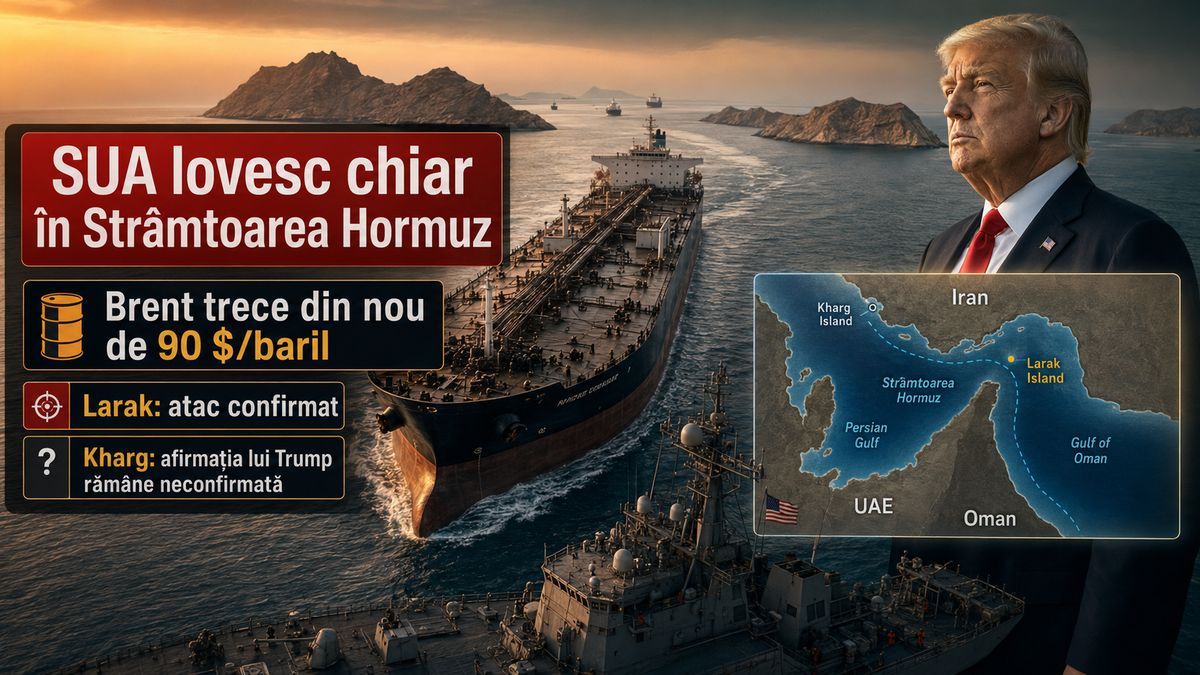
The United States has resumed strikes against Iran after a roughly one-month hiatus, hitting two launchers on Larak Island, located directly in the Strait of Hormuz near the main shipping lanes through which nearly a fifth of global oil flows passed before the war. Iran responded with ballistic missiles aimed at two US bases in Jordan, and the return of military confrontation immediately pushed Brent crude above $90 per barrel. Brent futures rose by more than 2% on Monday morning to around $90.3 per barrel, after surpassing $90.6 earlier in the session. US WTI advanced to over $85 per barrel. The market movement is significant not because the destruction of the two launchers directly removes oil supply, but because the attack occurred precisely where attempts to restore shipping were beginning to ease the geopolitical risk premium. The Strait of Hormuz remains one of the global economy's most sensitive natural chokepoints, and any return of naval mines, attacks on vessels, or military operations in its immediate vicinity could delay the normalization of flows. Larak brings military risk back to the oil route A US official confirmed that US forces struck two Iranian launchers on Larak, marking the first known American strikes on Iran since late July. According to US Central Command, forces of the Iranian Islamic Revolutionary Guard Corps (IRGC) were observed preparing launchers for missiles intended to deploy naval mines in the Strait of Hormuz. CENTCOM described the operation as a limited and precise action against an imminent threat to shipping and commerce. This explanation represents the official US position. While the strike on Larak is confirmed, the intelligence regarding the mining operation was provided solely by the US side. However, the island's location amplifies the significance of the incident. Larak sits at the entrance to the Persian Gulf, near Bandar Abbas, overlooking the shipping lanes of Hormuz. The attack did not target an isolated military facility deep inside Iran, but rather the immediate vicinity of the artery through which a critical portion of internationally traded oil and liquefied natural gas flows. The United States had previously announced that it had completed mine-clearing operations in the strait's international shipping lanes, and Donald Trump had warned that vessels attempting to lay new mines would be targeted. A return of naval mines would undermine the very premise on which the gradual resumption of traffic was based. Iran responds with missiles, but scale of impact remains disputed Iran responded to the US strike by launching ballistic missiles at two US bases in Jordan. Iranian media and the Revolutionary Guard framed the operation as a direct retaliation for Larak, claiming that US bases had been hit. However, Jordanian authorities confirmed the interception of eight missiles that entered the country's airspace. There is currently no independent confirmation of Iranian claims regarding significant damage to US facilities. Reports cited by Reuters from US sources indicated that nearly all projectiles were intercepted and no significant impact was observed. Nevertheless, the escalation is material for the energy market: the two sides have once again moved from sanctions, warnings, and indirect negotiations to a direct exchange of strikes. Hopes for a Hormuz corridor had just received a boost The new confrontation comes after several days in which the market had begun pricing in a potential improvement in the Hormuz situation. Iran and Oman were discussing the terms of a temporary shipping arrangement through the strait. Tehran had indicated an agreement in principle, while details and implementation conditions were still being negotiated. Visible commercial cargo ship traffic had risen to ten transits on Wednesday, August 26, up from eight the previous day, according to Kpler data cited by Reuters. However, this level remained below the 10-day moving average of approximately 15 vessels. By the weekend, the situation had deteriorated again. Reuters reported on Monday that the number of visible commercial cargo vessels transiting Hormuz had dropped to about five per day. This figure does not capture all transits, as some vessels sail with their Automatic Identification Systems (AIS) turned off to reduce the risk of detection. Prior to the war, Hormuz carried nearly a fifth of global crude oil and LNG flows. This explains the disproportion between the relatively limited military scale of the Larak attack and the immediate oil price reaction: the market is pricing in the risk to the corridor itself, not just the damage to two launchers. Brent above $90 shows how sensitive the market remains Oil had closed the previous week lower amid hopes that more volumes could return to the market and that Hormuz negotiations would allow for a gradual increase in traffic. The attack on Larak shifts the balance of risks once again. If shipping remains constrained or the normalization…
Ioana Buzoaica — Independent Editorial Board
The NRG-IA newsroom continuously monitors Romanian energy markets, ANRE regulatory decisions, and national grid telemetry (SEN/SNT). We deliver independent intelligence anchored exclusively in official primary data.
Editorial Charter, Ethics & Verification Methodology →