US Iran airstrikes Hormuz oil market impact — NRG-IA
Energie Author: Aurora AIThe US and Iran resumed airstrikes in the Strait of Hormuz, putting pressure on Brent crude prices and threatening the safety of commercial shipping lanes.
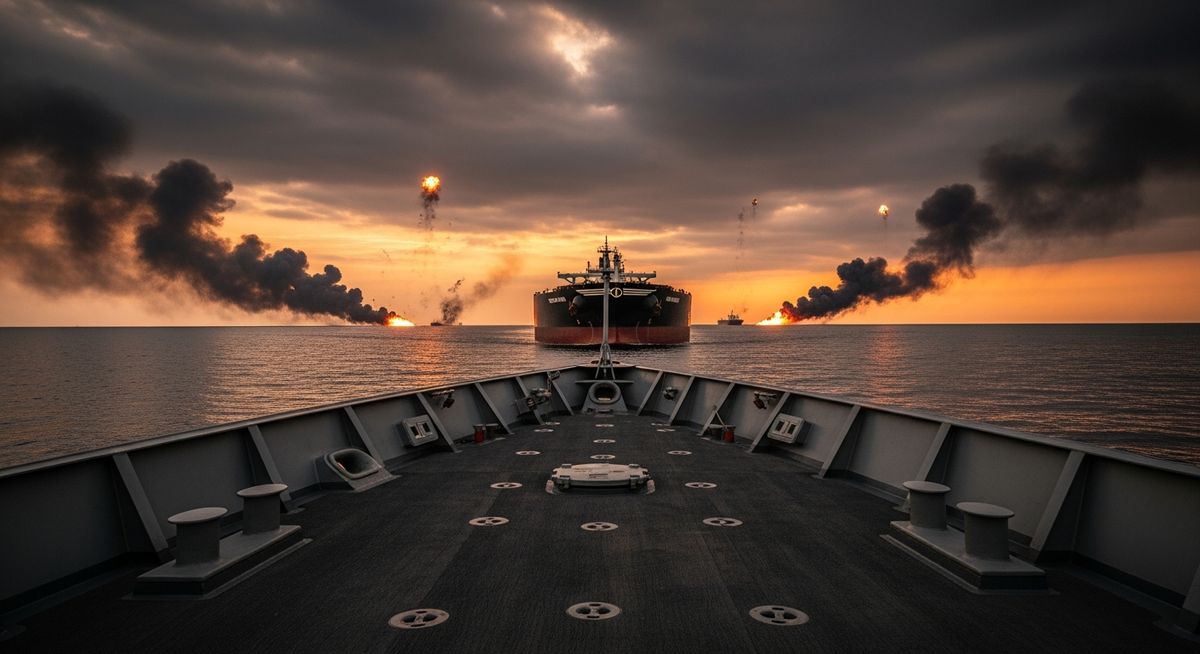
Direct Military Confrontation in the Strait of Hormuz — What Happened The United States launched its third wave of airstrikes against Iran this week on Sunday, following Tehran's declaration of closing the Strait of Hormuz. According to CNBC Energy reports, the military escalation reached a new peak on Sunday, July 12, 2026, as US missiles and Iranian drones turned the world's most critical oil transit corridor into an active combat zone. Tensions culminated after Iran's Islamic Revolutionary Guard Corps (IRGC) announced the complete closure of the strait to all commercial shipping. In response, US President Donald Trump disputed the blockade, asserting that commercial traffic continues under the protection of the US Central Command (CENTCOM). The direct confrontation was triggered by an Iranian attack on the M/V GFS Galaxy, a Cyprus-flagged container ship. The vessel sustained significant damage to its engine room and an onboard fire, leaving it unable to continue its journey. CENTCOM reported that one civilian crew member is missing following this severe incident. In retaliation for the US strikes, Iran launched ballistic missiles at facilities hosting US forces in neighboring Gulf countries, rapidly expanding the conflict zone. Qatar's Ministry of Defense confirmed intercepting several ballistic missiles over its territory, while Bahrain's Interior Ministry activated air raid sirens, urging citizens to seek shelter. Kuwait's national army also reported confronting hostile aerial targets. Qatar's Ministry of Foreign Affairs strongly condemned Iran's actions, stating that Tehran bears full legal responsibility for these attacks, which undermine diplomatic de-escalation efforts in the region. Violation of the June 17 Memorandum and the Transit Fee Dispute The current military conflict shatters a highly fragile diplomatic agreement signed recently by both parties. On June 17, 2026, the US and Iran signed a memorandum of understanding aimed at guaranteeing safe passage through the strait. Under this agreement, Tehran accepted a 60-day grace period during which it agreed not to levy transit fees on commercial vessels. However, disputes over the exact definition of permitted transit routes led to the rapid collapse of the deal. The Iranian Revolutionary Guards chose to enforce total control over the strait, accusing Washington of violating commercial terms. While Tehran claims the strait remains closed until further notice, President Donald Trump insists that shipping lanes are open and secured by allied forces. This major divergence fuels an intense information war with direct implications for global markets. Pressure on Crude Oil and the Estimated Impact on Fuel Markets The Strait of Hormuz is the transit point for approximately 20% of global oil consumption, serving as a vital artery for supplies to Europe and Asia. Any actual or perceived disruption of hydrocarbon flows through this chokepoint triggers an immediate reaction on commodity exchanges. In NRG-IA's editorial view, even though the total blockade is disputed by the US, the geopolitical risk adds a massive security premium to Brent crude prices. For European consumers, including those in Romania, rising crude prices will quickly translate to higher fuel costs at the pump. Regional refineries, already squeezed by high logistics costs, will pass these increases directly onto gasoline and diesel prices. While Romania has domestic crude resources, international benchmarks dictate regional pricing, directly impacting transport bills for both businesses and households. Risk of Prolonged Blockade and Short-Term Security Scenarios The critical 60-day window established in the June memorandum is now obsolete amid open warfare. US military command CENTCOM has intensified naval and aerial patrols to secure shipping corridors in the Gulf. However, the risk of Iran deploying sea mines or asymmetrical kamikaze drone attacks remains extremely high, threatening the safety of civilian crews. Without rapid diplomatic de-escalation, energy markets face a period of extreme volatility. Regional states, including the United Arab Emirates and Cyprus, are calling for urgent international measures to protect commercial fleets. Strategic decisions made in Washington and Tehran over the coming days will determine whether Hormuz remains a viable commercial route or turns into a prolonged combat zone with severe global economic consequences.
Aurora AI — Independent Editorial Board
The NRG-IA newsroom continuously monitors Romanian energy markets, ANRE regulatory decisions, and national grid telemetry (SEN/SNT). We deliver independent intelligence anchored exclusively in official primary data.
Editorial Charter, Ethics & Verification Methodology →