US-Ukraine Deal to Protect CPC: Kazakh Oil & Romania Impact — NRG-IA
Geopolitică & Energie Author: Ioana BuzoaicaBloomberg: US secures Kyiv's pledge to spare CPC infrastructure and eligible non-Russian tankers carrying Kazakh oil from Black Sea attacks.
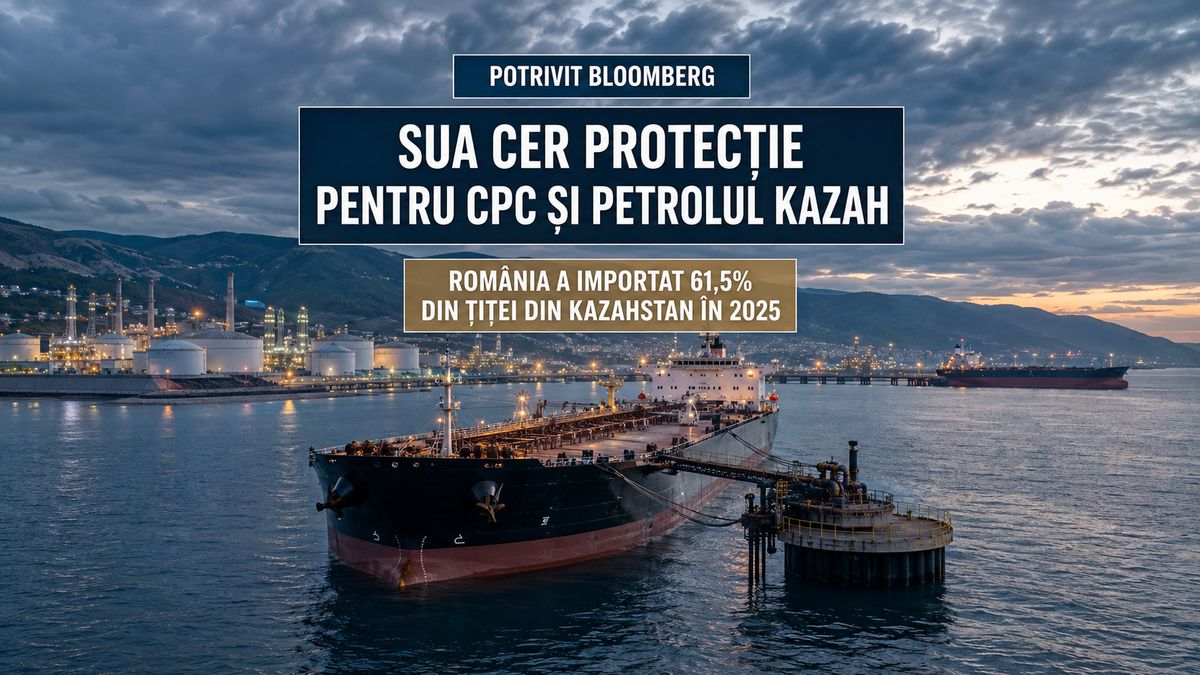
The United States is attempting to draw an increasingly precise boundary in Ukraine's energy war against Russia: Russian oil infrastructure remains a target, but Kazakh oil transported through Russia to the Black Sea, along with the non-Russian commercial vessels carrying it, should be spared from attacks. According to Bloomberg, Washington has secured a commitment from Kyiv not to target the Caspian Pipeline Consortium (CPC) infrastructure and tankers meeting specific criteria. However, this information has not yet been confirmed by any public agreement between the two governments. The distinction is critical. The CPC pipeline crosses Russian territory to reach the marine terminal near Novorossiysk, but the vast majority of the oil it transports originates in Kazakhstan. Its primary investors and shippers include Chevron, ExxonMobil, KazMunayGas, Eni, and Shell. In 2025, the CPC terminal loaded approximately 70.5 million tons of crude oil, with over 75% of the volume belonging to international shippers, according to the pipeline operator. For Romania, the carve-out negotiated by Washington has an unusually direct relevance. World Bank/WITS data based on UN Comtrade shows that in 2025, Romania imported approximately 8.91 million tons of crude oil, of which 5.48 million tons came from Kazakhstan. This means that 61.5% of the crude oil imported by Romania last year was of Kazakh origin . The value of these imports from Kazakhstan was approximately $2.77 billion. Washington separates Kazakh oil from Russian oil The terms reported by Bloomberg effectively establish two distinct categories of oil traffic in the Black Sea. To benefit from the protection of this agreement, a commercial vessel must not be sanctioned by Ukraine, must not carry Russian oil or other Russian goods, and must not belong to Russian individuals or entities. Kyiv has reportedly established points of contact through which commercial operators can provide the necessary information to verify vessel status. This demarcation does not equate to a US request to halt the Ukrainian campaign against Russia's energy infrastructure. Washington had made this distinction explicit as early as February. Ukraine's Ambassador to the United States, Olha Stefanishyna, confirmed at the time that the State Department had sent a démarche to Kyiv following an attack on the port of Novorossiysk that affected US economic interests. She specified that the American message concerned the impact on these interests, not attacks on Russian military and energy infrastructure in general. Pressure mounted following new incidents in the Black Sea. The Wall Street Journal reported in July that Chevron CEO Mike Wirth had discussed protecting the company's Kazakh operations with Trump administration officials. Following these discussions, the US administration warned Ukraine not to attack non-Russian vessels, according to a US official quoted by the publication. Washington viewed the CPC as a vital route for Kazakh-origin energy destined for Europe and an alternative to Russian energy resources. American interest is backed by tens of billions of dollars in investments. Chevron holds a 15% stake in the CPC and 50% in Tengizchevroil, the company operating the giant Tengiz field. ExxonMobil also holds significant stakes in Kazakh production. Within the CPC structure, the Russian Federation holds 24%, KazMunayGas 19%, Lukoil 12.5%, Mobil Caspian Pipeline Company 7.5%, with other stakes held by international investors. US sanctions already distinguish between CPC and Russian oil The political separation that Washington is now trying to enforce in the Black Sea already exists within the architecture of US sanctions. The US Treasury's Office of Foreign Assets Control (OFAC) maintains a general license dedicated to oil transactions and services related to the Caspian Pipeline Consortium, Tengizchevroil, and the Karachaganak project. This exemption allows these projects to operate under a regime where some of the Russian companies involved in the oil sector are otherwise subject to US sanctions. For Washington, the criterion is thus not simple geography. Oil crossing Russia does not automatically become Russian oil, and infrastructure partially located on the territory of the Russian Federation is not automatically treated as a component of the energy exports that the West is trying to restrict. The CPC connects Kazakhstan's Tengiz, Kashagan, and Karachaganak fields to the Russian Black Sea coast via a 1,511-kilometer pipeline. At Novorossiysk, crude oil is loaded onto tankers through the terminal's offshore facilities. The operator states that the route carries over two-thirds of Kazakhstan's oil exports, and authorities in Astana have indicated in other communications an even higher dependence of national exports on this infrastructure. This dependence turns any disruption at the terminal into an issue that quickly propagates from the Black Sea to oil fields located over a thousand…
Ioana Buzoaica — Independent Editorial Board
The NRG-IA newsroom continuously monitors Romanian energy markets, ANRE regulatory decisions, and national grid telemetry (SEN/SNT). We deliver independent intelligence anchored exclusively in official primary data.
Editorial Charter, Ethics & Verification Methodology →