US negotiates long-term access to 17 Venezuelan oil fields — NRG-IA
Geopolitică & Energie Author: Ioana BuzoaicaThe US is nearing a deal for long-term access to 17 Venezuelan oil fields, tapping into the world's largest reserves to secure heavy crude supplies.
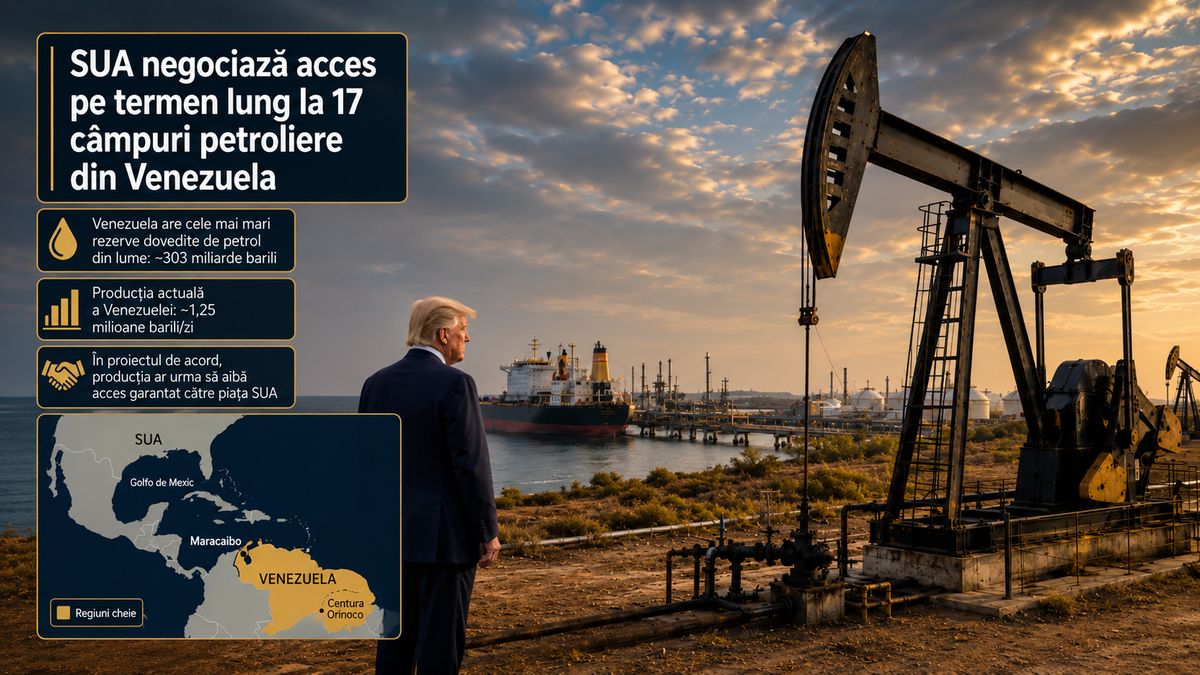
The United States is negotiating an agreement with Venezuela under which US companies could develop 17 oil fields, with the resulting production guaranteed access to the US market, according to Reuters. The list under discussion includes assets in both the Orinoco Oil Belt, where most of Venezuela's reserves are concentrated, and mature fields in the Lake Maracaibo region. The agreement has not yet been signed, and the final terms have not been made public. However, if the negotiations conclude in the form discussed, the energy relationship between the two countries would enter a much deeper phase: moving from importing currently produced oil to the participation of US companies in developing the fields that will yield future production. One of the formulas under consideration would allow fields to be allocated to US producers through a contractual mechanism similar to a concession. The extracted oil would then be directed to the United States. For Washington, the stakes are particularly high due to the sheer size of the resource. Venezuela holds approximately 303 billion barrels of proven oil reserves , equivalent to about 17% of the global total and the largest reserve reported by a single country. The negotiations do not grant the United States access to all of these reserves. They concern 17 fields, and the volume of oil associated with them has not been made public. However, the mere fact that Washington is attempting to link the development of such assets to the US market could alter the geography of US oil supply in the long term. The US produces the most oil in the world, but its refineries also need heavy crude The strategy may seem paradoxical. The United States is already the world's largest oil producer, with output reaching approximately 13.6 million barrels per day in 2025. However, the issue is not just quantity, but also the type of crude. A significant portion of US shale production is relatively light. In contrast, several complex refineries on the Gulf Coast were designed to process heavy, sour crude. Venezuelan oil fits this configuration perfectly. EIA data shows that Venezuelan heavy crudes are compatible with US Gulf Coast refineries, and the shipping distance is much shorter than for comparable volumes brought from the Middle East. For the US refining industry, Venezuela offers a rare combination: huge reserves, heavy crude, and geographical proximity . Venezuelan oil has already made a massive return to the US market This repositioning does not begin with the 17-field agreement. Trade flows have already shifted significantly in 2026. Venezuela exported approximately 786,000 barrels per day to the United States in July , according to Reuters data, the highest level since early 2019. In January, the volume was around 284,000 barrels per day. Weekly EIA data for the week ending August 21 indicated approximately 662,000 barrels per day of US crude imports from Venezuela. The energy relationship between the two countries has thus already moved past the symbolic phase. Venezuelan oil has once again become a relevant component of the US refinery supply chain, and current negotiations are attempting to transform this comeback into a structural arrangement. Washington began selectively easing sanctions and allowing greater involvement by US companies earlier in the year. Chevron and Shell have moved forward with new projects, while US oilfield services company SLB secured access to PDVSA's operational and geological data for a digitization and field data reconstruction project. The 17 assets currently under negotiation thus fit into a broader process of US capital and technology re-entering the Venezuelan oil industry. Venezuela has 303 billion barrels underground, but produces only 1.25 million per day The gap between geological potential and industrial reality is enormous. Venezuela currently produces approximately 1.25 million barrels per day , according to Reuters. Over two decades ago, production exceeded 3 million barrels per day. Years of underinvestment, sanctions, and infrastructure decay have crippled wells, power grids, pipelines, terminals, and refineries. This gap explains why an agreement on the fields would not immediately yield millions of additional barrels. The issue is also highly visible in ports. This summer, some tankers waited up to 30 days to load due to equipment failures, power outages, and logistical constraints. The José terminal, which handles about 70% of Venezuela's current exports, has become one of the main bottlenecks of the recovery. The US administration is promoting investments on the order of $100 billion to rebuild the Venezuelan energy sector. However, production can only increase if the capital invested in the fields is accompanied by the rehabilitation of pipelines, processing facilities, terminals, and power grids. In this context, the 303 billion barrels become relevant not because of their statistical magnitude, but through the industry's…
Ioana Buzoaica — Independent Editorial Board
The NRG-IA newsroom continuously monitors Romanian energy markets, ANRE regulatory decisions, and national grid telemetry (SEN/SNT). We deliver independent intelligence anchored exclusively in official primary data.
Editorial Charter, Ethics & Verification Methodology →