Prosumer Surplus: Self-Consumption, Batteries, or Grid — NRG-IA
Ghid Consumator Author: Ioana BuzoaicaA solar surplus can be consumed, stored, or injected, but each holds a different value. The right choice depends on consumption profiles and battery costs.
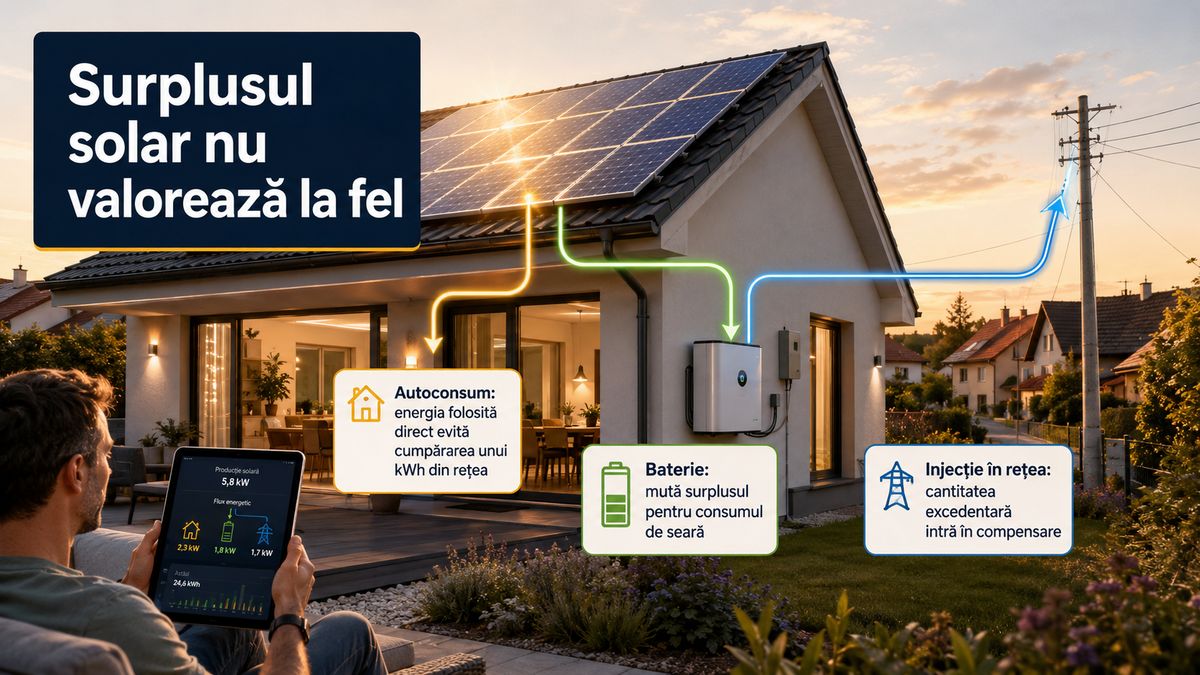
Photovoltaic panels generate the most electricity precisely during the hours when many households consume relatively little. In summer, this gap can become wide enough that prosumers inject a significant portion of their daily generation into the grid, only to start buying electricity again in the evening. This gives rise to one of the most critical economic decisions after installing a photovoltaic system: what to do with the surplus? The answer is not the same for every household. A kWh consumed directly, one injected into the grid, and one routed through a battery represent the same physical amount of energy at the source, but they do not hold the same economic value for the system owner. For most residential prosumers, the logical hierarchy is simple: self-consumption should be shifted as much as possible to solar production hours, the battery can absorb the surplus to be used a few hours later, and whatever remains can be injected into the grid. Directly consumed energy avoids purchasing a kWh from the grid Self-consumption is the energy produced by the panels and used simultaneously within the home. If the system generates 3 kW at noon and the house is consuming 2 kW at that moment, those 2 kW are used directly, and the difference can be injected into the grid or sent to the battery. The economic benefit of self-consumption stems from the fact that instantaneously used energy replaces electricity that would otherwise have to be purchased from the supplier. However, a consumer's bill does not consist solely of active electrical energy. The final price also includes regulated tariffs and taxes applicable to energy drawn from the grid. For this reason, the economic value of a directly consumed kWh can differ from the value assigned to a kWh delivered to the supplier. For prosumers with installations of up to 200 kW, the Romanian Energy Regulatory Authority (ANRE) specifies that the price of produced and delivered energy is benchmarked against the active electricity price stipulated in the supply contract. This difference explains why increasing self-consumption can be more important than simply maximizing photovoltaic generation. Quantitative compensation does not turn the grid into a physical battery Prosumers with installations of up to 200 kW benefit from the quantitative compensation mechanism, and ANRE confirms that their rights remain applicable following recent electricity market reforms. If a prosumer delivers more energy to the grid than they consume from it during a given period, the surplus quantity can be carried forward for up to 24 months, according to the applicable methodology. These quantities are subsequently utilized in accordance with the billing and settlement rules established by ANRE. However, this mechanism is purely accounting and commercial. Energy injected at 1:00 PM is not stored somewhere in the system to be sent back to the same house at 10:00 PM. At the moment of injection, the energy enters the power grid and is consumed elsewhere. The bidirectional meter separately measures energy drawn from the grid and energy delivered to the grid, and the supplier applies the compensation mechanism prescribed by regulations. From the consumer's perspective, the popular phrase „the grid is my battery” conveniently describes the carrying forward of energy volumes, but it does not reflect the physical mechanism or all the financial components of the bill. The first way to „store” energy does not require a battery Before making any additional investment, a household can modify its consumption profile. An electric water heater can heat water during periods of high photovoltaic generation. The washing machine, dryer, or dishwasher can be scheduled for midday. A heat pump can utilize more of the available solar energy during these same hours, and an electric vehicle can convert a substantial portion of the surplus into future mileage. In all these scenarios, the energy no longer flows into the grid first, only for the household to buy electricity back after sunset. Automation can take this strategy further. Inverters, smart plugs, energy management systems, and certain appliances allow loads to be switched on when photovoltaic generation exceeds the home's instantaneous demand. For a household with sufficient flexible demand, this shift in energy behavior can capture a portion of the surplus without purchasing a battery. Batteries shift midday production to evening consumption A residential battery solves a different problem. It physically stores energy produced when the sun is shining and delivers it a few hours later, when the panels generate little to no power. Instead of injecting the midday surplus into the grid, the inverter can direct it to the battery. After sunset, the home can consume the stored energy before starting to buy from the grid, within the power and capacity limits of the system. However, storage involves losses. Energy undergoes conversions during charging and…
Ioana Buzoaica — Independent Editorial Board
The NRG-IA newsroom continuously monitors Romanian energy markets, ANRE regulatory decisions, and national grid telemetry (SEN/SNT). We deliver independent intelligence anchored exclusively in official primary data.
Editorial Charter, Ethics & Verification Methodology →