Quaise Uses Fusion Tech for Superhot Geothermal Drilling — NRG-IA
Energie Author: Ioana BuzoaicaIf deep drilling becomes economic, geothermal energy could be accessed globally. The next step is drilling kilometers deep for power generation.
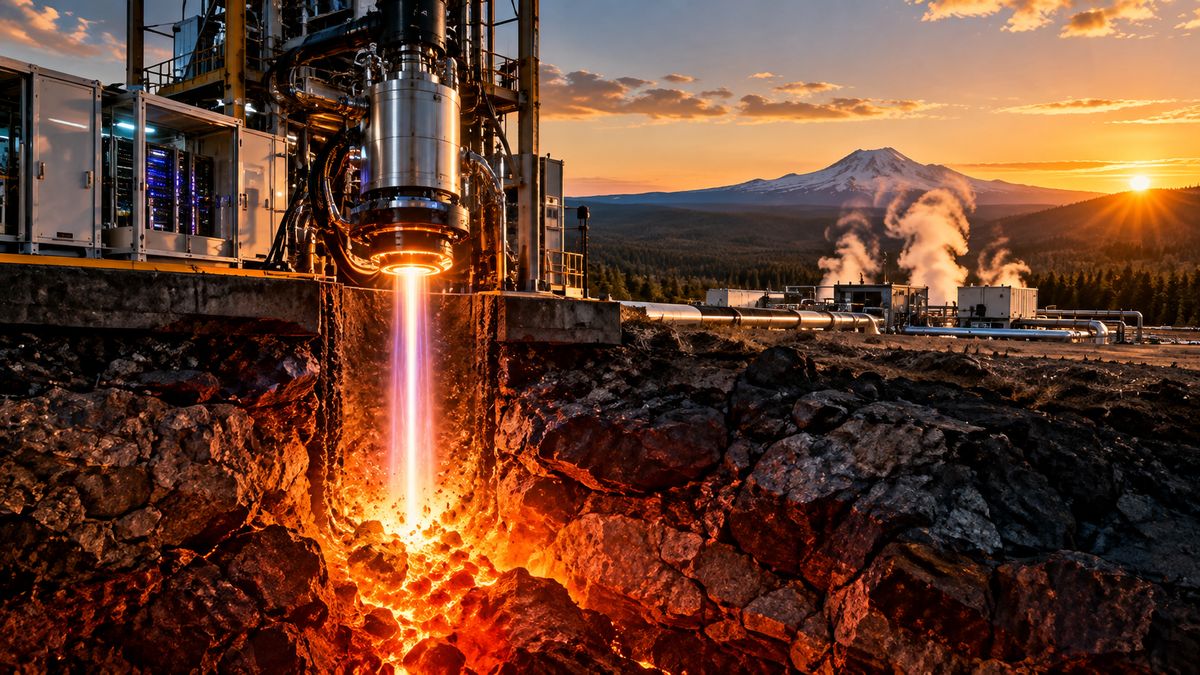
A technology designed to heat plasma to extreme temperatures in experimental fusion reactors is being adapted for a challenge in the opposite direction: drilling down into the Earth's deep heat. Kyoto Fusioneering has announced it will supply US-based Quaise Energy with a gyrotron system designed for millimeter-wave geothermal drilling. The contract, signed on August 17, 2026, represents the first order received by the Japanese company's plasma heating division from a client outside the fusion industry. A gyrotron is a high-power electromagnetic wave generator. In fusion facilities, these waves are used to heat and control plasma. Quaise aims to use the same family of technologies to direct energy deep underground, where rock is heated until it begins to melt and vaporize, eliminating the need for a mechanical drill bit in the deep section of the well. If this method can be economically scaled to depths of several kilometers, it addresses one of geothermal energy's most difficult limitations: accessing sufficiently hot rock in regions where heat exists but lies too deep for conventional drilling to be cost-effective. From Fusion Reactors to the Earth's Interior The link between the two technologies is no coincidence. The idea of using millimeter waves for deep drilling originated at the MIT Plasma Science and Fusion Center, where researcher Paul Woskov worked with gyrotrons used in fusion experiments. In 2008, MIT researchers began analyzing whether high-power electromagnetic beams could be directed at rock rather than plasma. Subsequent experiments demonstrated that granite, basalt, and other hard rocks could be fractured, melted, and partially vaporized using millimeter waves. Quaise was later founded to scale this concept into an industrial drilling technology. The system developed by the company is a hybrid. Conventional drilling remains suitable for near-surface sections and formations where mechanical drill bits operate efficiently. Millimeter waves are intended to take over the challenging part: the hard crystalline rock and high temperatures encountered at great depths. The technical difference is fundamental. Instead of lowering a mechanical assembly kilometers underground that must withstand pressure, temperature, and wear, the system generates energy at the surface and transmits it to the drilling front. Kyoto Fusioneering describes the gyrotron as the key component enabling this process. Quaise Has Already Moved from the Lab to Granite Drilling The technology is no longer confined to laboratory rock sample experiments. In 2025, Quaise deployed the system in a Texas granite quarry, drilling a 118-meter well using millimeter waves. The MIT Energy Initiative, which funded the initial research, confirmed the field demonstration and reported a penetration rate of up to 5 meters per hour in granite during testing. While this is still a fraction of the kilometers required to tap deep geothermal resources, the demonstration shifts the project's nature: the method has progressed from controlled interactions with rock samples to drilling an actual well in the field. In parallel, Quaise has integrated the technology with industrial equipment from the oil and gas sector, aiming to leverage existing deep-drilling infrastructure and expertise rather than building an entire industrial ecosystem from scratch. The New Order Must Operate Continuously The gyrotron ordered by Quaise presents an additional challenge. Many experimental fusion facilities heat plasma in pulses lasting only seconds. Drilling cannot operate this way: the beam must be maintained continuously as the well advances. Kyoto Fusioneering states that the unit destined for Quaise is explicitly designed for continuous operation . The company already manufactures gyrotrons ranging from 28 to 236 GHz and megawatt-class systems for fusion facilities such as MAST Upgrade, ST40, DIII-D, Wendelstein 7-X, and ASDEX Upgrade, though the exact specifications of the unit ordered by Quaise have not been disclosed. There is a mutual technological benefit here. Geothermal gains access to hardware developed for fusion, while the fusion industry can benefit from the experience gained in building and operating gyrotrons capable of continuous operation. Kyoto Fusioneering considers this experience highly relevant for future fusion power plants, which will also require heating systems with much longer operating runtimes than most current experimental facilities. The Target is Rock Exceeding 300°C The reason Quaise is pushing the limits of mechanical drilling is the energy density of superhot geothermal resources. At sufficient depths, rock temperatures can exceed 300°C and, in certain geological settings, approach 400°C or more. Available energy increases exponentially with temperature, and such geothermal systems can generate continuous electricity, independent of weather conditions. MIT estimates that geothermal fluids under supercritical conditions, at…
Ioana Buzoaica — Independent Editorial Board
The NRG-IA newsroom continuously monitors Romanian energy markets, ANRE regulatory decisions, and national grid telemetry (SEN/SNT). We deliver independent intelligence anchored exclusively in official primary data.
Editorial Charter, Ethics & Verification Methodology →