Passive Cooling Fabric: 8.5°C Cooler Than Cotton — NRG-IA
Energie Author: Ioana BuzoaicaTsinghua University researchers developed a fabric that limits solar heating and boosts body heat dissipation, keeping skin 2.8°C cooler than cotton.
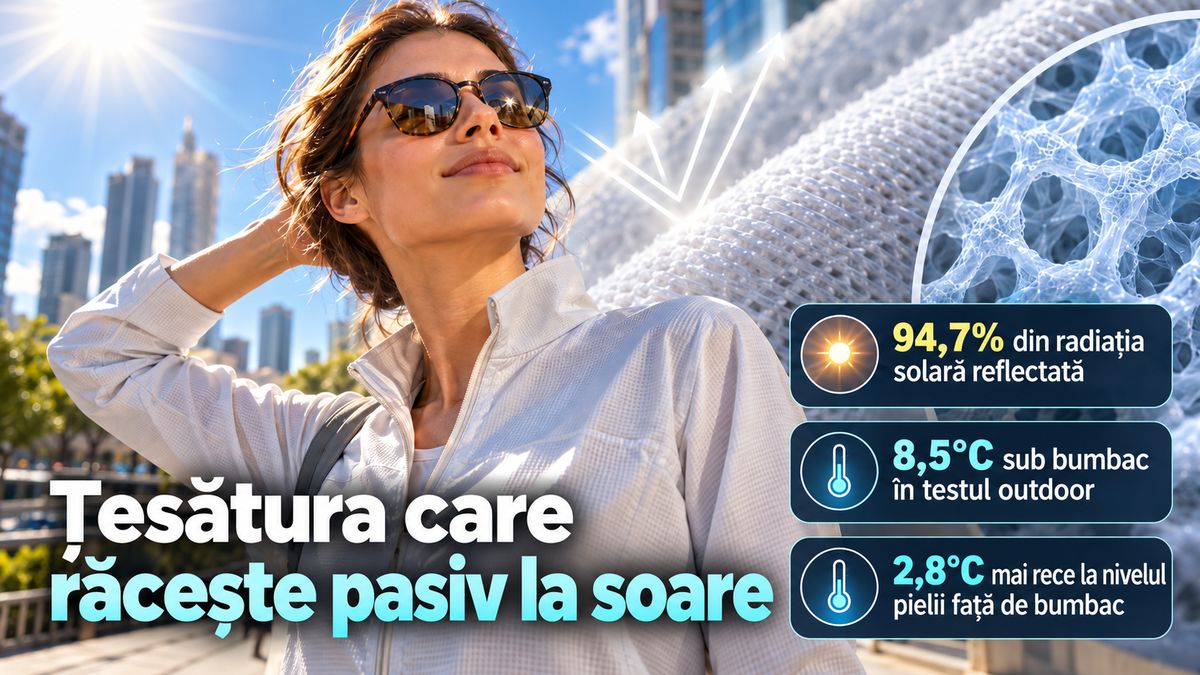
A fabric that cools the body without a battery, fan, or refrigeration unit has moved beyond purely optical demonstration and has been tested directly outdoors and on human skin. Developed by researchers at Tsinghua University , the material reflects 94.7% of solar radiation and has a mid-infrared emissivity of 97.3% —a combination that helps it absorb very little heat from the Sun and efficiently dissipate thermal energy outward. In a comparative outdoor test, the temperature of the experimental fabric was 8.5°C lower than that of commercial cotton fabric . In a separate experiment conducted directly on the forearm, skin covered by the new material was 2.8°C cooler than under cotton and 7.4°C cooler than uncovered skin . The study was published on September 26, 2026, in Nature Communications and addresses one of the core challenges of radiative cooling textiles: the material must control light and heat while remaining strong, flexible, and permeable enough to be made into actual clothing. The material acts as a mirror for the Sun and a radiator for the body Cooling is not actively produced. The material does not generate cold air or consume electricity to function. The principle is simpler: it attempts to block heat from reaching the body while simultaneously helping the body more easily dissipate the thermal energy it already produces. The first function is solar reflection. With a reflectivity of 94.7% , the fabric reflects back most of the incident solar radiation in the analyzed spectrum, reducing the energy that would otherwise be absorbed and converted into heat. The second function works in reverse. The human body continuously emits infrared radiation, and the new material has an emissivity of 97.3% in the mid-infrared range , facilitating the release of this thermal energy. The result is a material that controls energy exchange in both directions: it repels incoming solar energy from the outside and allows body heat to escape outward . For the user, this can mean a lower skin temperature without any electricity consumption. The 8.5°C difference belongs to the material, while the 2.8°C difference belongs to the skin The two results measure different things and are important precisely when kept separate. In the outdoor sample test, the experimental fabric reached a temperature 8.5°C below commercial cotton and 6.2°C below wool . This figure does not mean that a person wearing the material reduces their body temperature by 8.5°C. The directly relevant test for wearability is the one conducted on the forearm. There, the temperature of the skin covered with the new fabric was 2.8°C lower than under cotton . A difference of a few degrees at the skin's surface can be significant for thermal comfort, especially during outdoor activities where the body simultaneously receives heat from solar radiation and generates heat through muscular activity. The technology thus becomes easy for the public to understand: it does not aim to turn clothing into an air conditioner, but rather to directly reduce the heat load the body must endure. The aerogel must be extremely porous, yet strong enough to become a fiber Aerogel materials are attractive for thermal control because they contain a very high volume of air and numerous microscopic interfaces capable of influencing the propagation of light and heat. However, this same porosity creates a problem: aerogels are often fragile. An insulating panel can function even if it cannot withstand repeated deformation. A textile fiber, however, must be bent, twisted, pulled, wound, and woven before ending up in a daily-wear product. The Tsinghua team built the fiber from bacterial cellulose , organized into a porous structure with a radial gradient. The interior does not have the same architecture from the center to the outside, and this distribution is used to combine optical properties with mechanical strength. The fibers achieved a tensile strength of approximately 50 MPa , an elongation at break of 23% , and a toughness of approximately 8.2 MJ/m³ . These figures do not turn the material into a ballistic protection fiber. However, they demonstrate something far more relevant to the textile market: a structure porous enough for cooling can simultaneously be robust enough for handling and weaving. The microscopic structure scatters light before it heats the material The optical performance stems from how the fiber is organized. The numerous interfaces between air and cellulose scatter solar radiation multiple times within the structure. Instead of light penetrating and being absorbed, a large portion is reflected back. This strategy avoids the need for an active cooling mechanism. A standard shirt can absorb a significant portion of sunlight and heat up directly. A material with very high solar reflection attempts to stop energy before it turns into heat. At the same time, its infrared properties facilitate the release of thermal energy outward. This is a form of spectral…
Ioana Buzoaica — Independent Editorial Board
The NRG-IA newsroom continuously monitors Romanian energy markets, ANRE regulatory decisions, and national grid telemetry (SEN/SNT). We deliver independent intelligence anchored exclusively in official primary data.
Editorial Charter, Ethics & Verification Methodology →