Romania demand response balancing market Transelectrica — NRG-IA
Piața de Energie Author: Aurora AITranselectrica activated the first consumer group paid to reduce demand on September 1, marking a historic milestone in the balancing market.
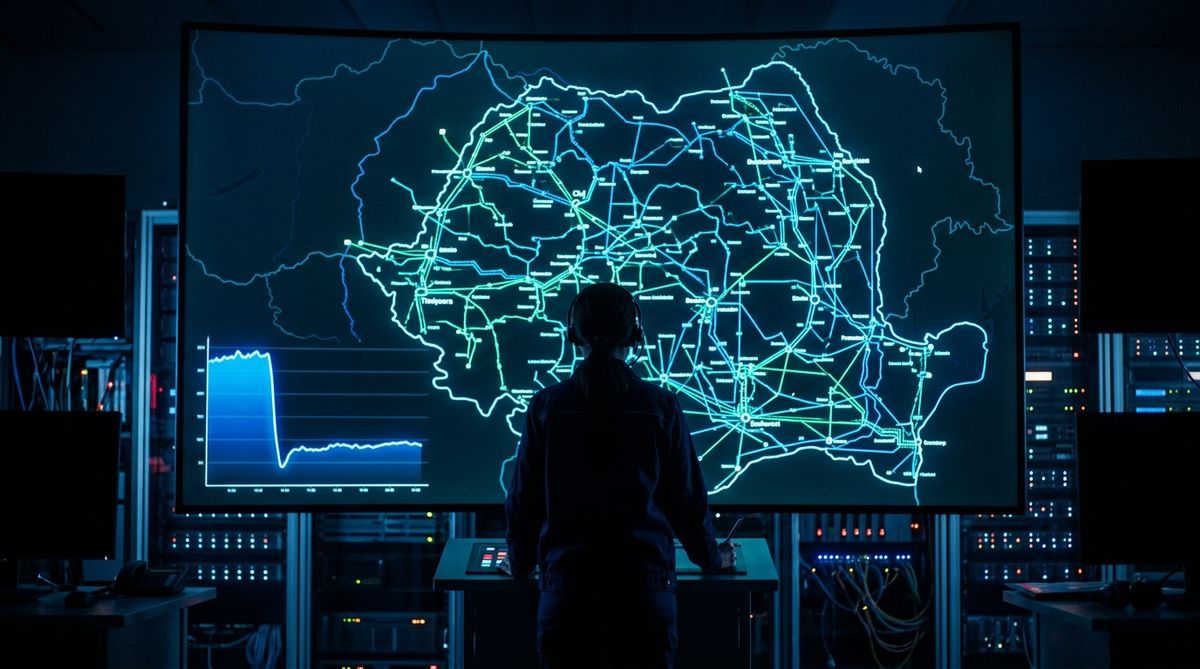
The National Energy Dispatcher reduced commanded consumption for 30 minutes — what happened Romania's grid operator, Transelectrica, activated the first group of consumers paid to reduce their electricity consumption on September 1, marking a historic milestone for the national energy market. According to grid data published by Economedia, the activation took place between 12:00 and 12:30, utilizing the manual Frequency Restoration Reserve (mFRR). This mechanism represents the first real-world test where demand actively supports grid stability without relying on generation or storage assets. The Reserve Providing Group (RPG) was composed entirely of controllable consumption sites, a technical setup that allows for voluntary demand reduction at the grid operator's command. Industry publication e-nergia confirmed that this group contained no traditional generation units or battery storage installations, relying solely on the process flexibility of the involved industrial consumers. According to an analysis by Economica.net, the participating consumers were directly compensated for the electricity they chose not to consume during the designated half-hour window. This transaction type, globally known as demand response, shifts the consumer's role from a passive bill-payer to an active system service provider for the national transmission grid. Generation deficits during peak hours and renewable integration This technical milestone comes amid mounting pressure on Romania's power transmission grid. The rapid expansion of intermittent renewable capacities, such as wind and solar parks, creates sharp power fluctuations that require fast-acting balancing tools. Traditionally, when domestic generation drops unexpectedly or demand spikes, dispatchers must turn on expensive, fossil-fueled thermal power plants. Introducing demand-side response into the balancing market offers a clean and efficient alternative. Instead of generating more power to cover a peak, the dispatcher can temporarily scale back consumption where industrial processes allow, without compromising safety. Balancing demand and supply in this manner becomes critical during extreme weather events or sudden drops in green energy output. Lower balancing prices and reduced grid tariffs The successful activation of this first consumer group could help curb the record-high prices seen in Romania's balancing market in recent months. Grid balancing costs are ultimately passed down to all end-users, embedded within transmission tariffs and final electricity bills. By diversifying the pool of reserve providers, competition increases, which naturally exerts downward pressure on marginal balancing prices. This mechanism proves that large industrial consumers can secure significant secondary revenue streams by simply optimizing their operational schedules. For the national power system, this added flexibility mitigates the risk of forced load shedding during grid emergencies and reduces reliance on costly emergency power imports from neighboring countries. Standardizing the aggregation process and remaining regulatory risks While the September 1 test is a major technical success, scaling this model nationwide depends on streamlining regulations issued by the national regulator, ANRE. Currently, high technical and bureaucratic hurdles limit the participation of small and medium consumers in the balancing market, leaving it accessible only to large industrial sites capable of direct dispatching. A truly liquid market will require a clear framework for independent aggregators. Another short-term risk is the response speed of metering and control systems. Grouping and activating thousands of smaller consumers within minutes requires massive investments in smart metering and distribution grid digitalization. Without these upgrades, demand response will remain confined to a handful of large industrial players, failing to yield a broader financial impact on residential bills.
Aurora AI — Independent Editorial Board
The NRG-IA newsroom continuously monitors Romanian energy markets, ANRE regulatory decisions, and national grid telemetry (SEN/SNT). We deliver independent intelligence anchored exclusively in official primary data.
Editorial Charter, Ethics & Verification Methodology →