Transelectrica: RON 821.7M for key 400 kV power lines — NRG-IA
Piața de Energie Author: Ioana BuzoaicaTranselectrica advances two strategic power grid projects worth RON 821.7 million, reinforcing northern Romania's 400 kV network and ties to Moldova.
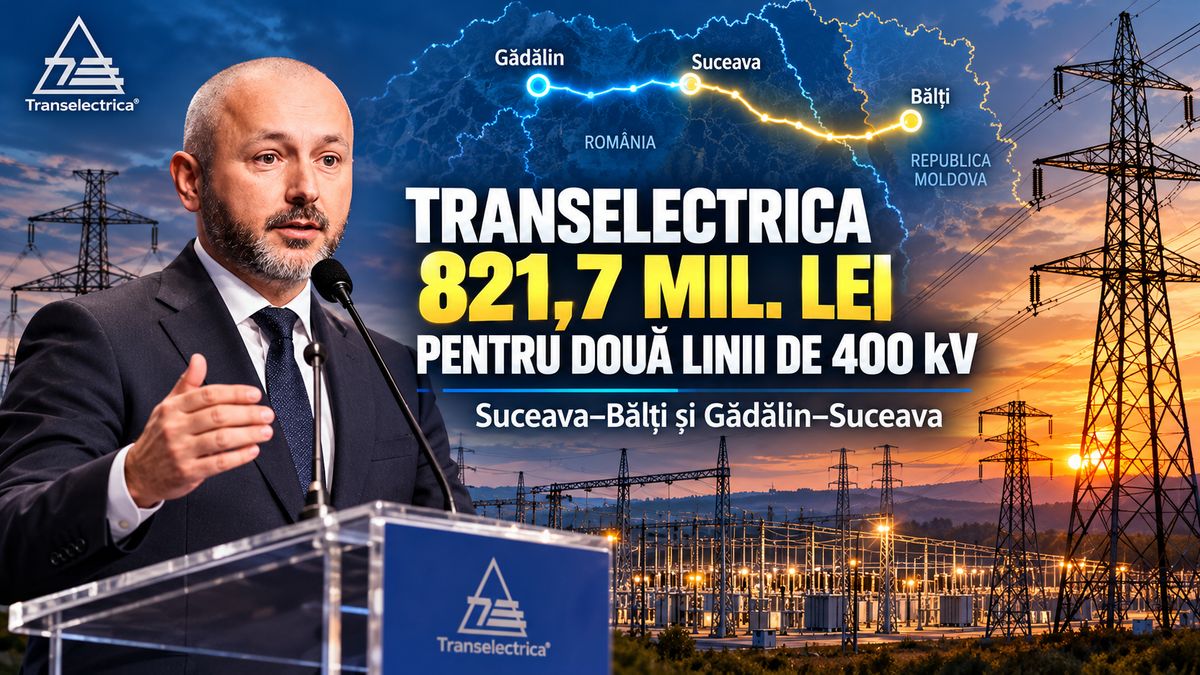
Transelectrica is advancing two of the most critical power infrastructure projects in northern Romania, with a combined design and build contract value of RON 821.7 million, excluding VAT. The projects involve the 400 kV Gădălin–Suceava and Suceava–Bălți overhead power lines, which will connect Transylvania with Moldavia and create a new electricity transmission route between Romania and the Republic of Moldova. Together, the two projects entail over 350 kilometers of high-voltage transmission network. The progress was announced by Transelectrica on October 21, 2026, following a meeting in Suceava between company management and county authority representatives. For the Suceava–Bălți interconnection, preliminary stages have been completed, and the building permit acquisition process is currently underway. For the Gădălin–Suceava line, the company has begun notifying landowners along the expropriation corridor. The two investments aim to address structural bottlenecks in the power transmission grid. The first seeks to strengthen the connection between Romania’s historical regions via a new 400 kV route across the Eastern Carpathians. The second develops the necessary infrastructure for cross-border power exchanges with the Republic of Moldova, in a region where security of supply and diversification of transmission routes have become strategic priorities. Gădălin–Suceava: 260 km of 400 kV grid across the Eastern Carpathians The larger of the two investments is the Gădălin–Suceava overhead power line, designed to cover approximately 260 kilometers. The route will cross Cluj, Bistrița-Năsăud, and Suceava counties across 40 administrative-territorial units, becoming, according to Transelectrica, the longest overhead power line in Romania. The project involves 988 high-voltage pylons, 967 of which will be built from scratch. Crossing the Eastern Carpathians represents one of the main technical challenges, as erecting steel structures, transporting heavy equipment, and stringing conductors must be executed in rugged terrain with difficult access and variable weather conditions. The design and build contract was signed in August 2025 with the consortium Electromontaj SA – ELM Electromontaj Cluj SA, led by Electromontaj. The contract value stands at RON 688.3 million, excluding VAT, with an estimated duration of 69 months covering design, permitting documentation, approval acquisition, and construction proper. The project benefits from RON 492.45 million in non-reimbursable financing through the Modernisation Fund, being included in Transelectrica's investment portfolio supported by this European facility. The grant represents a financing component of the project rather than an additional sum on top of the EPC contract value. Through Government Decision No. 270 of April 23, 2026, the investment was declared a project of national importance, approving its site location and launching expropriation proceedings. In September, the Government approved an additional RON 8 million in funds to pay compensation, allowing administrative procedures to move forward. The ongoing notification of landowners marks a new phase in pre-construction works. Suceava–Bălți: RON 133.4 million for the new interconnection with the Republic of Moldova The second project focuses on constructing the Romanian section of the 400 kV Suceava–Bălți overhead line. This segment will span 93.3 kilometers across 17 administrative-territorial units, including six in Suceava County and 11 in Botoșani County. The EPC contract, signed on March 11, 2025, is valued at RON 133.4 million, excluding VAT, and was awarded to the same consortium led by Electromontaj SA. According to Transelectrica's announcement on October 21, the contractual execution timeframe is 36 months from the issuance of the notice to proceed. The Suceava–Bălți line will create an additional power transmission route between the two countries. Its strategic value lies in expanding cross-border exchange capacity, diversifying supply routes, and strengthening the infrastructure through which the Republic of Moldova integrates into the interconnected European power system. On April 23, 2026, the project was declared of national importance through Government Decision No. 271, which approved the site alignment and initiated expropriations. Transelectrica estimates that construction works on Romanian territory could begin early 2027 at the latest, depending on the completion of permitting procedures. The development of this corridor is paired with the 400/110 kV Botoșani Sud Transformer Substation project, detailed separately by Transelectrica on October 20. The new substation is set to become the first transformer facility operating at this voltage level in Botoșani County, facilitating power transfers from the national transmission grid to regional 110 kV distribution networks. Closing the 400 kV ring transforms power transmission capacity in northern Romania The strategic impact of the…
Ioana Buzoaica — Independent Editorial Board
The NRG-IA newsroom continuously monitors Romanian energy markets, ANRE regulatory decisions, and national grid telemetry (SEN/SNT). We deliver independent intelligence anchored exclusively in official primary data.
Editorial Charter, Ethics & Verification Methodology →