Transelectrica suspends maintenance over 8,000 MW peak risk — NRG-IA
Piața de Energie Author: Aurora AITranselectrica cancels scheduled maintenance to prepare the power grid for an 8,000 MW consumption peak driven by a red alert heatwave.
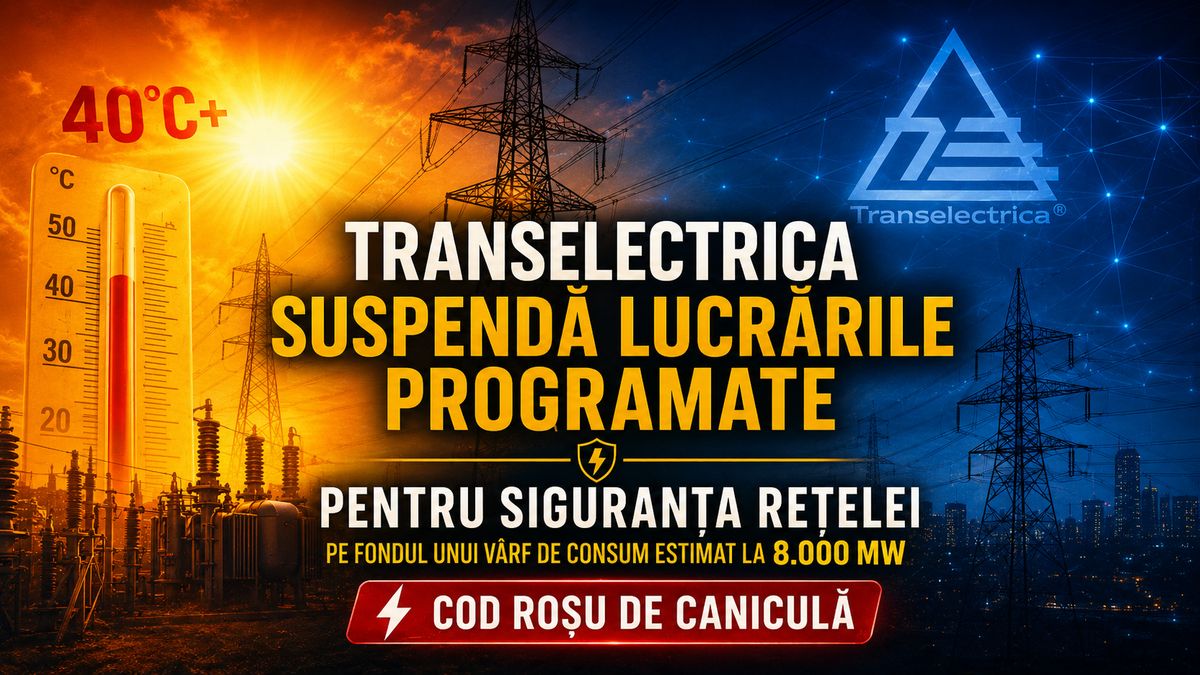
Emergency Mobilization in the Power Grid — Transelectrica Cancels Scheduled Works to Ensure Stability Transelectrica has urgently canceled all scheduled maintenance outages of its key installations amid forecasts pointing to a critical consumption peak of 8,000 MW this evening, according to official data analyzed by NRG-IA. This unprecedented summertime decision reflects the massive pressure exerted on the National Power System (SEN). According to Digi24 Energie, the measure to keep the entire transmission infrastructure at maximum capacity aims to eliminate any additional technical risk during the Red Alert weather warnings for extreme heat. The Ministry of Energy confirmed that the consumption peak is expected during the evening hours of Monday and Tuesday, when air conditioning units operate at maximum capacity and solar power production drops dramatically to zero, Ziarul Financiar reports. This operational decision indicates that the transmission grid is running close to its technical stability limits due to extreme temperatures, which impair the cooling of transformers and high-voltage overhead lines. Through this risk management decision, Transelectrica aims to prevent the overloading of interconnection lines and to secure a sufficient domestic transmission reserve. Normally, summer maintenance works are vital to prepare the grid for the cold season, but the severity of the heatwave has forced the prioritization of immediate security of supply. Red Alert Heatwave and the Collapse of Evening Solar Generation The direct cause of this mobilization is the overlap of two critical factors: extreme temperatures exceeding 40 degrees Celsius and a consumption curve shifted toward the evening hours. The heatwave drives intensive and continuous use of air conditioning systems in residential and commercial buildings, creating an atypically high demand curve. However, the major systemic issue occurs in the 20:00 - 22:00 time slot. During this critical window, consumption reaches the projected peak of 8,000 MW, but generation from photovoltaic parks—which supports a significant portion of demand during the day—drops rapidly to zero after sunset. The system must suddenly cover this massive deficit by starting up gas and coal-fired plants or through imports. Since traditional thermal power plants operate at reduced efficiency under high ambient temperatures (due to cooling water and air limitations), domestic generation capacity is severely constrained. Consequently, Transelectrica's transmission grid becomes the sole barrier preventing a major imbalance between generation and demand. Pressure on Spot Prices and Risk of National Grid Imbalances The consequences of this situation will be felt directly in the electricity market and, indirectly, on consumers' bills. From a technical standpoint, canceling maintenance reduces the risk of local outages or blackouts, but keeping the grid under maximum voltage during ambient temperatures above 40 degrees accelerates the physical wear and tear of transformer equipment. Commercially, an 8,000 MW consumption level at a time when solar power is absent forces Romania to import massive volumes of electricity through cross-border interconnectors. This mechanism will push prices on the spot market (PZU) managed by OPCOM to extreme levels during peak hours, costs that will ultimately be reflected in the bills of large industrial consumers and the state's compensation budget. Furthermore, the pressure on the transmission grid increases the risk of congestion in high-consumption areas, such as the Bucharest-Ilfov region or major industrial hubs in the western part of the country, where local generation cannot meet demand without massive support from the high-voltage grid. The July Resilience Test: Limits of Energy Infrastructure The short-term outlook shows that the next 48 hours represent a major stress test for the National Energy Dispatched (DEN). Any accidental outage of a large generation unit, such as a reactor at Cernavodă or a gas turbine at Brazi, during the 8,000 MW peak could threaten the stability of the entire national grid. The Ministry of Energy and Transelectrica are monitoring energy flows in real time, but experts warn that Romania remains highly vulnerable due to the lack of large-scale battery storage capacities. Such storage could have absorbed daytime solar surplus to discharge it into the grid during evening peaks, thereby reducing reliance on expensive imports and easing physical pressure on transmission lines. The decision to cancel maintenance is a temporary emergency solution. In the medium term, the increasing frequency of heatwaves will force authorities and investors to accelerate storage projects and upgrade transmission lines to withstand much higher operating temperatures.
Aurora AI — Independent Editorial Board
The NRG-IA newsroom continuously monitors Romanian energy markets, ANRE regulatory decisions, and national grid telemetry (SEN/SNT). We deliver independent intelligence anchored exclusively in official primary data.
Editorial Charter, Ethics & Verification Methodology →