Transelectrica: Over RON 12B Grid Investments by 2035 — NRG-IA
Piața de Energie Author: Ioana BuzoiacaTranselectrica unveils a RON 12B+ plan for 2026–2035, featuring 117 projects to modernize Romania's power grid and boost cross-border capacity.
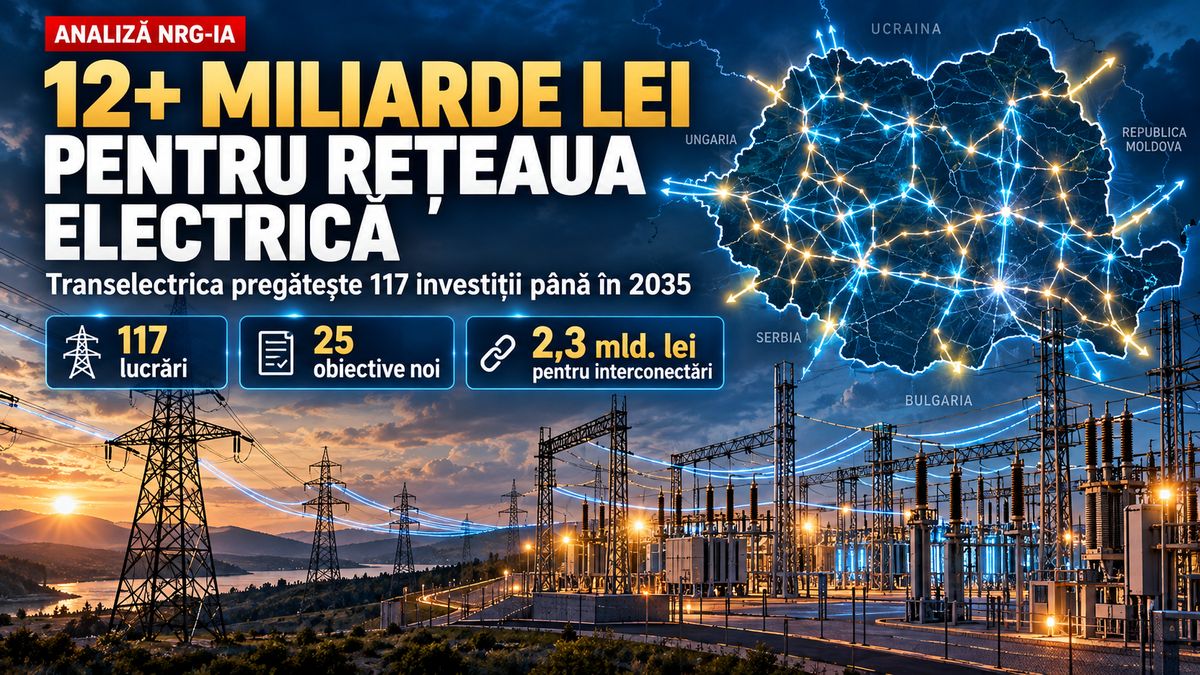
Romania is preparing one of the most extensive modernization phases for its power grid. Transelectrica, the national transmission system operator (TSO), announced on October 14, 2026, an investment program exceeding RON 12 billion for the development of the Power Transmission Grid through 2035. The plan encompasses 117 projects, 25 of which are completely new, aiming to overhaul the infrastructure that enables electricity transfers between power plants, major consumption centers, and neighboring power systems. Approximately RON 2.3 billion—representing nearly 19% of the program's total value—is earmarked for expanding cross-border interconnection capacity. Other investments focus on upgrading existing lines and substations, expanding the 400 kV network, integrating renewable generation, and deploying digital monitoring and control systems. The announced total value also includes funding from EU grants. The plan for the 2026–2035 period was approved by the National Energy Regulatory Authority (ANRE) in early September. Concurrently, the regulator mandated Transelectrica to accelerate specific interconnection projects with Hungary and Bulgaria to boost the effective capacity available for cross-border trading. The program thus serves both as a ten-year investment roadmap and a commitment to modernizing critical components of the National Power System. 117 Projects to Modernize the National Power Grid The 2026–2035 Transmission Grid Development Plan brings together expansion, modernization, and retrofitting projects structured around the needs of the power system. A significant portion of the work continues investments outlined in previous plan iterations, while the 25 new projects respond to structural shifts in electricity generation and demand. The investments aim to reinforce the national 400 kV backbone grid, the primary voltage level used for long-distance bulk power transmission. Expanding these corridors enables inter-regional energy transfers and links major generation assets, demand centers, and neighboring energy systems. Key initiatives include expanding transmission corridors in Moldova and Dobrogea, upgrading grid infrastructure in western Romania, and reinforcing links between regions constructing new power plants and high-demand zones. The program encompasses new transmission lines, substation retrofits, transformer and autotransformer installations, and equipment enabling more efficient power flow control. In Moldova, developing the Gădălin–Suceava corridor and associated infrastructure for cross-border links is of strategic importance. In western Romania, upgrading the Porțile de Fier–Reșița–Timișoara–Săcălaz–Arad axis aims to increase transmission capacity and strengthen regional grid ties. These investments are essential for a power system undergoing rapid transformation. Romania is deploying new solar, wind, and storage capacity, and this generation growth must be matched by grid infrastructure capable of delivering power to off-takers. Without this synchronization, newly built capacities risk grid connection bottlenecks or curtailments in power evacuation. Nearly RON 2.3 Billion Earmarked for Interconnections with Neighboring States One of the central pillars of Transelectrica's program is the development of cross-border electrical interconnections. Roughly 19% of the planned investment, or approximately RON 2.3 billion, is allocated to increasing commercial energy exchange capacity with neighboring power systems. Projects focus primarily on interconnections with Hungary, Serbia, and the Republic of Moldova, as well as reinforcing the domestic network to enable effective utilization of these interconnectors. Key planned investments include the 400 kV Oradea–Józsa line, the second circuit of the Nădab–Békéscsaba line, and expanding the Porțile de Fier–Đerdap interconnector. Regarding the Republic of Moldova, the plan includes the 400 kV Gutinaș–Strășeni line project on Romanian territory, a key component of the infrastructure required to link the two power grids. These investments enhance electricity transfer capacity between Romania and adjacent markets. The strategic value of interconnections extends beyond routine power trading. During periods of insufficient domestic generation, cross-border capacity enables emergency or balancing imports, subject to energy availability in neighboring grids. Conversely, during surplus periods, these ties facilitate exports and the commercialization of excess generation. However, ANRE highlighted a critical issue: while Romania has surpassed the European target for interconnection levels, it still faces constraints in maximizing commercial capacity for cross-border trading. By 2024, Romania's interconnection level reached 18.5%, exceeding the EU's 15% target. Nonetheless, monitoring data for 2025 indicated that the requirement to offer at least 70% of critical network element capacity to the market was not fully met on the borders with Hungary and…
Ioana Buzoiaca — Independent Editorial Board
The NRG-IA newsroom continuously monitors Romanian energy markets, ANRE regulatory decisions, and national grid telemetry (SEN/SNT). We deliver independent intelligence anchored exclusively in official primary data.
Editorial Charter, Ethics & Verification Methodology →