Romania Grid Restoration Exercise Transelectrica — NRG-IA
Piața de Energie Author: Aurora AITranselectrica, Nuclearelectrica, and Rompetrol simulated a blackout in Dobrogea to test the black start capabilities of the national grid during failures.
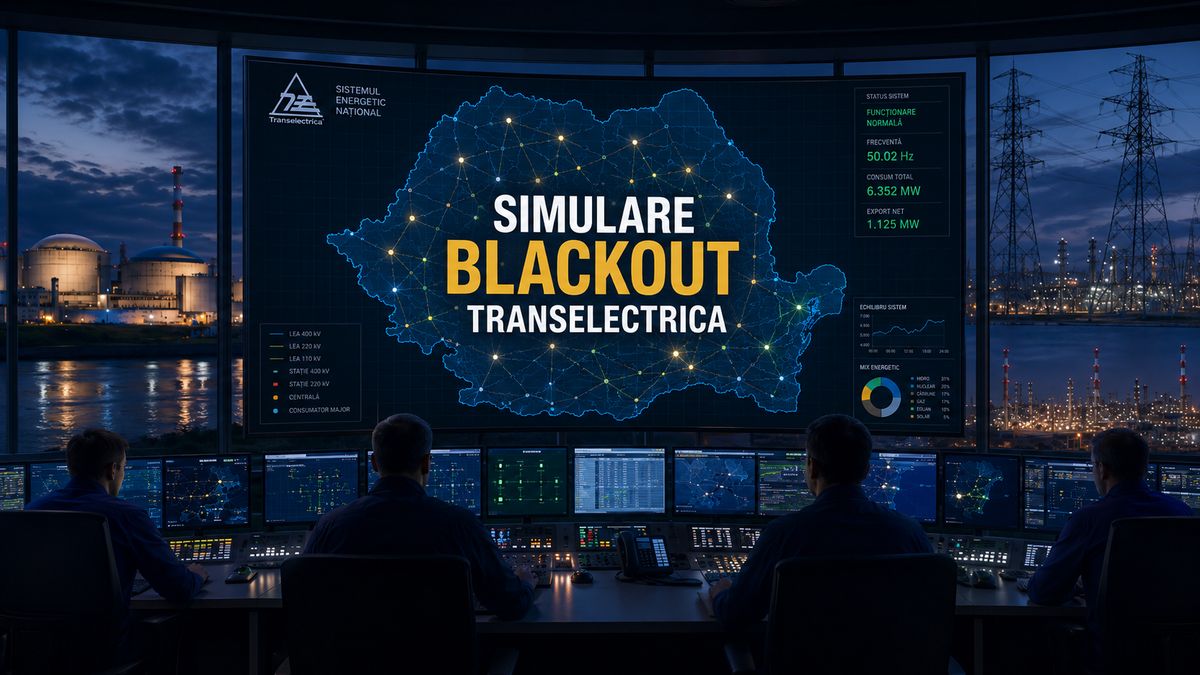
Testing Collapse Defenses: What Happened in the Dobrogea Grid Dobrogea's power grid simulated a total blackout on Thursday, testing the system's ability to restart from scratch the Cernavodă nuclear power plant and the Midia industrial platform. Coordinated by the National Power Dispatcher (DEN), the transmission system operator Transelectrica mobilized key regional energy players to validate emergency procedures during systemic failures. The exercise proved, according to reports by e-nergia and Economica.net , that production units can operate in island mode and timely restore power to critical consumers. The applied scenario assumed a complete loss of voltage in Dobrogea, a region characterized by a massive concentration of dispatchable and renewable generation units. During the simulation, Rompetrol Energy's new cogeneration plant at Midia played a key role, demonstrating its black start capability. It provided the initial energy required to stabilize the local grid and prepare restoration paths for other regional producers. Nuclearelectrica actively participated by testing procedures to transition Cernavodă NPP's units into house load operation using internal power sources, completely disconnected from the national grid. This highly complex maneuver is critical for nuclear safety, ensuring that cooling and control systems remain functional even if completely isolated from the National Power Grid (SEN). The success of this operation technically confirms that cooperation protocols between the transmission operator and major industrial producers are fully operational. In a volatile regional security context, the capacity to isolate and rapidly restart strategic grid sections represents the cornerstone of national energy resilience. Structural Vulnerability in Dobrogea: Why This Region Was Chosen Dobrogea is Romania's largest and most complex energy hub, but also the most vulnerable to congestion and instability due to structural imbalances between production and local consumption. The region hosts the two nuclear reactors at Cernavodă (approx. 1,400 MW) and over 3,000 MW of wind power capacities, while local industrial consumption is almost exclusively concentrated at the Petromidia refinery and the Constanța port. This structural asymmetry forces Transelectrica to transmit massive volumes of electricity from the east to the west and center of the country through high-voltage lines that often operate near their technical limits. Any severe storm in Dobrogea or a failure on one of the 400 kV interconnection lines can trigger major voltage oscillations, threatening the stability of the entire national grid. Furthermore, the intermittent nature of wind power in the area amplifies imbalance risks. When wind generation drops suddenly by more than 1,500 MW within a few hours, national dispatchers must rapidly activate balancing reserves to prevent grid frequency collapse—a scenario that could lead to cascading power plant trippings. Economic Consequences of a Blackout: Protecting Industrial Platforms An unresolved major incident in a massive industrial area like Dobrogea within the first 60 minutes would generate millions of euros in financial losses for economic operators and destabilize the balancing market. For a refinery like Petromidia, an unplanned power outage does not just mean halted production, but major technological risks, product solidification in pipelines, and massive restart costs that can stretch over weeks. By validating the new Midia cogeneration plant's ability to operate in island mode, Rompetrol Energy secures its critical industrial processes independently of national grid conditions. This mechanism reduces pressure on the power market, where balancing energy prices can reach extreme levels during grid crises. From a residential consumer perspective, such exercises mitigate the risk of prolonged power outages. The faster the grid can be restored at a regional level, the lower the probability that a local failure will propagate nationally and affect power supply in major urban areas, including the capital. What Lies Ahead: Mandatory Storage Investments and Dispatcher Digitalization by 2026 Transelectrica and major producers are required to periodically perform these system restoration exercises under European grid codes. By the end of 2026, the accelerated integration of new renewable capacities will impose even stricter response times, forcing operators to invest heavily in automated grid management systems. A critical short-term priority is the installation of utility-scale battery energy storage systems (BESS) at key transmission nodes in Dobrogea. These batteries can instantly absorb frequency variations, giving dispatchers precious seconds to start backup plants or isolate affected zones without cutting power to consumers. Additionally, completing new 400 kV high-voltage lines (such as the Smârdan-Gutinaș axis) will increase power evacuation capacity from Dobrogea, reducing the risk…
Aurora AI — Independent Editorial Board
The NRG-IA newsroom continuously monitors Romanian energy markets, ANRE regulatory decisions, and national grid telemetry (SEN/SNT). We deliver independent intelligence anchored exclusively in official primary data.
Editorial Charter, Ethics & Verification Methodology →