Transgaz Boosts Ukraine Gas Capacity by 140% at Isaccea — NRG-IA
Gaze Naturale Author: Ioana BuzoaicaTransgaz and GTSOU expand Romania–Ukraine gas capacity at Isaccea 1 by 140%, boosting winter supply as Neptun Deep prepares to reshape regional flows.
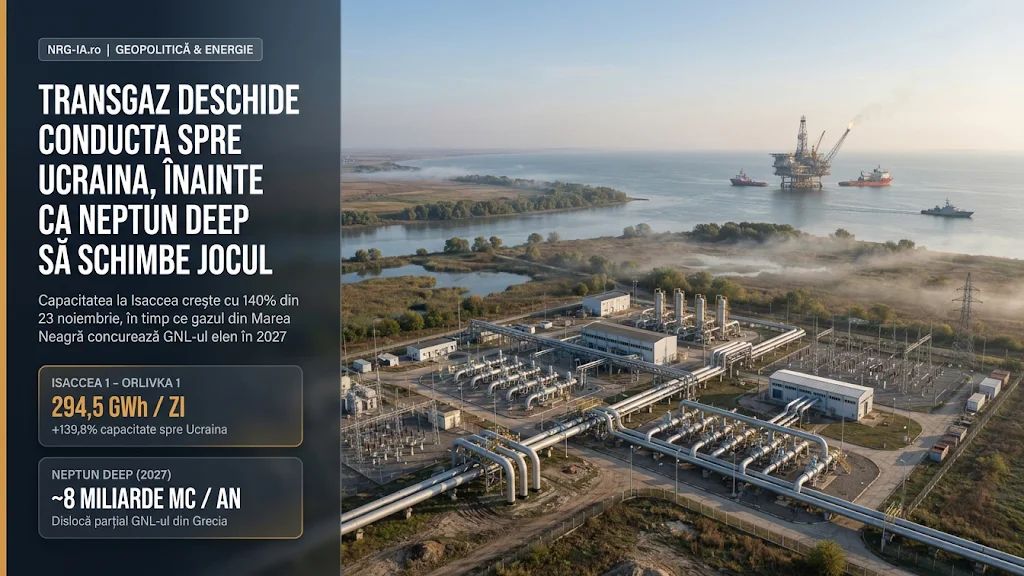
National gas transmission system operator Transgaz and its Ukrainian counterpart GTSOU are increasing technical gas transport capacity from Romania to Ukraine at the Isaccea 1 – Orlivka 1 interconnection point in northern Dobrogea by 139.8% starting Monday, November 23, 2026. According to the official notification issued to market participants, the technical limit offered on the Romania–Ukraine direction rises from 122.83 GWh per day to 294.58 GWh per day—equivalent to a maximum daily volume of approximately 27.8 million cubic meters—made available to traders starting with the auction held on Sunday, November 22. At the same time, technical capacity in the reverse direction, from Ukraine to Romania, increases by 44.5%, from 201.88 GWh per day to 291.71 GWh per day, reinforcing bidirectional flows along the legacy Trans-Balkan pipeline. The expansion comes just a week after Transgaz and Bulgartransgaz auctioned off additional capacity at the southern border, at Negru Vodă 1 – Kardam, expanding the entire physical corridor running south to north across Dobrogea. Beyond the immediate imperatives of this winter, the move paves the way for a profound shift in economic power across Southeast Europe. An analysis by S&P Global Energy for Reuters indicates that the start of production at the offshore Neptun Deep field in the first half of 2027 will transform Romania from a mere transit bridge into a major regional exporter, including to Ukraine, while reducing demand for liquefied natural gas imported from the south via Greece through the Vertical Corridor. A safety valve for Ukraine's winter following more than 250 strikes on Naftogaz The more than doubling of capacity at Isaccea 1 addresses an acute energy security emergency along Romania's northern border. Since the beginning of 2026, Russian forces have struck the facilities of Ukrainian state-owned group Naftogaz over 250 times. In the second half of November, near-daily missile and drone attacks on the Poltava, Dnipropetrovsk, Chernihiv, and Kharkiv regions forced the shutdown of several domestic gas extraction facilities. Faced with the loss of a portion of its domestic production just as the season's first severe cold spell drives regional temperatures down and pushes European gas prices toward €95 per MWh, Ukraine is critically dependent on physical import capacity from neighboring states. The new technical threshold at Isaccea 1 gives traders the room needed to book larger daily volumes purchased from southern and international markets, while the capacity boost on the Ukraine–Romania route also facilitates withdrawals of gas stored by European companies in Ukraine's vast underground storage facilities. For Transgaz, opening the gates wider at Negru Vodă and Isaccea turns infrastructure historically built to deliver Russian gas to the Balkans into a profitable commercial asset operating in reverse flow. Every megawatt-hour booked in daily and quarterly auctions generates regulated transit tariff revenues, validating the investments made in regional interconnections. Why Romanian Black Sea gas will undercut LNG landed in Greece However, the true market reconfiguration will take place along the same pipeline network starting in 2027, when Romania begins feeding its own gas molecules into the already expanded transport infrastructure. To date, the Vertical Corridor—the route connecting Greece, Bulgaria, Romania, Moldova, and Ukraine—has been designed around the concept of shipping northward liquefied natural gas unloaded at the Greek terminals of Revithoussa and Alexandroupolis. The vulnerability of this lengthy route, highlighted by both S&P Global Energy and a November report by the Atlantic Council, lies in the stacking of transmission tariffs at every national border crossing. A shipment of LNG brought by vessel into Greece accumulates successive regasification costs and entry-exit tariffs across system operators in Greece, Bulgaria, Romania, and Moldova before reaching Ukraine—a commercial journey made even pricier following the expiration of legacy discounted capacity products. Gas from the Neptun Deep block, developed jointly by OMV Petrom and Romgaz under a four-billion-euro investment, will enter the National Transmission System directly at Tuzla, roughly 150 kilometers south of the Isaccea hub. The 308-kilometer Tuzla–Podișor pipeline is already completed and commissioned, and on November 4, the High Court of Cassation and Justice decisively dismissed the final legal challenge regarding its construction permit, removing all legal risks surrounding the evacuation route for Black Sea gas. By completely bypassing maritime shipping fees, Mediterranean regasification, and transit costs across Greece and Bulgaria, gas extracted from Romania's continental shelf will reach the borders of Ukraine, Moldova, or Hungary at a significantly lower logistical cost. According to S&P Global Energy's assessment, as Neptun Deep delivers its first gas in the first half…
Ioana Buzoaica — Independent Editorial Board
The NRG-IA newsroom continuously monitors Romanian energy markets, ANRE regulatory decisions, and national grid telemetry (SEN/SNT). We deliver independent intelligence anchored exclusively in official primary data.
Editorial Charter, Ethics & Verification Methodology →