Transgaz Projects 1 Bcm Gas Demand Rise in Winter 2026-27 — NRG-IA
Gaze Naturale Author: Ioana BuzoaicaRomania's winter 2026–2027 gas demand could rise by up to 1 bcm, driven by gas-to-power and new grid connections ahead of Neptun Deep's 2027 launch.
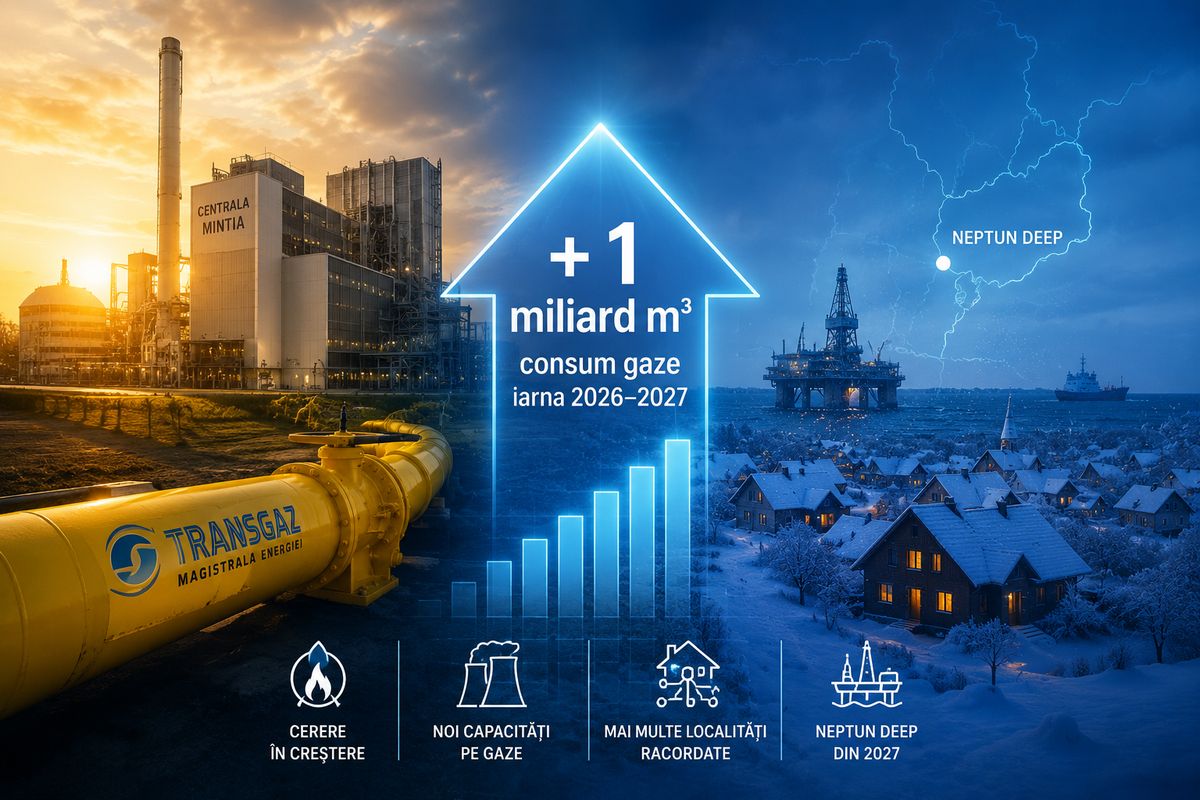
Romania is entering the 2026–2027 winter with a major shift in its natural gas equation: seasonal consumption could increase by 800 million to 1 billion cubic meters (bcm) between November 1 and March 31, according to estimates presented by Ion Sterian, the Director General of Transgaz. The estimate does not merely point to a more demanding winter for the transmission system. It marks a structural shift: natural gas is returning to the core of power generation, while the expansion of distribution networks to local communities is adding new demand to final consumption. Mintia is rapidly reshaping the gas demand profile The most visible source of pressure comes from gas-fired power plants. Transgaz has completed the approximately 56 km pipeline that will supply the future Mintia power plant, which has an announced maximum transmission capacity of 2.5 bcm per year for this facility. The Mintia plant is designed as one of the largest new investments in gas-fired power generation in Romania. The total capacity announced for the project is approximately 1,700 MW, and the first publicly targeted operational phase aims to commission at least one 576 MW turbine by the end of the year. In practice, this phase could transform Mintia from an infrastructure project into an active gas consumer in the system. A gas-fired power plant does not consume gas evenly throughout the year, but the introduction of large-scale capacity into power generation shifts the demand profile during periods when the system requires dispatchable power. For the gas market, this distinction is crucial. Residential consumption is highly temperature-dependent. Industrial consumption depends on economic activity. Meanwhile, consumption by gas-fired power plants is also driven by electricity prices, renewable generation, balancing needs, and the availability of other capacities. New connections add distributed demand to the system The second source highlighted by Transgaz stems from the expansion of gas networks to local communities. Programs such as "Anghel Saligny" have enabled the preparation of distribution and connection projects, and Transgaz has linked this development to the projected increase in cold-season consumption. This demand differs from that of a large power plant. Instead of occurring at a single point in the system, it is distributed across municipalities, households, public institutions, and small consumers. From an energy perspective, the impact is felt as cumulative pressure on the grid, particularly during winter peaks. The National Gas Transmission System Development Plan for 2026–2035 points in the same direction: over the next 3 to 4 years, Transgaz projects a significant increase in natural gas consumption, driven by gas-fired power plants, potential industrial consumers, and communities slated for network connection. This outlook shifts the conversation surrounding Romanian gas. The key question is no longer just how much gas Romania produces, but how much it will consume domestically in the coming years and what volumes will remain available for the regional market. Neptun Deep enters a growing domestic market Neptun Deep remains the cornerstone of Romania's future gas production. Developed by OMV Petrom and Romgaz, the project has estimated recoverable volumes of approximately 100 bcm, with production scheduled to begin in 2027. At its plateau, the project's announced annual production is approximately 8 bcm for about 10 years. Transgaz indicates in its NTS Development Plan that the first gas from Neptun Deep is expected to be extracted and transported via the Tuzla–Podișor pipeline starting in the autumn of 2027, with annual volumes estimated around the 8 bcm threshold. While this production could reshape Romania's position in the European gas market, it will enter a domestic market that is far from static. If the 2026–2027 winter adds up to 1 bcm to seasonal consumption, and subsequent years bring new power plants, connected communities, and higher industrial demand, a significant portion of this new gas will find a natural domestic market. This does not eliminate Romania's export potential or its regional role. However, it makes them more dependent on the actual pace of domestic consumption, the timeline of major projects, infrastructure capacity, and regional prices. Gas becomes the bridge between security and flexibility The growth in gas consumption must be viewed alongside the transformation of the power system. Romania is adding renewable capacity, but it also requires dispatchable capacity for hours with low solar and wind output, or during periods of peak demand. Gas-fired power plants can fulfill this flexibility role, but they shift part of the pressure from the power system onto the gas network. When the electricity grid requires rapid, dispatchable capacity, gas demand can spike at critical moments. For Transgaz, this shift translates into infrastructure readiness, transmission capacity, operational…