Transgaz Plans 73 km of Gas Pipelines in Bihor — NRG-IA
Gaze Naturale Author: Aurora AITransgaz plans 73 km of new gas pipelines in Bihor County, potentially reaching 49,200 homes, though local distribution networks are still required.
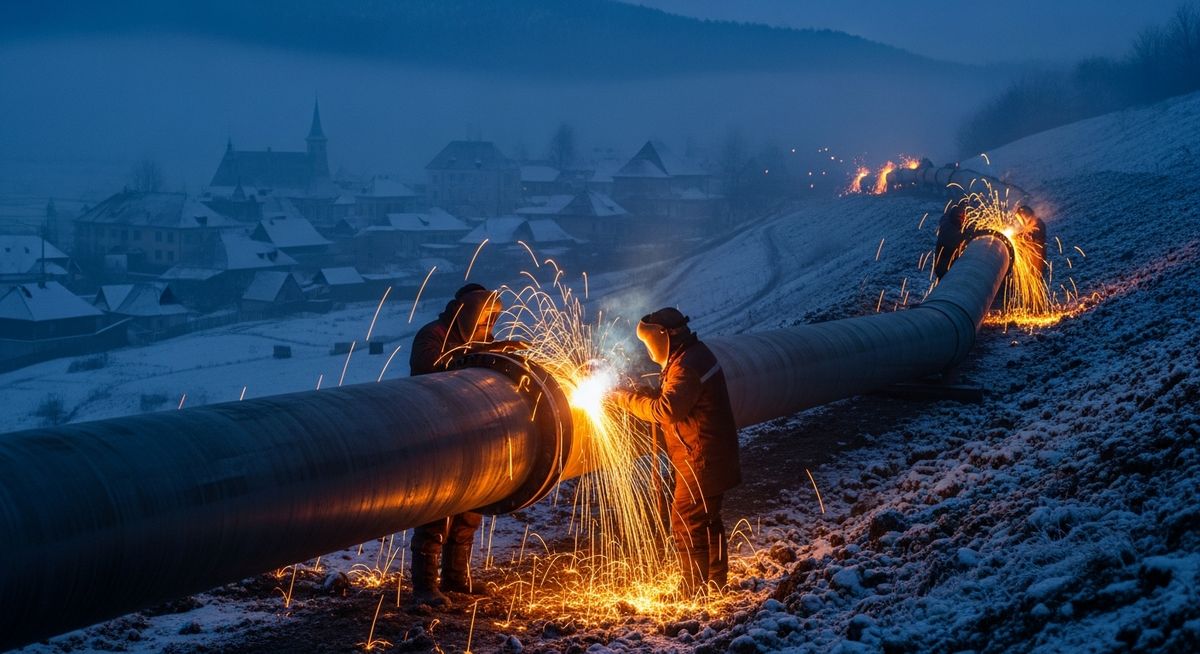
Transgaz is preparing three gas transmission network expansion projects in Bihor County, with a cumulative length of approximately 72.7 kilometers and an estimated value, based on published costs, of RON 260.62 million. The investments could bring the main infrastructure closer to nearly 49,200 households, 310 public institutions, and several economic zones across 21 towns and communes. However, these projects do not represent direct consumer connections. Transgaz builds the high-pressure pipelines that transport gas between regions and delivery points. For supply to reach individual streets, pressure reduction stations, local distribution networks, service connections, and indoor installations must still be built. Three pipelines for three different areas of the county The largest project is the pipeline between Huedin and Lugașu de Jos, with a total length of approximately 70.1 kilometers. The route crosses Cluj, Sălaj, and Bihor counties, with about 37.7 kilometers located within Bihor territory. The investment is estimated at RON 195.1 million. In Bihor, the new pipeline could pave the way for supplying approximately 34,635 households and 127 public institutions. The potentially served area includes Aleșd, Bratca, Borod, Vadu Crișului, Măgești, Aștileu, Țețchea, and Lugașu de Jos. The other two projects expand the existing infrastructure in the central and southeastern parts of the county. The pipeline between Căpâlna and Ceica would span approximately 23 kilometers and is estimated at RON 43.06 million. Its coverage area could encompass around 11,066 households and 131 public institutions in localities such as Holod, Sâmbăta, Pomezeu, Răbăgani, Ceica, Dobrești, Lăzăreni, and Drăgești. The pipeline between Beiuș and Căbești would be approximately 12 kilometers long, with a preliminary cost of RON 22.46 million. The project could provide access to gas infrastructure for about 3,517 households and 52 institutions in the communes of Pocola, Remetea, Curățele, Căbești, and Roșia. The figures regarding households and institutions describe the potential of the crossed territories. They do not represent already contracted consumers, nor do they guarantee that every property will be connected. The Huedin–Lugașu pipeline also serves a national role The main project does not only aim to supply communities in Bihor. The pipeline would better connect the Oradea area to the system coming from Cluj and the center of the country, providing the network with an additional transmission route. Such a connection can allow areas to be supplied from multiple directions. If a pipeline becomes unavailable or a source delivers less, the operator can reroute gas through an alternative path, within the limits of available technical capacity. The investment could also support the transmission of additional volumes that might enter the system with the development of Black Sea production. Gas can only be utilized domestically if the network has sufficient pipelines, stations, and interconnections between consumption regions. For the Huedin–Lugașu pipeline, Transgaz has submitted a funding application through the Modernisation Fund. Out of a reported eligible value of EUR 33.92 million, the company is requesting 70% financing, equivalent to approximately EUR 23.75 million. The remainder would be covered by the operator's own resources. The submitted application does not yet represent secured funding. Fund approval, contract signing, and procurement procedures remain distinct stages prior to the full execution of the works. The two smaller expansions are in an earlier stage The Căpâlna–Ceica and Beiuș–Căbești pipelines are presented as expansions of the existing Cefa–Căpâlna–Ștei infrastructure. They respond to several connection requests received for localities where the current transmission network does not reach close enough to consumption areas. Available public information does not yet indicate final execution contracts or financing schemes for these two projects as detailed as the one requested for the Huedin–Lugașu pipeline. The published costs are estimates that may change after projects are finalized, permits are obtained, and contracts are awarded. Exact routes, terrain conditions, road and water crossings, land expropriations, and material prices could alter the final value. Transgaz pipelines do not connect directly to households The national grid transports gas at high pressures between sources, regions, and delivery points where volumes are handed over to local operators. A home or business cannot be connected directly to such a pipeline. After Transgaz's infrastructure is built, connections to each local system and stations that measure gas and reduce pressure must be constructed. This is followed by distribution pipelines on streets, service connections to properties, and consumers' indoor installations. These investments can be developed by distribution system operators, local authorities, or through community…