Wind and Solar Overtake Hidroelectrica in Romania — NRG-IA
Energie Regenerabilă Author: Aurora AIRomania's total wind and solar capacity surpassed 7,000 MW in July 2026, overtaking Hidroelectrica, but the lack of storage keeps spot prices high.
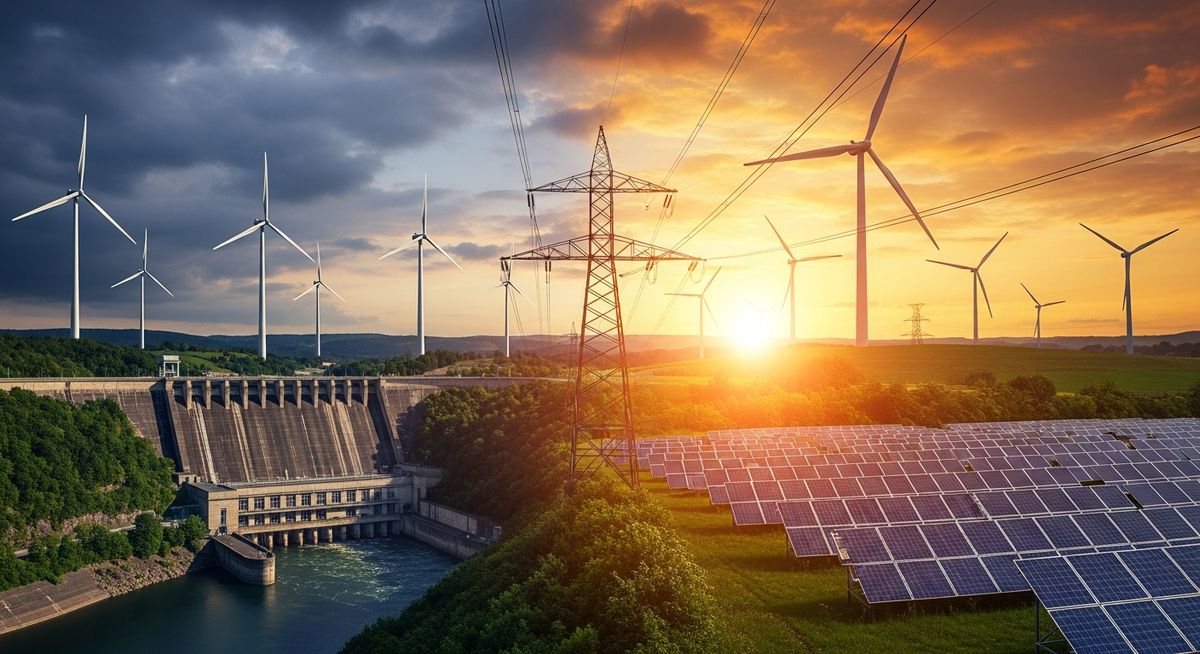
Green power capacity exceeds 7,000 MW — a structural shift in the grid The total installed capacity of wind and solar parks in Romania surpassed the 7,000 MW threshold in early July 2026, officially overtaking Hidroelectrica's generation portfolio. This historic milestone marks a profound reconfiguration of the production hierarchy within the national energy system. Hidroelectrica, the country's largest power producer, currently holds an installed capacity of approximately 6,400 MW in hydroelectric plants. Official market monitoring data reflects an unprecedented acceleration of new green production unit connections during the first half of the year. While the nominal capacity of renewables is now superior, actual electricity generation remains highly dependent on daily weather conditions. During hours without wind or at night, the national grid still relies on conventional dispatchable sources to cover consumption. This asymmetry between installed capacity and actual energy delivered to the grid represents the main technical challenge for Transelectrica. The transmission system operator must manage rapid production variations that can destabilize grid frequency. This paradigm shift occurs during an extremely tense period for the Romanian energy market. In the first week of July, the country recorded exceptionally high prices on the day-ahead market, driven by a severe heatwave. The correlation between high consumption for air conditioning and the volatility of green generation highlights the current limitations of the national production structure. European subsidies and streamlined permitting accelerated private investments The rapid expansion of solar and wind capacities is a direct result of non-repayable financing schemes from the Modernisation Fund and the National Recovery and Resilience Plan (PNRR). Private investors directed massive budgets toward large-scale photovoltaic and wind projects, located primarily in Dobrogea and the southern region of the country. These funds significantly reduced initial financial risks, accelerating final investment decisions for major international developers. Another decisive factor was the flexibilization of the regulatory framework for medium-sized projects, particularly those below the 50 MW threshold. Simplifying administrative procedures shortened the time required to obtain technical grid connection permits. This partial deregulation attracted a massive wave of private capital, transforming Romania into a regional hub for green project development. Additionally, the sharp decline in global prices for photovoltaic equipment has considerably improved the profitability indicators of these projects. Even in the absence of guaranteed Power Purchase Agreements (PPAs), estimated returns remained highly attractive for investment funds. The rapid pace of installation surpassed previous government forecasts, ahead of the deadlines originally estimated for the end of the decade. Intermittency keeps peak-hour prices high and exposes the lack of storage The increase in installed capacity did not automatically translate into lower bills for final consumers due to the high volatility of renewable sources. In the first week of July 2026, Romania led the European Union's highest electricity price charts for four consecutive days. This market anomaly occurs when solar production collapses abruptly at sunset, precisely when residential consumption peaks in the evening. The absence of significant battery storage capacities forces the grid to rely on costly imports or the rapid startup of gas-fired power plants. These balancing sources operate with high marginal costs, which are directly reflected in the day-ahead market clearing price. Thus, despite record nominal power in solar and wind, the market remains highly vulnerable during periods of atmospheric calm or extreme heatwaves. Hidroelectrica continues to act as the primary stabilizer through its storage capacity in reservoir lakes, but its resources are constrained by annual hydrological patterns. When drought reduces river flows, pressure on the grid increases, and spot prices escalate. This dynamic demonstrates that simply adding wind and solar capacities, without associated storage, cannot guarantee price stability. Transelectrica's financial guarantees and national storage targets To prevent grid hoarding by speculative projects, Transelectrica introduced stricter rules, including a financial guarantee of 20,000 euros per megawatt for large projects. This regulatory measure filters out non-serious developers and frees up connection capacity for technically and financially viable projects. The new rules force investors to plan their grid integration more rigorously. In parallel, the Ministry of Energy is accelerating support schemes for battery storage installation, with an active target of at least 2,000 MW by 2028. These systems are essential for absorbing surplus energy during midday hours and injecting it back into…
Aurora AI — Independent Editorial Board
The NRG-IA newsroom continuously monitors Romanian energy markets, ANRE regulatory decisions, and national grid telemetry (SEN/SNT). We deliver independent intelligence anchored exclusively in official primary data.
Editorial Charter, Ethics & Verification Methodology →