Gulf Oil: Hormuz, Petroline, Bab el-Mandeb Under Pressure — NRG-IA
Geopolitică & Energie Author: Ioana BuzoaicaWith Hormuz disrupted, Petroline and the Red Sea became vital. Now, all three face security risks, from pipeline shutdowns to Houthi advances.
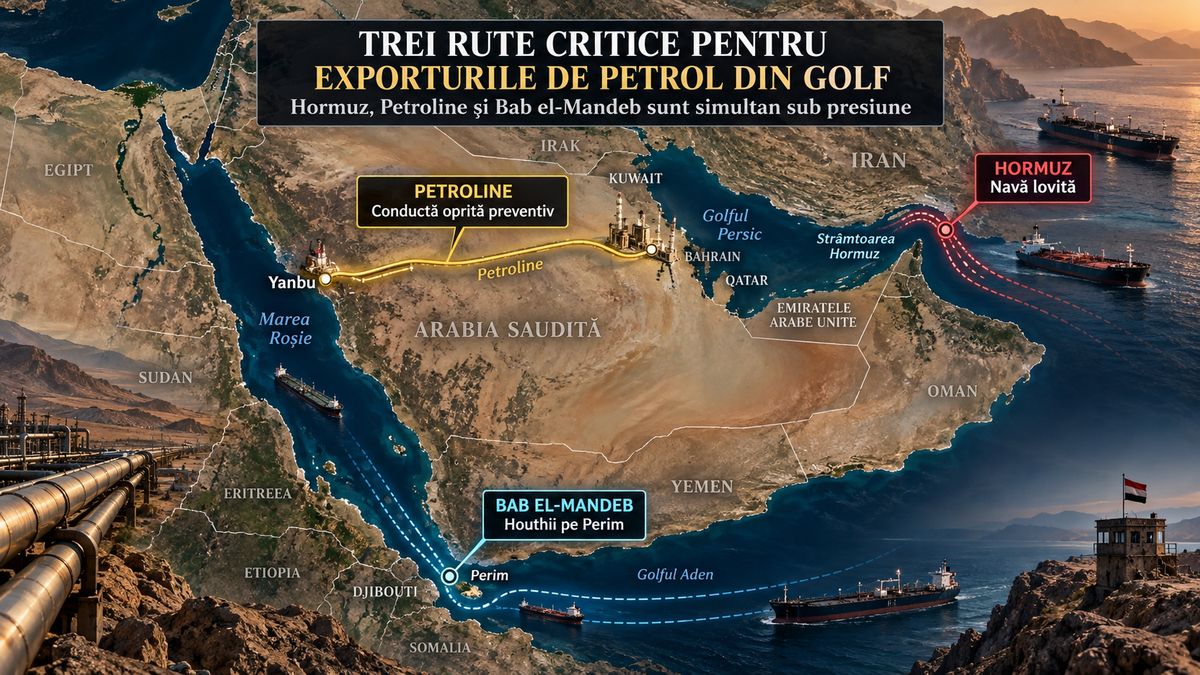
A vessel was struck by a projectile in the Strait of Hormuz on Sunday, Saudi Arabia's East-West pipeline remains preemptively shut down following infrastructure attacks, and Houthi forces have reached Perim Island in the Bab el-Mandeb strait. While these three events do not describe the same flow and cannot be aggregated, they simultaneously impact three critical pathways for Gulf oil to reach the global market. This represents a major shift over the past few days. The severe reduction in traffic through Hormuz has increased reliance on alternative routes, particularly the Saudi pipeline to the Red Sea and the maritime corridor continuing through Bab el-Mandeb and Suez. Pressure is no longer concentrated at a single geographical point. The UK Maritime Trade Operations reported that a vessel was hit by an unknown projectile while transiting the Strait of Hormuz. Based on initial public reports, the extent of the damage and the full status of the crew were unknown. Separately, Iranian media reported that an Iranian commercial vessel was struck off Iran's southern coast, resulting in one death and three injuries. Reuters had not established responsibility for the attack in its report published on Sunday. Hormuz carries far less oil than before the conflict The significance of the incident stems primarily from where it occurred. The Strait of Hormuz is the primary maritime gateway for oil exports from several Gulf producers. Data from the U.S. Energy Information Administration shows that an average of 21.6 million barrels per day of crude oil and other petroleum liquids passed through the strait in the fourth quarter of 2025 . By the second quarter of 2026, the average flow had dropped to approximately 4.9 million barrels per day . The difference highlights how much the region's oil transit architecture has already shifted. Much of the logistical pressure has moved to routes that bypass Hormuz or transport oil to terminals located on the Red Sea. Petroline has absorbed a key portion of the flows bypassing Hormuz For Saudi Arabia, the primary overland alternative is the East-West pipeline, known as Petroline. The system spans approximately 1,200 kilometers across the Arabian Peninsula, transporting crude from the kingdom's eastern fields to Yanbu on the Red Sea coast. Over the past six months, Petroline carried approximately 4–5 million barrels per day , according to Reuters. Relative to global oil supply, this volume represents about 4–5% . The pipeline allows Saudi Arabia to move significant volumes westward without transiting the Strait of Hormuz. This specific function makes it far more critical at a time when traffic through the strait has been heavily reduced. On September 10, the pipeline's infrastructure in the Riyadh and Medina regions was targeted by several attacks. The Saudi Ministry of Energy announced a preemptive shutdown of the system for safety inspections. The attacks also resulted in injuries. Saudi authorities did not initially report any confirmed loss of capacity or a precise volume of affected exports. Therefore, the Petroline shutdown should be characterized as a precautionary measure following the attacks, rather than confirmed destruction or an inability of the pipeline to return to service. Baghdad and Riyadh stated that the drones were launched from Iraqi territory. No group had claimed responsibility for the attack at the time of Reuters' reporting. US President Donald Trump's assertion that Iran is "probably" responsible represents a political attribution rather than independently established responsibility. Bab el-Mandeb has grown in importance as flows shifted toward the Red Sea At the other end of the Saudi transit route, Bab el-Mandeb is gaining increasing importance. Four sources within the internationally recognized Yemeni government told Reuters that Houthi forces have seized Perim Island, also known as Mayyun, located in the middle of the strait. Bab el-Mandeb is approximately 29 kilometers wide at its narrowest point and serves as the link between the Gulf of Aden and the Red Sea. For vessels continuing toward Europe via the Suez Canal, the strait is an unavoidable transit point. Its energy significance has grown alongside the redistribution of regional flows. EIA data, based on Vortexa intelligence, shows that an average of 8.1 million barrels per day of crude oil and petroleum products passed through Bab el-Mandeb in the second quarter of 2026 , up from 5.4 million barrels per day in the fourth quarter of 2025. Of the Q2 volume, approximately 6.1 million barrels per day consisted of crude oil and condensate. Houthi control over Perim does not automatically translate to a blockade of Bab el-Mandeb. The group stated that navigation remains permitted, with the exception of Saudi vessels targeted by its previously announced blockade. However, their position on the island gives them a direct presence at one of the region's most critical maritime chokepoints. The three figures…