€22.1bn Black Sea Energy Corridor: Romania's Strategic Role — NRG-IA
Piața de Energie Author: Ioana BuzoaicaA €22.1B energy corridor could link Caspian renewables to EU markets via three subsea Black Sea cables, positioning Romania as a key entry point.
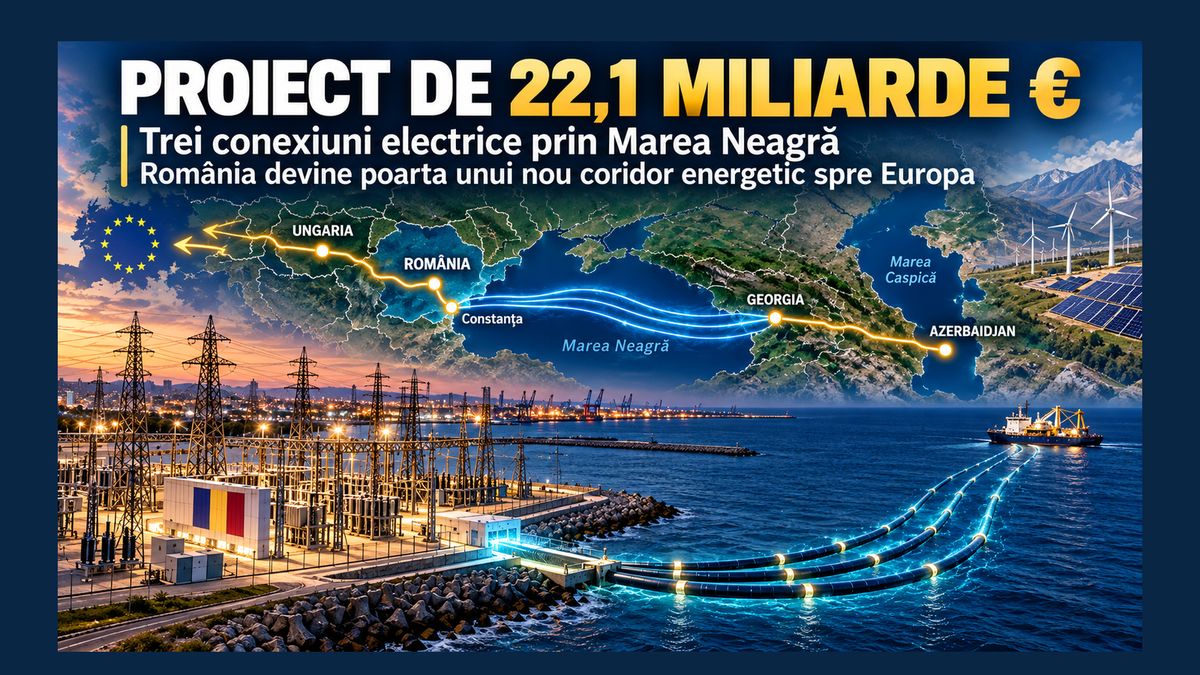
One of the most ambitious power infrastructure projects connecting Asia and Europe is beginning to take concrete technical and financial shape. The energy corridor linking Azerbaijan to the European Union via Georgia and the Black Sea requires an estimated investment of €22.1 billion and entails constructing three high-capacity electrical interconnectors, with Romania serving as one of the primary entry points into the European power grid. New data presented by the project company Green Energy Corridor Power Company (GECO) and published on October 26, 2026, outlines an infrastructure designed to transmit up to 3,900 MW across three independent links deployed in phases between 2032 and 2040. Each Black Sea crossing involves laying subsea cables across approximately 1,120 kilometers, reaching depths of up to 2,200 meters. The feasibility study conducted by Italian engineering firm CESI—completed and approved by the four participating nations in July 2026—estimates that the project could enable the annual transfer of approximately 20 billion kWh of renewable electricity to the European Union by 2040. For Romania, this infrastructure offers new supply opportunities, trade route diversification, and a heightened role in regional energy transmission. Three Power Interconnectors to Be Built by 2040 The Green Corridor is grounded in a strategic agreement signed in Bucharest in December 2022 by Azerbaijan, Georgia, Romania, and Hungary. The initiative seeks to tap into the Caspian Sea region's vast renewable energy potential and export electricity to European markets via high-voltage infrastructure traversing Georgia and the Black Sea. Phase one, scheduled for 2032, involves constructing an interconnector spanning roughly 3,040 kilometers along the Baku–Ksani–Anaklia–Constanța Sud–Albertirsa (Hungary) route. It will feature a transmission capacity of 1,300 MW, while the cross-border section between Romania and Hungary is designed for 2,000 MW. Once operational, this initial link could facilitate the annual transfer of roughly 8 billion kWh of renewable power to the EU. Phase two, slated for 2036, will introduce a link of approximately 2,340 kilometers along the Baku–Tskaltubo–Poti–Constanța Sud–Domnești route. Adding this segment will boost the corridor's total transmission capacity to 2,600 MW. The third interconnector, planned for 2040, will follow the Baku–Tskaltubo–Poti–Constanța Sud alignment over approximately 2,020 kilometers, raising final capacity to 3,900 MW. Long-distance transmission will rely on High-Voltage Direct Current (HVDC) technology. Unlike conventional Alternating Current (AC) systems, HVDC allows for efficient long-distance bulk power transmission via subsea cables while minimizing line losses and optimizing power flows. Converter stations at the link terminals will integrate the imported electricity into existing national grids. Deploying cables at depths reaching 2,200 meters stands as one of the project's most complex technical challenges. The route demands specialized engineering solutions for subsea cable manufacturing, transportation, laying, and protection, as well as seamless integration with onshore grid infrastructure. €22.1 Billion Capital Expenditure Includes Renewable Generation The estimated project budget extends far beyond the cost of subsea cables. According to GECO's presentation, €14.3 billion is allocated to power transmission infrastructure, while an additional €7.8 billion is designated for developing renewable generation capacity. Consequently, transmission infrastructure accounts for roughly 65% of the total estimated capital outlay, with generation making up the remaining 35%. This cost breakdown highlights the project's massive scale: building the interconnectors must be synchronized with expanding generation capacities to supply required export volumes. Azerbaijan possesses substantial offshore wind potential in the Caspian Sea, alongside onshore wind and solar resources. The feasibility study projects that establishing the corridor could unlock at least 8,000 MW of renewable generation buildout in the region. Generation and transmission assets will need to be developed in tandem. A 1,300 MW interconnector represents the maximum capacity the infrastructure can carry under design specifications, whereas the actual energy delivered annually hinges on generation availability, market demand, and commercial utilization rates. This distinction underscores why the project integrates grid expansion alongside renewable plant development. The financial framework under consideration blends public and private capital, long-term debt, and potential EU grant funding. Each 1,300 MW link is structured around a 500 MW regulated component and an 800 MW commercial merchant component. The commercial viability of the merchant allocation relies heavily on securing long-term power purchase and wheeling agreements. Financial modeling also factors in EU grants equivalent to 25% of capital…
Ioana Buzoaica — Independent Editorial Board
The NRG-IA newsroom continuously monitors Romanian energy markets, ANRE regulatory decisions, and national grid telemetry (SEN/SNT). We deliver independent intelligence anchored exclusively in official primary data.
Editorial Charter, Ethics & Verification Methodology →