Electric trains as grid batteries: 190 GW potential — NRG-IA
Tehnologie & Inovație Author: Ioana BuzoaicaElectric trains could act as grid flexibility assets, unlocking 190 GW by 2025 and cutting storage investments by up to 20%, a study finds.
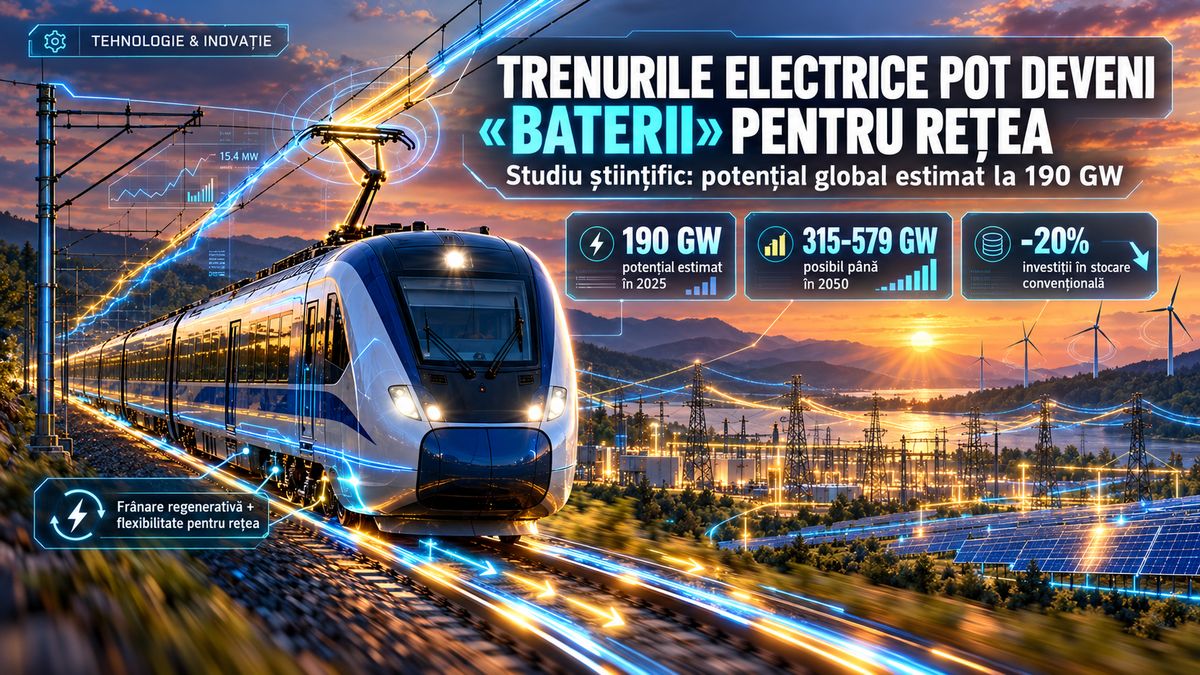
Electric trains could become a global energy resource capable of helping power grids manage generation surpluses and peak demand periods. A study published on October 19, 2026, in the scientific journal Nature Communications estimates that electrified rail infrastructure could provide a global energy flexibility potential of 190 GW by 2025. Through expanded electrification and rail transit development, this capacity could reach 315–579 GW by 2050, offering power systems a complementary alternative to building dedicated storage facilities. The research proposes leveraging an inherent feature of electric trains: they consume substantial amounts of energy when accelerating and can recover part of their kinetic energy when braking. By coordinating speed, acceleration, and braking within operational rail safety limits, power consumption can be temporarily shifted or reduced, and recovered energy can be utilized more efficiently. The system would act like a virtual battery, harnessing train kinetic energy and operational rail flexibility without requiring chemical battery packs on every vehicle. The estimated economic scale is substantial. Models developed for China, Europe, and India indicate that integrating this resource could reduce required investments in conventional storage by 11.9–20%. Extrapolated globally, researchers estimate potential annual savings at $14.9–35.1 billion. In parallel, coordinated train operations could help reduce power system operational emissions by tens or even hundreds of millions of metric tons of CO₂ annually across the analyzed scenarios. How electric trains can act as batteries without extra onboard accumulators The underlying principle begins with the energy required to propel a train. During acceleration, electric traction motors convert power drawn from the catenary into mechanical energy. A moving train accumulates kinetic energy proportional to its mass and speed. When braking, modern electric motors can act as generators, converting a portion of that momentum back into electricity that can be reused by nearby trains or fed back into the grid where infrastructure allows. This feature, known as regenerative braking, is already standard on many modern electric locomotives and trainsets. However, the study in Nature Communications proposes a major expansion of its role: coordinating the entire electrified rail system to meet power grid needs, using operational train flexibility to dynamically adjust the timing and intensity of energy consumption. For instance, during periods when solar power generation exceeds demand and electricity is plentiful, trains with sufficient schedule leeway could temporarily absorb more power by adjusting traction modes. Conversely, when the power system experiences sudden demand spikes, modulating acceleration and optimizing regenerative braking can curtail draw from the grid. Part of the mechanical energy already stored in train momentum can thus be leveraged to adjust the overall power balance. Researchers refer to this approach as Electrified Rail-Based Energy Storage (ERES). The concept treats rolling stock, power supply infrastructure, and timetables as a unified, coordinated energy system. Rather than operating each train purely for transit between stations, train operation could simultaneously help regulate power consumption within the constraints of transit safety and passenger timetables. The distinction between this and a conventional battery is key. A chemical battery absorbs electricity, stores it, and discharges it later. In the proposed rail system, equivalent behavior is achieved by modulating power draw relative to a baseline schedule and capturing mechanical energy. From the grid operator’s perspective, a coordinated reduction in power demand offers a balancing effect similar to injecting additional generation. The actual energy fed back into the public grid depends on the design of traction power substations and their capacity for bidirectional power flow. A 190 GW potential identified through the analysis of over 326,000 inter-station trips To quantify this resource, the international research team evaluated 326,034 inter-station rail journeys, accounting for movement parameters, energy consumption, and potential adjustments to train operations. These results fed into optimization models estimating the capacity of rail networks to modulate electricity intake in response to grid demands. The global potential estimated at 190 GW for 2025 refers to flexibility capacity, not a stored energy capacity of 190 GWh. The distinction between these units is fundamental: gigawatts measure instantaneous power capability, whereas gigawatt-hours represent energy delivered or absorbed over time. For electric trains, the research focuses on rapid adjustments in consumption and energy recovery across response windows of up to 15 minutes. This rapid response capability makes the system particularly valuable for grid balancing. Electricity…
Ioana Buzoaica — Independent Editorial Board
The NRG-IA newsroom continuously monitors Romanian energy markets, ANRE regulatory decisions, and national grid telemetry (SEN/SNT). We deliver independent intelligence anchored exclusively in official primary data.
Editorial Charter, Ethics & Verification Methodology →