Trump Delays Canada Tariffs; Keystone XL Returns — NRG-IA
Geopolitică & Energie Author: Ioana BuzoaicaThe US delayed 50% tariffs on Canadian imports. Energy is back in focus as Trump revives Keystone XL via the Prairie Connector and Bridger projects.
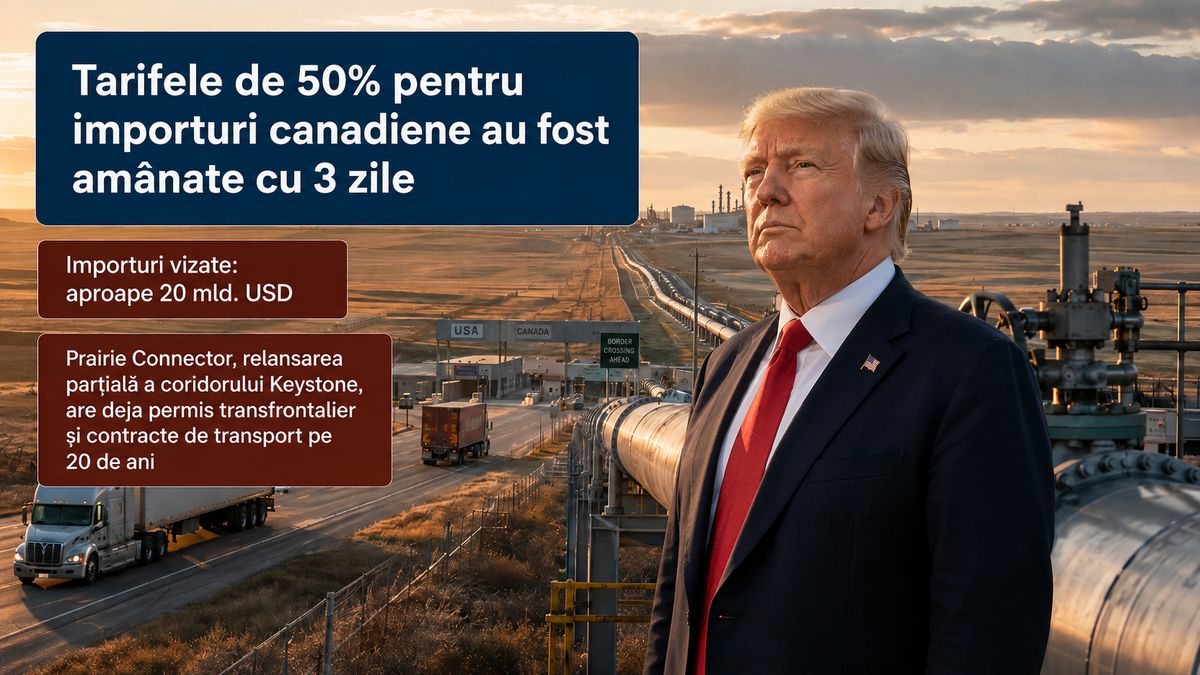
Donald Trump has postponed at the last minute, by three days, the entry into force of 50% tariffs on nearly $20 billion worth of Canadian imports, announcing that Washington and Ottawa have reached an agreement that has yet to be formalized in writing. In the same message, the U.S. President brought Keystone XL back into the discussion, once again turning oil infrastructure into a bargaining chip in the economic negotiations between the two nations. However, the reference to Keystone XL paints an incomplete picture if read as an announcement of a restart from scratch. Part of the old project is already on track to return in a different form. South Bow and Bridger are developing a new oil corridor that repurposes infrastructure built for Keystone XL, holds a presidential border-crossing permit, and has secured firm 20-year commercial commitments. Therefore, the stakes of the August negotiations go beyond customs tariffs. Behind the trade conflict lies a broader discussion about how oil, goods, and capital will flow in a North America where Washington uses access to the U.S. market as leverage, and Canada seeks secure routes for its energy exports . Tariffs postponed, not eliminated The new U.S. duties were scheduled to take effect on August 19, targeting a category of Canadian imports valued at nearly $20 billion. The 50% rate would have represented a sharp escalation in the trade conflict between the two countries. However, just hours before the deadline, Trump announced that their implementation would be delayed by three days , stating that the two sides had reached an agreement conditional on finalizing the documentation. This phrasing establishes the true status of the negotiations. The conflict is not resolved, and the tariffs have not disappeared. The three days buy time to translate a political understanding into an agreement clear enough to prevent the return of the duties. The measure targets only a portion of bilateral trade, not the entirety of Canadian imports, nor all existing tariffs between the two economies. The targeted imports represent approximately 5% of the goods the United States had purchased from Canada in the previous year. The dispute stemmed from a broader package of U.S. grievances, including trade in automobiles, dairy products, alcohol, and other goods. In recent weeks, however, energy has increasingly and visibly returned to the negotiating table. Keystone XL returns politically, but the industrial project is not starting from scratch Keystone XL is one of the most controversial oil projects of the last two decades. The original pipeline was designed to transport approximately 830,000 barrels of oil per day from Alberta to Nebraska, from where the volumes could continue through existing infrastructure to major U.S. hubs and refineries. The project was blocked during the Barack Obama administration, revived during Trump's first term, and then halted again after the Joe Biden administration revoked its presidential permit. TC Energy subsequently abandoned the project. The figure of 830,000 barrels per day belongs to this original Keystone XL . It cannot be automatically applied to the project being developed today. The new architecture is named Prairie Connector on the Canadian segment and is being developed by South Bow, a spin-off of TC Energy's oil pipeline business. The project intends to utilize approximately 150 kilometers of pipeline already installed for the old Keystone XL , alongside about 380 kilometers of new pipeline in Canada and additional infrastructure in the United States. On the U.S. side, Bridger is developing the connection through Montana and Wyoming, and the two companies are also working on extending the route to Cushing, Oklahoma, one of the primary oil hubs in the United States. It is, in essence, a partial and redesigned relaunch of the economic concept behind Keystone XL, rather than an identical reconstruction of the route abandoned in 2021. Trump has already authorized the border crossing The relaunch is not merely a political intention. On April 30, Trump granted Bridger Pipeline Expansion a presidential permit to construct, connect, operate, and maintain pipeline infrastructure at the Canada-U.S. border in Montana. The permit is a key piece of the puzzle, but it does not equate to full authorization of the entire route. The project remains dependent on other federal, state, and local permits, costs, financing, and the final investment decision. Meanwhile, South Bow has cleared another major hurdle: the commercial open season concluded with firm 20-year shipping commitments . These contracts are crucial because a pipeline does not become a bankable project solely through political permits. It requires producers and shippers willing to reserve transport capacity over the long term, generating the revenues needed to support the investment. South Bow is currently targeting a final investment decision around mid-2027 , with company documents pointing…
Ioana Buzoaica — Independent Editorial Board
The NRG-IA newsroom continuously monitors Romanian energy markets, ANRE regulatory decisions, and national grid telemetry (SEN/SNT). We deliver independent intelligence anchored exclusively in official primary data.
Editorial Charter, Ethics & Verification Methodology →