US-Venezuela Deal: 17 Fields, 65B Barrels & US Control — NRG-IA
Geopolitică & Energie Author: Ioana BuzoaicaThe US and Venezuela agreed to develop 17 oil fields with 65B barrels, potentially giving the US majority control and long-term rights for generations.
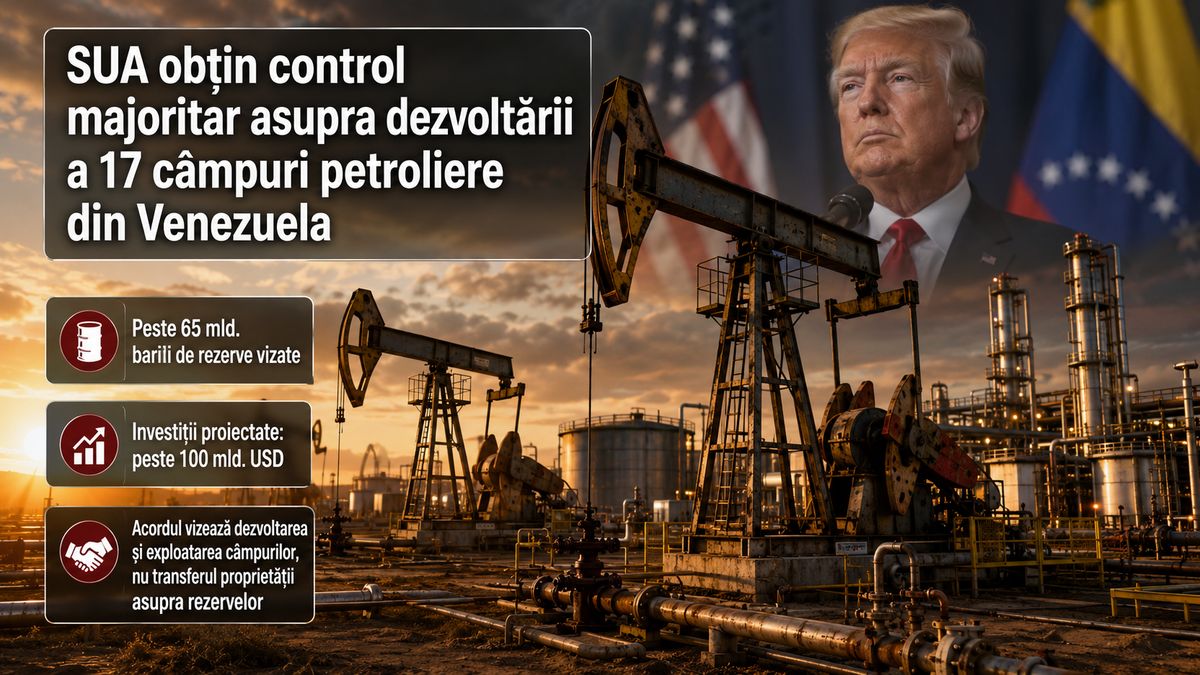
On August 28, the United States and Venezuela announced an agreement that could reshape the oil map of the Western Hemisphere in the long term. Donald Trump announced that the US side has secured "majority control" over the development of Venezuelan fields containing over 65 billion barrels of oil reserves , while Caracas confirmed that 17 strategic fields are targeted, with projected investments exceeding $100 billion . The scale is exceptional. Venezuela holds approximately 303.2 billion barrels of proven reserves , according to OPEC data, the largest volume reported by any country globally. The 65 billion barrels associated with the agreement thus represent about one-fifth of Venezuela's entire reserve base and exceed the approximately 46 billion barrels of proven crude oil and condensate reserves reported by the United States. However, the agreement does not transfer ownership of these 65 billion barrels to Washington. Venezuela's Constitution keeps hydrocarbon deposits under the public ownership of the Republic. What is at stake is the economic and operational control over the development of resources that remain underground and will require massive investments to be converted into actual production. The agreement targets approximately one-fifth of Venezuela's reserves Caracas described the project as the development of 17 fields with a proven potential of over 65 billion barrels. Reuters reported that these are located in two of the country's key oil regions, the Orinoco Belt and the Lake Maracaibo area. These two regions concentrate vast resources, but their exploitation is far from simple. Much of the Orinoco oil is heavy or extra-heavy, requiring investments in extraction, diluents, upgrading, transport, and infrastructure. In Maracaibo, many facilities and fields are mature and require rehabilitation after years of underinvestment. Therefore, the 65-billion-barrel figure reflects the scale of the resource at stake, not the volume that can immediately reach the market. Venezuela currently produces about 1.25 million barrels per day , according to Reuters, despite its reserves of over 300 billion barrels. The gap between these two figures highlights the fundamental challenge of the Venezuelan industry: the geological resource is enormous, but the capacity to convert it into commercial production is far more limited. US control concerns field development, not oil ownership Trump used the phrase "majority U.S. control," but the US administration has not yet published the full text of the agreement or the complete legal mechanism through which this control will be exercised. Venezuela's Constitution establishes that hydrocarbon deposits belong to the Republic, are part of the public domain, and are inalienable. Consequently, the underground oil does not become a US national reserve and cannot simply be added statistically to the 46 billion barrels of proven US reserves. The announced control is tied to the economic vehicle through which the fields will be developed, operating rights, and access to the resulting production. The Associated Press and the Wall Street Journal reported, citing officials familiar with the agreement, that the structure would include a new public-private joint venture in which the US side would control approximately 55% , alongside development rights for up to 100 years . If these terms are confirmed in the final contract documents, the deal would go far beyond a standard oil transaction. It would establish an economic control structure capable of linking the development of a significant portion of Venezuela's resources to US capital, technology, and demand for generations to come. A 55% stake and 100-year terms could turn the agreement into a strategic realignment The approximately 55% stake and the 100-year duration have been reported by US media, but the full contract is not yet public. These elements must therefore be treated with caution at their current level of confirmation. However, they explain why the announcement carries a far higher geopolitical stake than a mere purchase of oil volumes. A long-term development right provides access to future production, influence over investments, and the ability to direct trade flows toward specific markets. In Venezuela's case, this would bring the world's largest oil reserve base closer to US infrastructure and refining capacity. Venezuelan heavy oil is highly relevant for US refineries designed to process such crudes. Geography further favors this relationship: shipping from Venezuela to the US Gulf Coast is significantly shorter than routes from the Middle East. Washington would thus gain not physical ownership of the resources, but something of immense strategic value: controlled, long-term access to the production that can be developed from them . Over $100 billion must be invested before the oil reaches the market Caracas estimates investments of over $100 billion to develop the projects. This figure represents projected…
Ioana Buzoaica — Independent Editorial Board
The NRG-IA newsroom continuously monitors Romanian energy markets, ANRE regulatory decisions, and national grid telemetry (SEN/SNT). We deliver independent intelligence anchored exclusively in official primary data.
Editorial Charter, Ethics & Verification Methodology →