Trump Rolls Back CO2 Rules for US Coal and Gas Plants — NRG-IA
Geopolitică & Energie Author: Ioana BuzoaicaTrump's EPA repeals 2024 CO2 rules for power plants and challenges federal authority under the Clean Air Act to regulate power sector emissions.
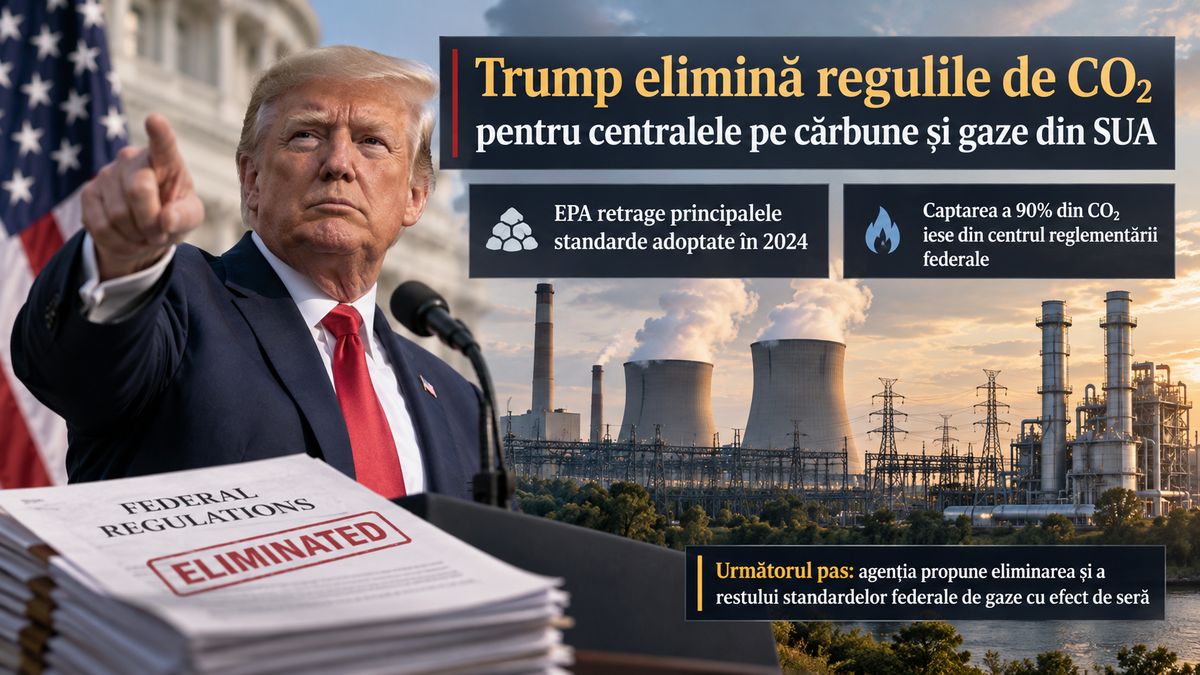
The Trump administration has taken its most significant step yet toward rolling back federal CO₂ standards for US power plants. On September 14, the Environmental Protection Agency, led by Lee Zeldin, signed the repeal of most requirements adopted in 2024 for fossil-fuel power plants, eliminating standards that pushed certain coal units and new gas plants to capture 90% of their carbon dioxide emissions. However, the shift goes beyond merely rolling back a rule introduced by the Biden administration. In parallel, the EPA launched a separate proposal aimed at eliminating all remaining federal greenhouse gas standards for power plants, while challenging the legal basis previously used to regulate the sector's CO₂ emissions under Section 111 of the Clean Air Act. These two steps have different legal statuses. The repeal of the primary 2024 standards is a final rule, set to take effect 60 days after publication in the Federal Register. The elimination of the remaining standards and the broader reinterpretation of the EPA's authority are still in the proposal phase and are entering a public comment period. 90% CO₂ capture is removed from the core of federal regulation The rule adopted in 2024 had built a major part of the US power sector's decarbonization around carbon capture and storage (CCS). For existing coal-fired plants intending to operate past January 1, 2039, the standard required emissions reductions equivalent to capturing 90% of CO₂, with a compliance deadline in 2032. A category of coal plants with a shorter operating horizon was required to meet a standard based on co-firing with 40% natural gas by 2030. New baseload gas turbines were also set to enter a phase where the standard was based on 90% CO₂ capture starting in 2032. The EPA is now eliminating these major components. The new administration argues that the 90% capture performance has not been sufficiently demonstrated at the scale and under the conditions necessary to support mandates imposed on the entire sector. The agency also disputes whether the infrastructure required for CO₂ transport and storage could be available at the scale demanded by the 2024 deadlines. In its reassessment, the EPA analyzed the performance of facilities such as Boundary Dam in Canada and Petra Nova in Texas, arguing that their results do not demonstrate the consistent capture of 90% of a plant's total emissions under the conditions required for a federal standard. The divergence from the Biden administration is fundamental. In 2024, the EPA considered this technology sufficiently demonstrated and economically reasonable to form the basis of the standards. The 2026 EPA has reached the opposite conclusion. Some gas plant standards remain in place for now The action signed on September 14 does not eliminate all federal greenhouse gas standards for power plants. Under the current rule, the EPA is retaining the 2024 standards built around efficiency for certain new combustion turbines. Their elimination is included in the separate proceeding in which the agency proposes to withdraw all remaining GHG requirements. This distinction substantially changes how the event should be framed: the United States has not eliminated all CO₂ standards applicable to the power sector in a single decision. The administration has finalized the rollback of the most significant requirements introduced in 2024 and has initiated the process to eliminate the rest. Other federal rules governing power plant pollution also remain unaffected by this decision. Standards for CO₂ and other greenhouse gases are distinct from regulations controlling mercury, particulate matter, nitrogen oxides, sulfur dioxide, and other pollutants. US states also retain the ability to enforce their own climate policies and requirements within their jurisdictions. The EPA also seeks to alter the legal basis of climate regulation The separate proposal launched alongside the final rule could have more lasting consequences than the elimination of current technology standards. The EPA now argues that Section 111 of the Clean Air Act does not grant it the authority to regulate power plant emissions in the manner used to combat global climate change. If this interpretation is finalized and survives legal challenges, a future administration would face a much more difficult path to rebuilding a similar regulatory regime on the same legal basis. This dispute continues a conflict that has already reached the Supreme Court. In West Virginia v. EPA, the court limited the agency's ability to use Section 111(d) for policies that would force a system-wide shift in electricity generation from coal to other technologies. The Biden administration subsequently attempted to tie standards to technologies directly applicable to power plants, including carbon capture. The current administration is now attacking this framework as well. The legal front is thus becoming just as important as the immediate impact on power plants. Environmental…