Trump Urges Ukraine to Stop Russian Refinery Strikes — NRG-IA
Geopolitică & Energie Author: Ioana BuzoaicaTrump urged Zelenskyy to stop striking Russian refineries, but IEA data shows the diesel crisis is driven by both Russian and Middle East supply drops.
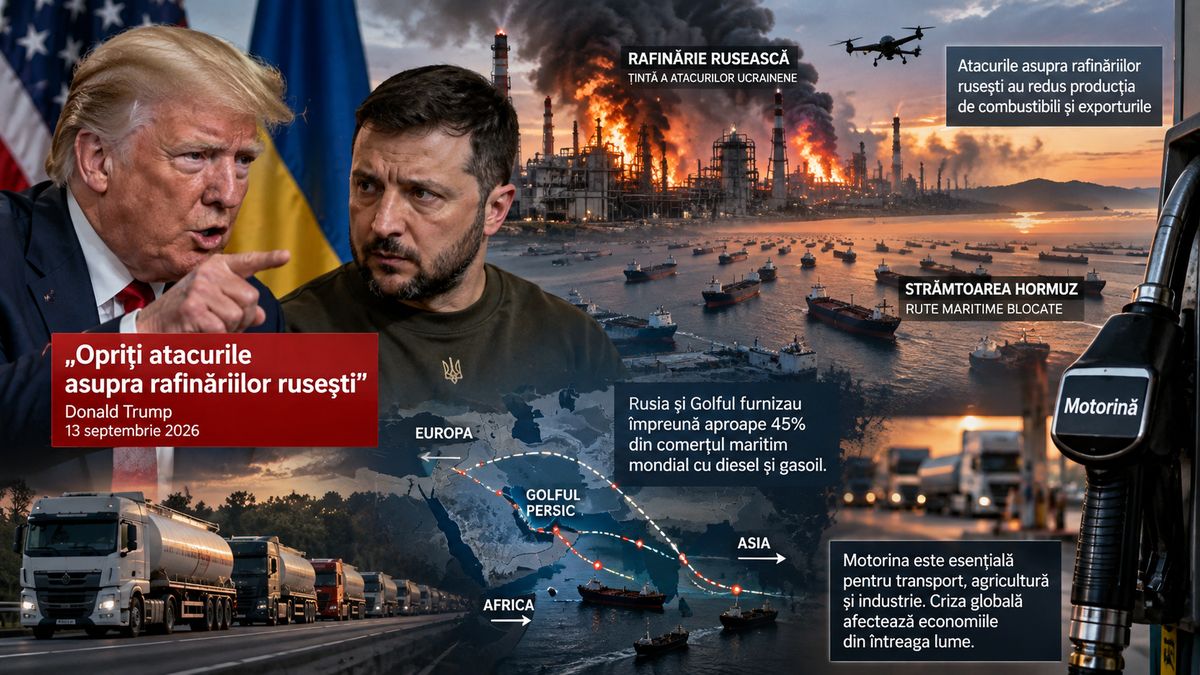
Donald Trump has turned the global diesel crisis into a direct military strategy issue. On September 13, the US president asked Volodymyr Zelenskyy to halt attacks on Russian fuel-producing infrastructure and choose other targets, arguing that strikes on refineries contribute to the shortages affecting the global market. The core of the claim is factually supported: Ukrainian attacks have reduced Russia's refining capacity, worsened domestic supply issues, and contributed to a decline in Russian oil product exports. But Trump went further, stating that the current diesel problem "isn't done by the Middle East." Here, International Energy Agency (IEA) data shows otherwise. The market is facing two overlapping shocks: oil product exports from the Gulf have dropped massively following the Hormuz crisis, and attacks on Russian refineries have further reduced supply at a time when the rest of the global refining system has very little spare capacity. In August, net diesel and gasoil exports from Russia and the Gulf states combined were approximately 1.6 million barrels per day below February levels . Before the crisis, the two regions supplied nearly 45% of global seaborne trade in these products . Diesel has thus become the intersection where two wars meet in the same market. Attacks on Russian refineries have a measurable economic effect For months, Ukraine has been striking refineries and other components of Russian oil infrastructure, viewing them as part of the economic and logistical foundation supporting Moscow's war effort. The effects have become visible both within Russia and in its exports. By late August, Russian gasoline production had fallen to approximately 80,000 tonnes per day , an estimated 70% of domestic demand. Moscow responded with administrative measures to protect the domestic market, including export restrictions. In the case of diesel, the current export ban on Russian producers is in place until September 30 . Russia is normally one of the world's largest diesel exporters, meaning that the reduction in available volumes does not remain a purely domestic issue. A liter of diesel that no longer leaves a Russian port must be replaced by another refinery. In a normal market, this redistribution can be absorbed. In 2026, substitution capacity is much tighter. The Gulf has lost far more than Trump's claim suggests The IEA report from September 11 shows the scale of the other component of the crisis. In August, exports of refined oil products and LPG from the Gulf were approximately 3.7 million barrels per day, nearly 60%, below February levels . For diesel and gasoil, the region's net exports had fallen to about 390,000 barrels per day , just over a quarter of pre-war levels. These volumes vanished from a market that relied heavily on the Persian Gulf for distillates. For this reason, the claim that the current pressure on diesel is not caused by the Middle East contradicts IEA data. Ukrainian attacks exacerbate the problem, but they did not single-handedly create the global shortage of refined products. The distinction is also politically significant. Trump's demand to Zelenskyy is based on a real effect of the attacks on Russian refining, but his proposed solution addresses only one of the two major sources of the imbalance. Striking a refinery does not automatically remove Russian crude from the market Attacks on refineries also produce a seemingly paradoxical effect. A facility that can no longer process crude consumes less raw oil, and a portion of that volume can become available for export. Therefore, the immediate impact of Ukrainian strikes is stronger on refined products than on global crude availability. The market can still receive a Russian barrel of crude, but it loses the capacity that transformed it into diesel, gasoline, or kerosene. This difference explains why refined product prices have ended up sending a stronger crisis signal than crude oil. In early September, the IEA calculated a US diesel price of over $200 per barrel , approximately 94% above pre-Middle East war levels. The United States is the world's largest oil producer, but this advantage does not insulate it from the global shortage of distillates. Crude oil and diesel are linked markets, not interchangeable products. The diesel crisis is beginning to influence the choice of military targets Trump's request to Kyiv marks a significant shift. The effects of attacks on Russian energy infrastructure are no longer evaluated solely in terms of Moscow's revenues or its military capacity. They are now also evaluated through the lens of fuel prices in the United States and their impact on the global market. Washington thus finds itself in the position of asking Ukraine to limit a category of Russian targets because the success of the attacks generates economic costs outside of Russia as well. For Kyiv, the calculus is different. The oil sector is one of the Russian state's primary revenue sources, and refineries…