Trump Asks US to Accept Higher Gas Prices Amid Iran War — NRG-IA
Geopolitică & Energie Author: Ioana BuzoaicaDonald Trump has linked fuel costs to US strategy against Iran, asking Americans to accept higher pump prices as the conflict drives up energy costs.
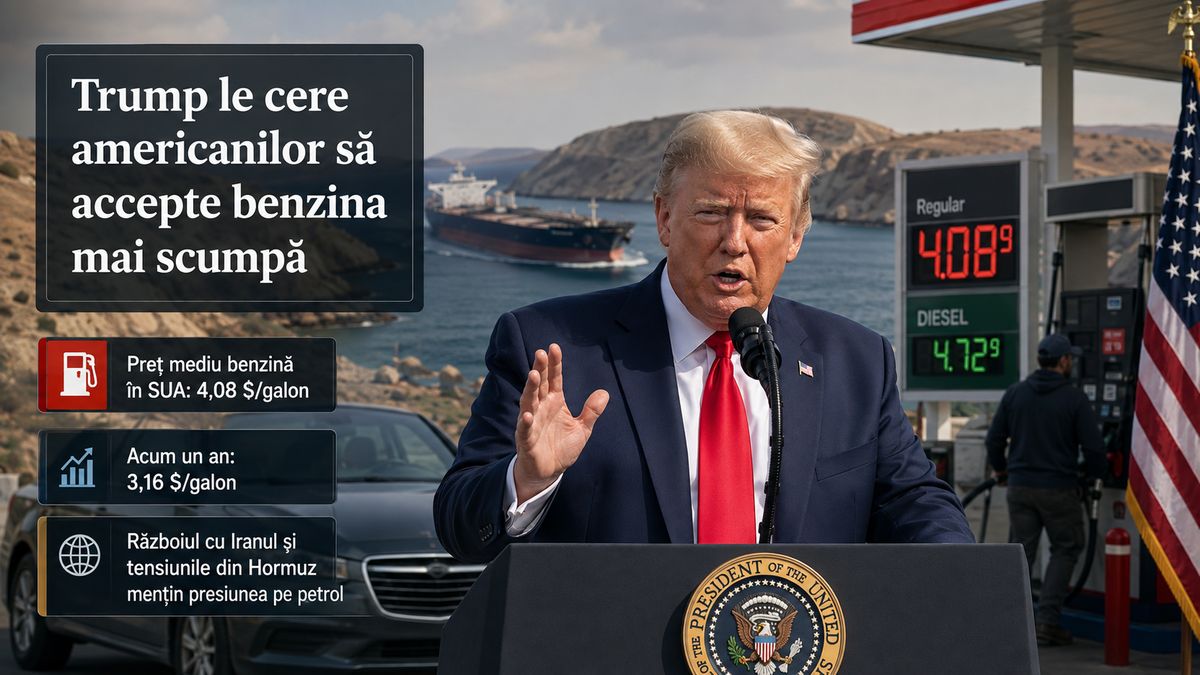
Donald Trump has asked Americans to accept higher gasoline prices as part of the cost of the US strategy against Iran. The statement was made on Friday, August 14, at a time when regular gasoline averaged approximately $4.08 per gallon nationwide, up from about $3.16 a year ago. In a speech delivered in Garden City, New York, the US President said that Americans must agree to pay " a tiny little bit more for your gasoline "—linking this cost directly to his administration's stated goal of preventing Iran from acquiring nuclear weapons. Later, Trump stated that " what we're doing is a great service for the world, not only for ourselves ," characterizing the US operation against Iran as a service to the world. The two statements are part of the same political justification for the war, but they are not equivalent: Trump did not say that expensive gasoline itself is "a great service to the world," but rather that the US intervention justifies, in his view, the costs borne by consumers. The statement marks a significant political shift. After months of the administration promoting cheap energy as one of its key economic achievements and priorities, higher fuel prices are now being explicitly framed as an acceptable cost for a national security objective. Gasoline is nearly a dollar per gallon more expensive than last year AAA data highlights the extent of the pressure on consumers. On August 14, the national average for regular gasoline was approximately $4.0776 per gallon, compared to $3.1601 during the same period last year. The difference is approximately 29%. Comparing this to the period immediately preceding the war provides even more relevant context. On February 26, two days before the conflict broke out, gasoline cost about $2.98 per gallon. By the end of March, the average had already reached around $3.98. Therefore, Trump's phrasing of a "tiny little bit" higher price is political. Statistically, the increase compared to the pre-conflict period is substantial. Official inflation data confirms this pressure. The Bureau of Labor Statistics shows that in July 2026, the US Consumer Price Index was 3.4% above its level from a year earlier, while energy was 14.7% more expensive, and the gasoline component was 24.6% higher than in July 2025. The trend has not been linear. Gasoline prices fell in July compared to June, highlighting high market volatility. However, the year-on-year level remains well above pre-conflict figures. Hormuz translates war into a direct energy cost The economic mechanism behind the price increase is much broader than the political rhetoric coming out of Washington. The Strait of Hormuz, one of the world's most critical energy transit chokepoints, has been severely disrupted by the conflict. Prior to the war, approximately one-fifth of the world's oil and nearly a quarter of global maritime oil trade passed through this corridor. Observable traffic has remained extremely low in recent days. On Friday, commercial tracking systems cited by Reuters identified only two vessels that had actually transited the strait, and no visible crude oil shipments. Some vessels may sail with their Automatic Identification System (AIS) turned off, meaning these data describe observable traffic rather than absolute total flows. However, the economic impact is clear from market behavior. Asian refiners are already purchasing oil from the US and West Africa for the coming months, Gulf exporters are utilizing alternative pipelines and logistics solutions, and shipping and insurance costs have surged. Brent crude closed on Friday at $88.52 per barrel, up about 6% from the end of the previous week. Disruptions in Hormuz are a central factor, but not the only one: supply issues at Russia's Sheskharis terminal in Novorossiysk have added further pressure to the market. US gasoline prices cannot be attributed, cent for cent, to a single event. However, the conflict with Iran and the restriction of flows through Hormuz are documented major drivers of the current pressure on oil and fuel prices. From "cheap energy" to accepting the cost of war The August 14 statement is particularly significant given that cheap energy was a cornerstone of the Trump administration's economic messaging. In 2025, the White House framed the drop in gasoline prices below $3 per gallon as a direct result of administration policies, and continued to promote lower energy costs for families into early 2026. Following the outbreak of the war, the rhetoric evolved alongside prices. In early March, when gasoline was around $3.25 per gallon, Trump stated he was unconcerned about potential increases, arguing that the operation against Iran was more important. By early August, as gasoline neared $4.10 per gallon, the President shifted course, criticizing ExxonMobil and Chevron for their high profits and demanding that oil companies lower prices for consumers. Now, the argument is shifting once again. Higher prices are no longer just a problem to…
Ioana Buzoaica — Independent Editorial Board
The NRG-IA newsroom continuously monitors Romanian energy markets, ANRE regulatory decisions, and national grid telemetry (SEN/SNT). We deliver independent intelligence anchored exclusively in official primary data.
Editorial Charter, Ethics & Verification Methodology →