Trump-Xi: China Eyes US LNG Tariff Cuts, Impacting Europe — NRG-IA
Geopolitică & Energie Author: Ioana BuzoaicaTrump and Xi meet in Washington. Lowering US LNG tariffs could reopen China's market just as US exports surge and Europe relies heavily on US gas.
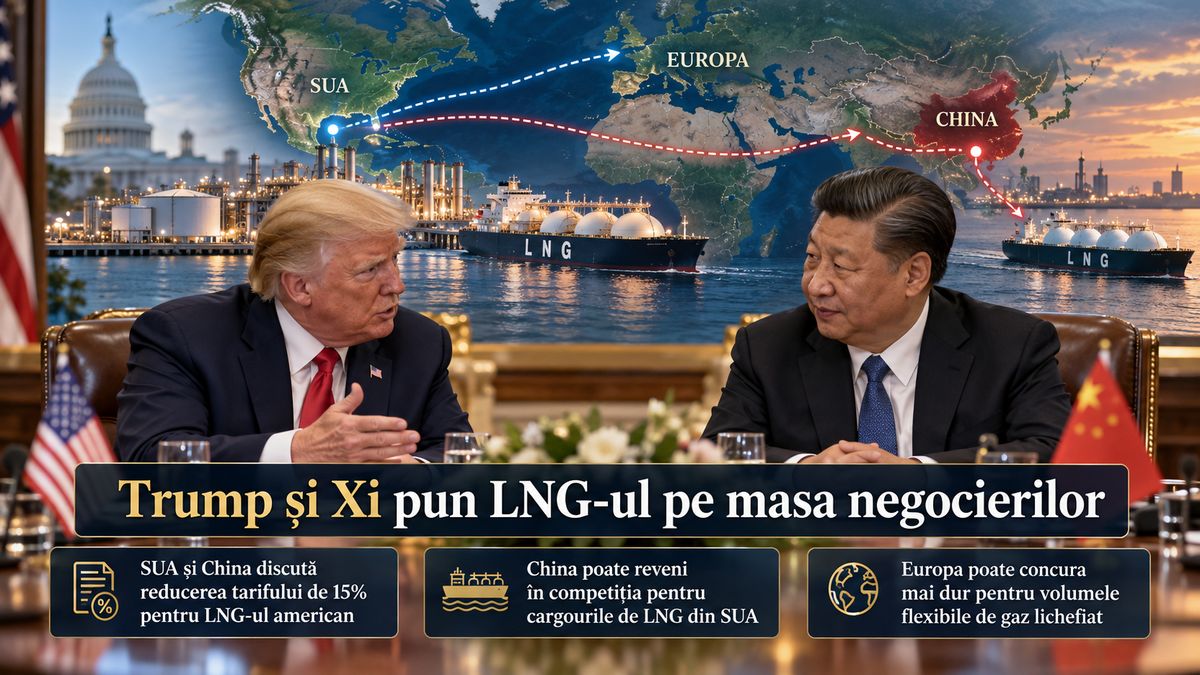
Donald Trump and Xi Jinping are meeting in Washington on September 24 with energy stakes that transcend the bilateral trade relationship between the two economies. The United States and China are negotiating the reduction or elimination of Beijing's additional 15% tariff on American liquefied natural gas, a move that could bring Chinese buyers back into a market from which the tariff dispute had almost completely excluded them. For Europe, this discussion is directly relevant. The US has become the primary source of LNG for the European market, while flexible cargoes are routed based on price signals in the Atlantic and Asia. If American gas becomes competitive for China once again, a buyer of Beijing's scale could significantly increase competition for the volumes that currently flow to European terminals. Tariffs Have Almost Completely Excluded China from US LNG Flows In February 2025, Beijing introduced an additional 15% tariff on LNG originating from the United States. This is compounded by a general 10% surcharge maintained on US imports, raising the total additional tariff burden on US LNG to 25%. Removing the specific 15% component would significantly lower this barrier, though it would not automatically mean the elimination of all tariffs. The impact on trade was abrupt. According to the Energy Information Administration, US LNG exports to China plummeted from approximately 0.6 billion cubic feet per day in 2024 to zero in 2025 , as traders rerouted cargoes to other markets. Europe absorbed the lion's share of this supply: in 2025, approximately 68% of US LNG exports , equivalent to an average of 10.3 billion cubic feet per day, went to Europe. Flows to China began showing signs of recovery in 2026, with Reuters identifying US cargoes bound for Chinese ports once again. However, the difference between a few spot deliveries and the return of a major market is vast. A tariff agreement could alter this exact equation, reducing the commercial disadvantage of US gas compared to other sources available to Chinese buyers. The US Is Rapidly Adding LNG Capacity and Needs Large Markets The timing of the summit is also critical for the US industry. United States LNG exports averaged 17.4 billion cubic feet per day in the first half of 2026 , up 23% compared to the same period in 2025. The EIA projects an average of 17.3 billion cubic feet per day in the second half of this year and 18.7 billion in the first half of 2027, as new capacities and expansions such as Plaquemines, Corpus Christi, and Golden Pass increase export availability. This growth shifts the challenge for the US industry: it is no longer just about building terminals, but finding markets capable of absorbing the additional volumes. Reuters estimates that nearly 25 million tonnes per annum of US LNG capacity currently under development is not yet covered by long-term contracts . China is one of the few markets large enough to materially shift this balance. A commercial signal emerged just ahead of the summit. On September 14, Venture Global and China Gas Holdings announced a contract for 0.5 million tonnes of LNG per year for 20 years, with deliveries starting in 2030 . The new agreement brings China Gas's long-term contracted volumes from Venture Global's portfolio to 2.5 million tonnes per year. The contract demonstrates that strategic interest in US LNG did not vanish with the tariffs. A reduction in these duties could further improve the economics of such purchases and facilitate the contracting of new US capacity. China May Return, but It Is Buying Less LNG Than Before However, a commercial reopening would not meet the same Chinese market seen during the LNG boom years. The International Energy Agency estimates that China's total natural gas demand fell by approximately 4% between March and June 2026 compared to the same period of the previous year. Over the same timeframe, Chinese LNG imports dropped by about 12%, equivalent to around 3 billion cubic meters , amid high prices, increased domestic production, and access to alternative gas sources. Customs data for August confirms a still-weak market: Chinese LNG imports were 17.8% lower than in August 2025, with a 6.8% decline recorded over the first eight months of the year. A tariff reduction could therefore bring US LNG back into competition for this demand, but actual volumes will depend on price, China's requirements, and the alternatives available to Beijing. Europe Could Once Again Face a Strong Rival for US Cargoes For Europe, the primary impact would not stem from a political decision to redirect gas, but rather through market mechanisms. LNG cargoes with contractual flexibility can be routed to whichever region offers a price spread that justifies the shipping costs. The IEA highlights how powerful this mechanism can be: between March and June 2026, the Asian spot JKM price averaged a premium of approximately $2.1/MMBtu over the TTF , after Europe had offered a premium in the…