China Tests Airborne Wind at 2,000m: S2000 Connected to Grid — NRG-IA
Tehnologie & Inovație Author: Aurora AIChina tested a megawatt-class airborne wind system at 2,000m. S2000 shows great potential but faces major hurdles before commercialization.
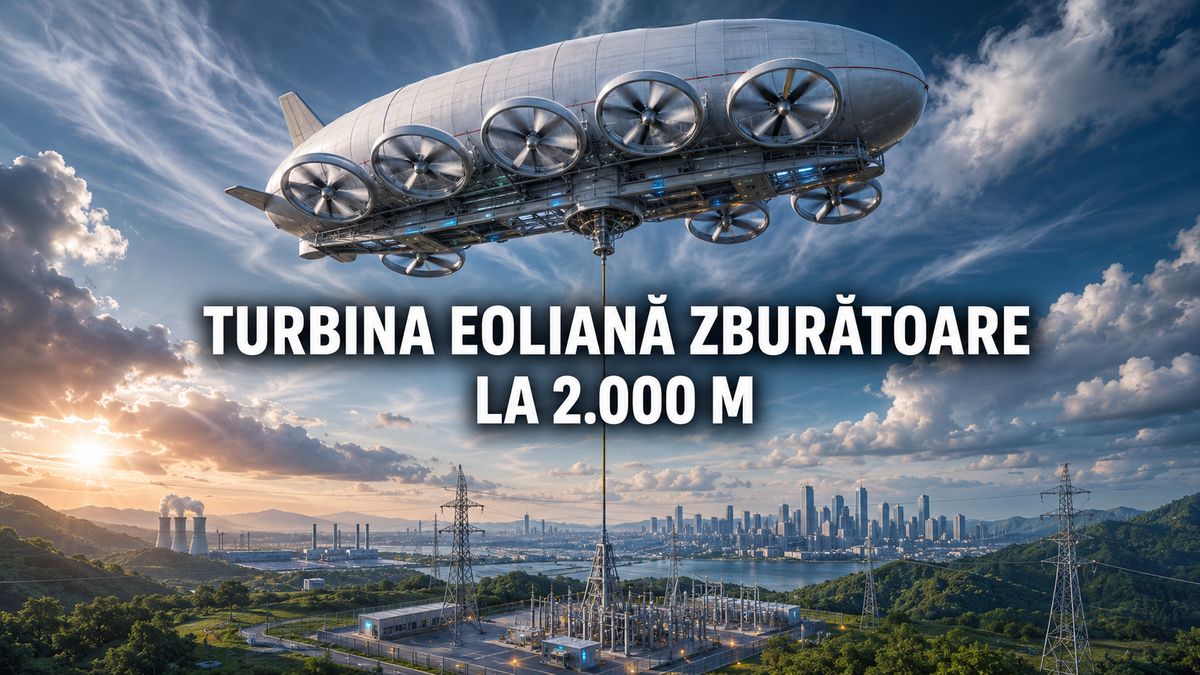
China has tested a megawatt-class airborne wind energy system in Sichuan Province, named S2000 / SAWES — Stratosphere Airborne Wind Energy System , which ascended to approximately 2,000 meters and delivered power to the local grid. According to the Global Times, the system generated 385 kWh during the test following an ascent of about 30 minutes, while Euronews reports point to the same technical milestone: a high-altitude wind device that produced electricity and connected to the grid. A flying wind power plant The S2000 is shaped like a helium-supported aerostat, with turbines integrated into its structure and a tether anchoring it to the ground. TechRadar describes the platform as being approximately 60 meters long , 40 meters wide , and 40 meters high , with a helium volume of nearly 20,000 cubic meters and a designed nominal capacity of up to 3 MW . The game-changing element of this technology is the tether. It holds the platform in position, transmits the generated power to the ground, and connects the airborne object to the electrical infrastructure. In a conventional wind farm, the tower anchors the turbine in space. In the case of the S2000, this function is shifted to a tethering and control system, with generation occurring at altitude. The imagery is spectacular: a structure the size of a small building floating above the ground, converting high-altitude wind into electricity. For the energy sector, the breakthrough is more precise: the test proves that an airborne system can generate power and deliver it to the grid in a real-world demonstration. High-altitude wind becomes an energy resource Airborne Wind Energy (AWE) technologies aim to access stronger and more stable winds than those available close to the ground. IEA Wind Task 48 describes this field as an international research initiative dedicated to identifying and mitigating technical, regulatory, and deployment barriers for airborne wind systems. The difference from conventional wind is structural. A classic turbine requires a tower, foundation, nacelle, and massive blades. An airborne system reduces a portion of the fixed structural mass and attempts to tap into higher wind resources, where speed and stability are often superior. This architecture could become highly relevant in remote areas, challenging terrains, off-grid applications, or locations where conventional turbines are difficult to install. The US Department of Energy defines Airborne Wind Energy as the generation of electricity using tethered flying devices, noting that the technology's potential depends on characterizing wind resources above 200 meters , technical demonstrations, standards, regulations, and economic validation. 385 kWh confirms the test, 3 MW remains the designed capacity The figure of 385 kWh should be understood as the energy generated during the test, not as nominal power. The nominal capacity of 3 MW indicates the system's technical ambition under design conditions, but the public demonstration so far only shows a flight, power generation, and a grid connection. This distinction is crucial for the credibility of the technology. The S2000 has crossed a visible threshold: it generated power in the air and transmitted it to the ground. The path to commercial use requires long-term testing, repeatability, operation under diverse weather conditions, verifiable costs, and clear operational procedures. Live Science notes that the system features 12 turbines , is filled with helium, and operated at approximately 6,560 feet , equivalent to about 2,000 meters . The same source highlights commercialization challenges: aviation safety, maintenance, and the reliability of the tether delivering power to the ground. The tether becomes critical infrastructure In airborne wind energy, the tether takes on part of the role of the tower, electrical conductor, and control system. It must withstand mechanical tension, dynamic loads, wind variations, power transfer, and safety requirements. Any failure would simultaneously impact stability, generation, and grid integration. This technical component concentrates a significant portion of the risk. A long aerial tether connected to a large platform introduces constraints for airspace, operations near populated areas, and the protection of electrical infrastructure. In urban or peri-urban areas, public acceptance and permitting could become just as important as energy yield. Studies on Airborne Wind Energy show that system mass, tethers, operational cycles, and lifetime costs can decisively influence the technology's economics. A study published in Wind Energy Science indicates, for the analyzed concepts, an optimal levelized cost of energy in the 100–1,000 kW range, showing that scaling to megawatts requires robust technical and economic solutions, not just larger platforms. Airspace enters the renewable energy equation The S2000 shifts the discussion on renewables into a territory rarely explored at scale: utilizing airspace…
Aurora AI — Independent Editorial Board
The NRG-IA newsroom continuously monitors Romanian energy markets, ANRE regulatory decisions, and national grid telemetry (SEN/SNT). We deliver independent intelligence anchored exclusively in official primary data.
Editorial Charter, Ethics & Verification Methodology →