Ukraine Attacks St. Petersburg Oil Terminal for 3rd Time — NRG-IA
Geopolitică & Energie Author: Ioana BuzoaicaTwo St. Petersburg oil facilities caught fire after a massive Ukrainian drone strike. The export terminal handled 5.29M tonnes of cargo in 2025.
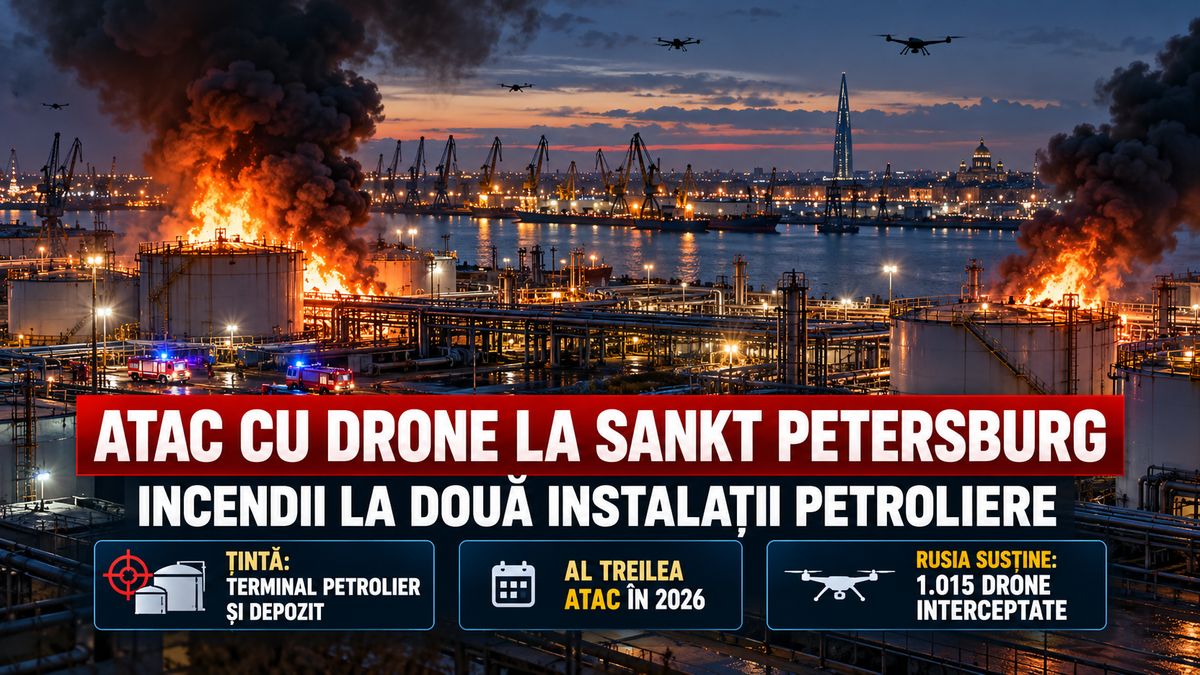
Ukraine launched a massive drone strike on St. Petersburg and the Leningrad region on October 18, 2026, causing fires at two major oil facilities: the Petersburg Oil Terminal, an export terminal located in Russia's Baltic port, and the Ruchi fuel depot. Russian authorities confirmed firefighters were deployed at both sites following one of the largest Ukrainian aerial offensives targeted at northwestern Russia since the start of the war. The Russian Ministry of Defense reported intercepting 1,015 Ukrainian drones between 20:00 on October 17 and 08:00 on October 18 over several Russian regions, occupied Crimea, and the Black Sea. This figure represents Moscow's unverified report and spans a far broader geographical area than St. Petersburg alone. For the Leningrad region, Governor Aleksandr Drozdenko separately reported 145 downed drones. The attack also resulted in civilian casualties. St. Petersburg Governor Aleksandr Beglov reported one death and five injuries, as well as damage to 12 apartment blocks and two private houses. Pulkovo Airport temporarily imposed flight restrictions, while damage to power and digital infrastructure was reported in the neighboring region. Beyond the scale of the operation, this latest strike on the oil terminal underscores a pattern of repeated attacks on the same strategic infrastructure, previously targeted in June and July. Fires at Oil Terminal and Ruchi Fuel Depot; Digital Infrastructure Also Targeted The Petersburg Oil Terminal and the Ruchi depot were among the primary targets affected on the morning of October 18. Governor Beglov confirmed that Emergency Situations Ministry crews were continuing firefighting operations at both facilities, as well as at industrial warehouses in the Kolpino district. Footage published by international agencies captured smoke plumes rising above the port area where petroleum storage and handling facilities are located. The attack also impacted assets outside the oil sector. Russian tech company VK confirmed damage to a data center in the Leningrad region, while e-commerce operator Ozon reported a fire at a logistics center. Temporary power outages were reported in the Yanino area, affecting approximately 20,000 residents. Regional authorities later stated that the primary equipment at the Vostochnaya electrical substation remained operational and power was being progressively restored. A more specific attribution of the operation emerged on the evening of October 18, when Ukrainian news agency Ukrinform cited statements from drone manufacturer Fire Point. According to the company, Ukrainian forces deployed FP-1 drones to attack oil and digital infrastructure in the St. Petersburg region, with targets including the Petersburg Oil Terminal, the Ruchi depot, and the VK data center. While the use of these devices was claimed by the manufacturer, individual participating drones have not been independently verified. While the reported fires and damage confirm that significant targets were hit, the full extent of the destruction at the oil facilities remains unquantified. As of the morning of October 19, no public operational report had established the number of damaged tanks, unavailable loading capacity, or potential fuel losses. Petersburg Oil Terminal Monthly Capacity Exceeds 1M Tonnes; Handled 5.29M Tonnes in 2025 Petersburg Oil Terminal is a major liquid cargo operator in the Port of St. Petersburg, tasked with receiving, storing, and dispatching petroleum products via Baltic Sea maritime infrastructure. The terminal handles flows originating from rail, river, and road transport and is equipped with facilities for loading commercial tankers. Products handled include fuel oil, diesel, marine fuels, aviation kerosene, and other refined oil products. According to technical data published by the operator, the terminal has a nominal intake and loading capacity of up to 1.1 million tonnes of petroleum products per month, equivalent to roughly 13.2 million tonnes annually if operated at full capacity. The infrastructure features four berths for tankers with a deadweight tonnage of up to 100,000 tonnes and a separate berth for bunkering vessels. Technical capacity represents maximum operational potential rather than actual exported volumes. Financial data for 2025 provides a clearer picture of actual throughput. According to Russian media outlet Fontanka, Petersburg Oil Terminal handled 5.29 million tonnes of cargo, down 17.1% from 6.38 million tonnes in 2024. Company revenue reached approximately 7.3 billion rubles, with a net profit of around 4.3 billion rubles. These financial results predate the 2026 strikes and do not reflect their impact. The terminal's strategic importance stems from its key position in the refined product export supply chain. Fuel from refineries or storage facilities arrives at the terminal, is transferred into storage tanks, and is subsequently loaded onto commercial vessels. Damage to tanks, pumps, pipelines, or port…
Ioana Buzoaica — Independent Editorial Board
The NRG-IA newsroom continuously monitors Romanian energy markets, ANRE regulatory decisions, and national grid telemetry (SEN/SNT). We deliver independent intelligence anchored exclusively in official primary data.
Editorial Charter, Ethics & Verification Methodology →