Ukraine strikes TANECO refinery: Impact on Russian fuel — NRG-IA
Geopolitică & Energie Author: Ioana BuzoaicaUkraine has struck Russia's TANECO refinery amid ongoing fuel supply issues, which have already forced Moscow to restrict exports and import fuel.
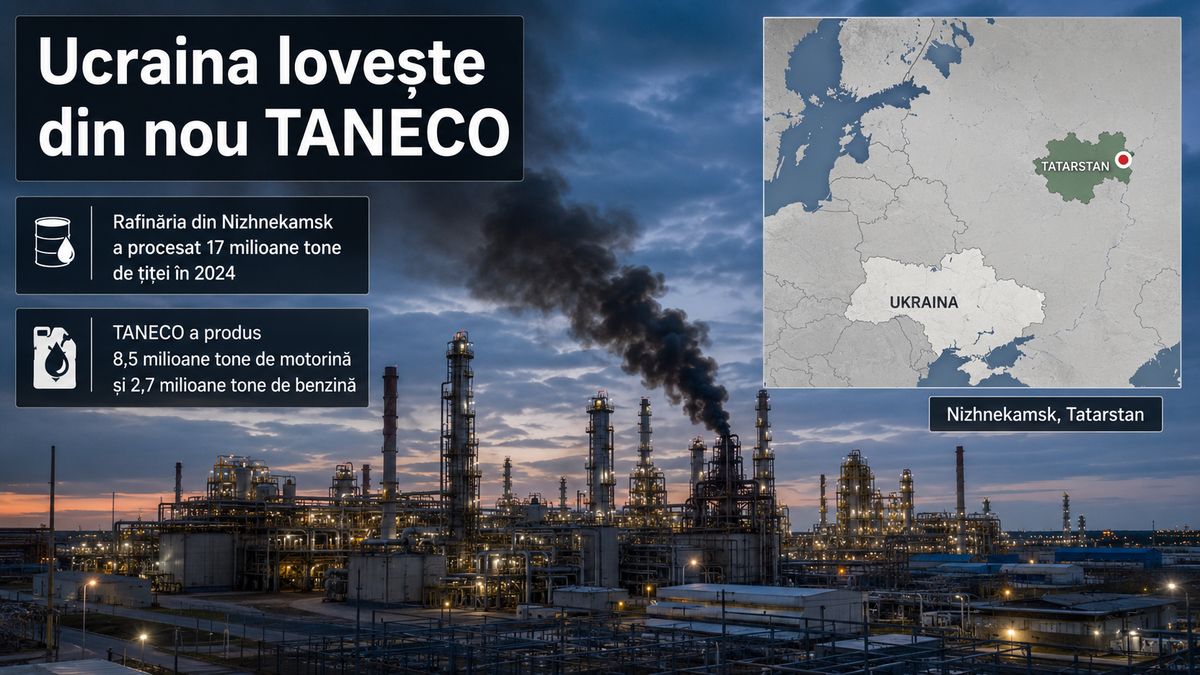
Ukraine has struck Tatneft's TANECO refinery in Nizhnekamsk, in the Republic of Tatarstan, approximately 800 kilometers east of Moscow, continuing its campaign of attacks on Russian refining infrastructure. The Ukrainian military announced that a fire broke out at the facility, and Reuters verified social media footage showing smoke rising from the refinery area. The complex processed 17 million tons of crude oil in 2024, producing 2.7 million tons of gasoline and 8.5 million tons of diesel. The August 10 attack also resulted in a severe human toll. Authorities cited by Reuters reported at least 13 deaths in Nizhnekamsk, including a child and several Central Asian citizens. Nine of the victims were reportedly in a hostel, according to the Russian news agency RIA, information that Reuters could not independently verify. The casualty toll is for the overall attack on the city and cannot be attributed solely to the strike on the refinery. TANECO processes large volumes of crude into fuel for the Russian market TANECO's importance stems not only from the volume of crude oil processed, but especially from the large output of petroleum products. The 8.5 million tons of diesel produced in 2024 represent half of the total volume of crude processed that year, in addition to 2.7 million tons of gasoline. The refinery is therefore highly relevant at a stage in the war where pressure on Moscow is no longer focused exclusively on crude oil exports. Striking refining infrastructure targets the segment that converts crude oil into diesel, gasoline, and other products directly usable in transport, industry, and the wider economy. For the fuel market, this distinction is crucial. A barrel of extracted crude can be rerouted, stored, or exported within the limits of available infrastructure. However, offline refining capacity reduces the ability to convert that crude into the finished products demanded by the market. The exact impact of the August 10 attack cannot be quantified at this time. There is not yet any confirmation regarding the specific processing unit affected, the volume of capacity potentially knocked offline, or the duration of repairs. These details will determine whether the strike remains an incident with limited operational impact or adds another significant loss to Russian refining capacity. The attack comes after months in which refineries have become the weak point of the Russian fuel market The timing is far more sensitive than that of the initial Ukrainian attacks on TANECO. In recent months, drone strikes on Russian refineries and unplanned outages have contributed to reduced fuel production and supply issues in several regions. Reuters reports that Moscow has resorted to importing fuel from abroad to bolster domestic supply, even though Russian authorities claim that many of the initial problems have since been resolved. Pressure has mounted to the point where Russia has directly intervened in exports. On July 8, the government introduced a ban on diesel exports to increase volumes available on the domestic market, after refinery attacks led to shortages and price hikes in some regions. Deputy Prime Minister Alexander Novak noted at the time that the fuel situation remained difficult and that Russia was set to begin fuel imports. In July, Russian seaborne exports of petroleum products fell by 33% compared to the previous month, to approximately 3.9 million tons, amid lower production, refinery attacks, and export restrictions. At the same time, Belarus increased fuel deliveries to Russia to record levels. In July, rail shipments of gasoline reached approximately 212,000 tons, 13% higher than in June, while diesel shipments rose to 162,000 tons, roughly double the previous month's volume. Reuters reported that Russian gasoline production had fallen to about 65% of average seasonal consumption, while diesel production barely covered domestic demand. In this context, every new material outage at a major refinery reduces the margin the Russian system has to redistribute production between regions and compensate for facilities undergoing repairs. TANECO had already been hit this summer The August 10 attack is not the first on the Nizhnekamsk complex. Reuters reported in June that the Ukrainian military had struck TANECO in an overnight attack on Russian oil and petrochemical infrastructure. The refinery thus appears once again among the targets of the Ukrainian campaign against the Russian oil sector. TANECO had also been attacked in April 2024, when a drone struck the CDU-7 primary distillation unit. The unit could process approximately 155,000 barrels of crude oil per day, nearly half of the refinery's total capacity. The damage was assessed as non-critical at the time, the fire was quickly extinguished, and production was not interrupted. This precedent shows why the image of a fire is not enough to estimate the energy impact. In a refinery, the consequences depend on the specific unit affected,…
Ioana Buzoaica — Independent Editorial Board
The NRG-IA newsroom continuously monitors Romanian energy markets, ANRE regulatory decisions, and national grid telemetry (SEN/SNT). We deliver independent intelligence anchored exclusively in official primary data.
Editorial Charter, Ethics & Verification Methodology →