Ukraine Strikes Yaroslavl: Russian Diesel Exports Plunge — NRG-IA
Geopolitică & Energie Author: Ioana BuzoaicaUkrainian strikes on Russian refineries are curbing fuel exports, forcing Moscow to restrict outbound shipments and import diesel.
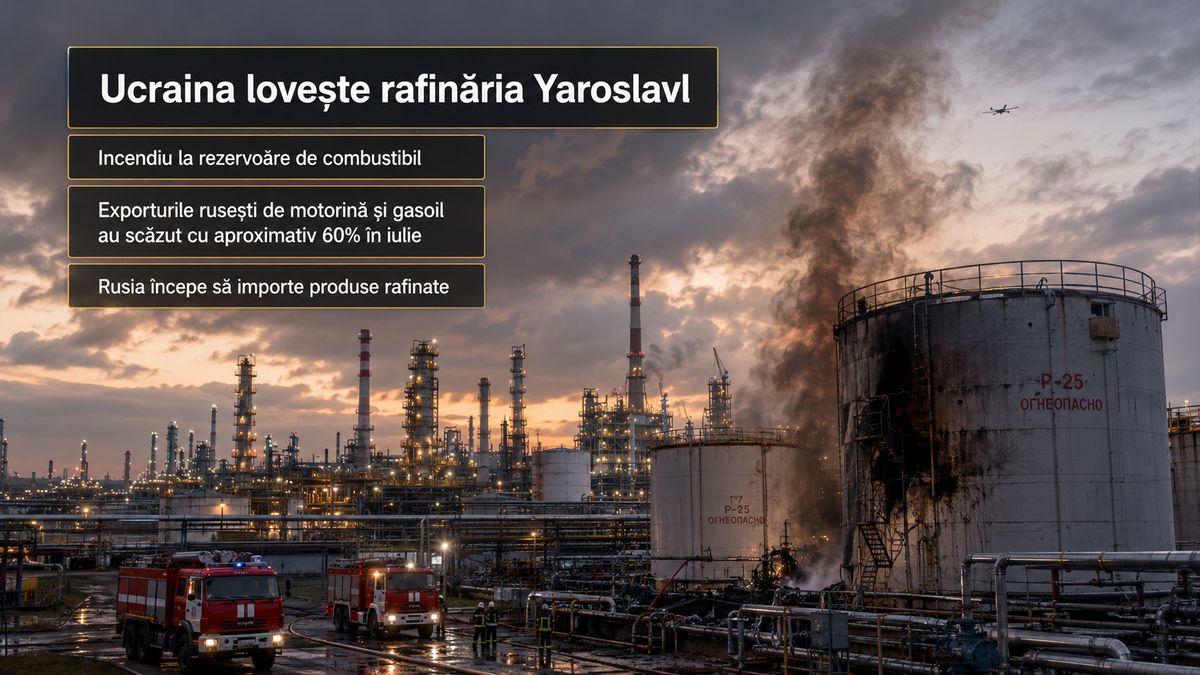
On August 6, Ukraine struck two refineries in Russia, including Slavneft-YANOS in the Yaroslavl region, one of the country's largest oil processing facilities. Russian regional authorities confirmed a fire at fuel storage tanks following the drone attack, and Ukrainian President Volodymyr Zelenskyy announced that Kyiv's forces had targeted both the Yaroslavl refinery and Bashneft-Novoil in Bashkortostan. In Yaroslavl, Governor Mikhail Yevrayev stated that the fire was caused by drone debris and was extinguished with the involvement of 102 firefighters and 47 emergency response vehicles. Four people were injured by shrapnel, with no fatalities reported. Yevrayev claimed that air defenses and electronic warfare systems intercepted all 93 drones involved in what he described as the largest attack on the region. The Slavneft-YANOS refinery has an annual processing capacity of approximately 15 million metric tons of crude oil, equivalent to around 300,000 barrels per day. This figure represents the facility's total capacity, not the capacity confirmed lost in the August 6 attack. At the time of the Reuters report, authorities and the operator had not confirmed a complete shutdown of processing operations. This distinction is crucial for assessing the actual scale of the event: Yaroslavl cannot automatically be counted as another 300,000 barrels per day removed from Russian refining capacity. However, the strike gains significance through accumulation. It adds to an extensive campaign targeting Russian refineries at a time when the effects of previous attacks are already visible in domestic production, exports, and fuel imports. Yaroslavl joins a growing list of targeted refineries The August 6 attack is not an isolated incident. In recent months, Ukraine has intensified its long-range strikes on Russian oil infrastructure, targeting refining capacities, depots, terminals, and other elements of the energy supply chain. In late July, Ukrainian drones struck infrastructure in Perm and Ryazan, and Reuters reported that repeated attacks had already caused fuel supply difficulties in several Russian regions. In Perm, one of the crude distillation units was subsequently taken offline following an attack, according to Reuters. For Kyiv, refineries represent targets with a different strategic value than oil wells and fields. Russia can continue to extract crude oil, but converting it into diesel, gasoline, jet fuel, and other usable products depends on the operation of a much more concentrated and complex infrastructure. Disruption at a refining facility does not mean the oil disappears. It means that a portion of it can no longer be processed locally, at the usual pace, into the products required by the economy, transport networks, and armed forces. And this effect is beginning to show in trade data. Russian diesel and gasoil exports plunged by approximately 60% in July Russia's total seaborne exports of petroleum products fell in July by about a third compared to June, to approximately 3.9 million metric tons, according to LSEG data and market sources cited by Reuters. The decline reflected lower fuel production following the refinery attacks, as well as restrictions introduced by Russian authorities to protect the domestic market. For diesel and gasoil, the contraction was far more severe. Export volumes through Russian ports fell in July by approximately 60% compared to the previous month , to just 0.75 million metric tons . Seaborne naphtha exports also declined by about 35%, to around 0.8 million metric tons. This reduction is significant because Russia has traditionally been one of the world's major exporters of petroleum products. Following the European Union's ban on Russian oil products, which took effect in February 2023, volumes were primarily redirected to Turkey, Brazil, West Africa, and other markets in Asia and the Middle East. Such a sharp reduction in diesel available for export does not remain an exclusively domestic issue for Russia. It shrinks the supply of finished products to the markets that absorbed Russian fuels following European sanctions. Russia restricts exports to protect the domestic market Within Russia, pressure on fuel production has become severe enough for authorities to limit exports. By early July, Russian gasoline production had fallen to a level equivalent to approximately 65% of average seasonal consumption , according to industry data and Reuters calculations. Diesel production was roughly at the level required to cover domestic demand. Amid rising wholesale and retail prices, the Russian government introduced restrictions on diesel exports, with certain exceptions for existing contracts and deliveries made under intergovernmental agreements. Similar restrictions were already in place for gasoline and jet fuel. The attacks on refineries thus produce a consequence that goes beyond the physical damage to a facility: Moscow must choose between maintaining domestic supply and…
Ioana Buzoaica — Independent Editorial Board
The NRG-IA newsroom continuously monitors Romanian energy markets, ANRE regulatory decisions, and national grid telemetry (SEN/SNT). We deliver independent intelligence anchored exclusively in official primary data.
Editorial Charter, Ethics & Verification Methodology →