EU Imports €238B in Russian Energy Since Ukraine Invasion — NRG-IA
Geopolitică & Energie Author: Ioana BuzoaicaThe EU has imported an estimated €238bn in Russian fossil fuels since the invasion of Ukraine, as new data fuels Transatlantic debate over sanctions.
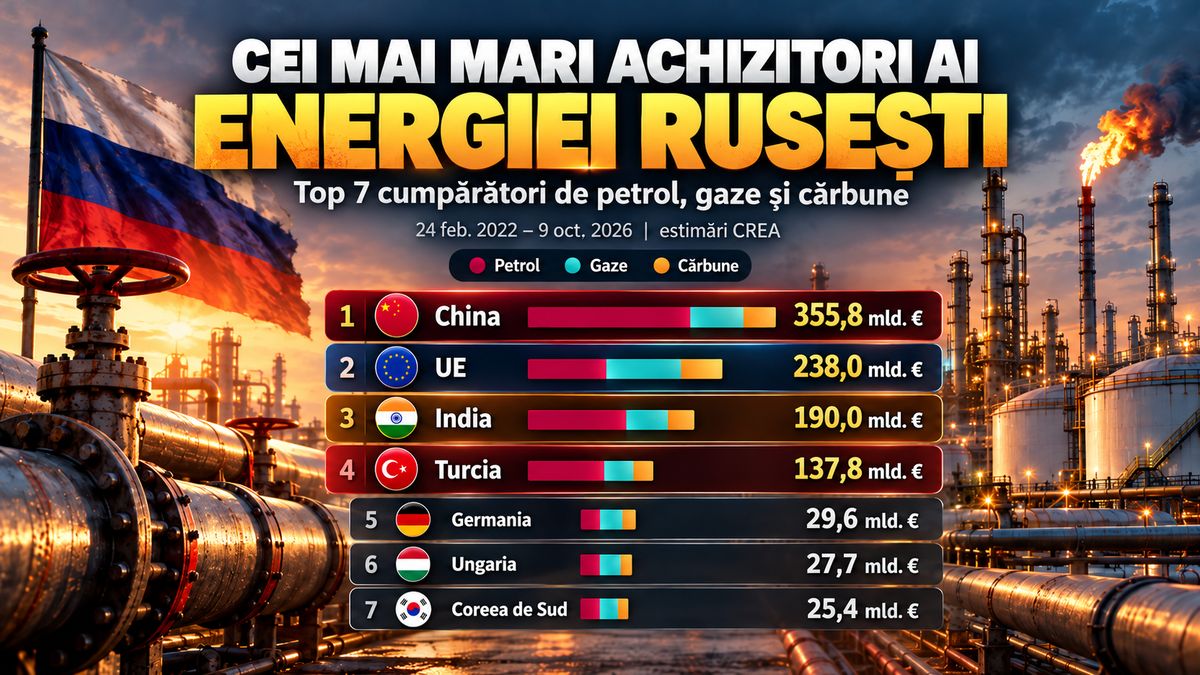
The European Union purchased an estimated cumulative €238 billion worth of Russian fossil fuels between February 24, 2022, and October 9, 2026, according to data from the Centre for Research on Energy and Clean Air (CREA). This total ranks the bloc second globally among buyers of Russian energy since the invasion of Ukraine began—behind China, which recorded purchases of approximately €356 billion, but ahead of India and Turkey. The scale of these transactions resurfaced at the center of international political confrontation on October 12, after Donald Trump cited European spending on Russian energy to justify his administration's decision to temporarily allow transactions involving Russian diesel. The US President accused Europe of paying Moscow $250 billion for oil, gas, and coal while criticizing the reopening of certain commercial ties between Washington and Russia. However, recent data indicates a major shift compared to the early years of the war. In August 2026, direct EU imports from Russia stood at approximately €1.2 billion, with natural gas accounting for 87% of this value. Crude oil and coal, which made up a significant portion of the historical bill, have been largely eliminated from direct EU-Russia trade through sanctions and supply diversification. China Leads Global Rankings, While the EU Remains Second Cumulatively CREA data, updated through October 9, 2026, illustrates the extent of Russia’s energy export reorientation since the outbreak of the war. China is the top global buyer of Russian fossil fuels, with cumulative purchases of approximately €355.8 billion. The European Union follows with €238 billion, India with €190 billion, and Turkey with nearly €138 billion. These four major markets accounted for a substantial share of Russia’s foreign revenue from crude oil, petroleum products, natural gas, and coal exports. China and India became essential destinations for Russian crude, while Turkey strengthened its role in gas and refined products trade. The European Union transitioned from a dominant market across multiple Russian energy commodities to a far more limited trade relationship, heavily concentrated in the gas sector. The cumulative ranking also reflects heavy imports by European states in 2022, prior to the implementation of major oil embargoes and the restructuring of gas flows. In CREA’s breakdown, Germany is listed separately at approximately €29.6 billion, Hungary at €27.7 billion, France at €22.8 billion, and the Netherlands at €20.7 billion. These national figures are already included in the €238 billion total attributed to the European Union. The EU’s position in the historical ranking highlights the scale of its energy ties with Russia since the start of the invasion. However, monthly trends illustrate their transformation: in August 2026, China imported €8.4 billion in Russian fossil fuels, India €4.8 billion, Turkey €1.5 billion, and the European Union approximately €1.2 billion. This dropped the EU to fourth place among global buyers during that month. Natural Gas Accounts for 87% of Remaining Direct EU Imports from Russia The drop in European imports has been accompanied by a profound shift in their structure. According to CREA’s August 2026 report, pipeline gas accounted for 61% of the total value of fossil fuels directly imported by the EU from Russia, equivalent to roughly €756 million. Liquefied natural gas (LNG) added another 26%, worth €323 million. The remaining 13% came from crude oil delivered via the Druzhba pipeline to Slovakia, under exemptions granted to specific pipeline flows. Natural gas thus accounted for approximately €1.08 billion of the monthly European total spent on direct Russian fossil fuel purchases. Trade dependence works both ways, however. CREA estimates that over its reference period, the European Union purchased approximately 49% of Russian LNG exports and 32% of Russian pipeline gas exports. For Moscow, the European market remains an important destination, even as Russia's share in Europe’s overall energy supply has shrunk. Eurostat data confirms this decline from the European import perspective. In the second quarter of 2026, Russia supplied 17.3% of the EU’s imported LNG volume and 10.2% of its gaseous gas imports. The United States provided 63.2% of European LNG imports, while Norway remained the primary supplier of pipeline gas. In August, CREA also recorded a 46% drop in the monthly volume of Russian LNG unloaded at European ports compared to July, marking the lowest monthly level since the start of the invasion. Roughly 57% of this volume was discharged at French ports. Hungary was the largest single EU buyer by total value of Russian fossil fuel imports, at approximately €386 million, consisting entirely of pipeline gas. Trump Accuses Europe, While Russia Claims Sales Exceeded $320 Billion The return of energy statistics to the transatlantic debate was triggered by a commercial agreement announced by Donald Trump regarding…
Ioana Buzoaica — Independent Editorial Board
The NRG-IA newsroom continuously monitors Romanian energy markets, ANRE regulatory decisions, and national grid telemetry (SEN/SNT). We deliver independent intelligence anchored exclusively in official primary data.
Editorial Charter, Ethics & Verification Methodology →