Romania can seek 0.6% of GDP fiscal leeway for energy — NRG-IA
Legislație & Reglementări Author: Ioana BuzoaicaEU rules allow fiscal leeway for energy security. Romania's 0.6% GDP cap is over RON 12B, but access depends on EU approval and fiscal health.
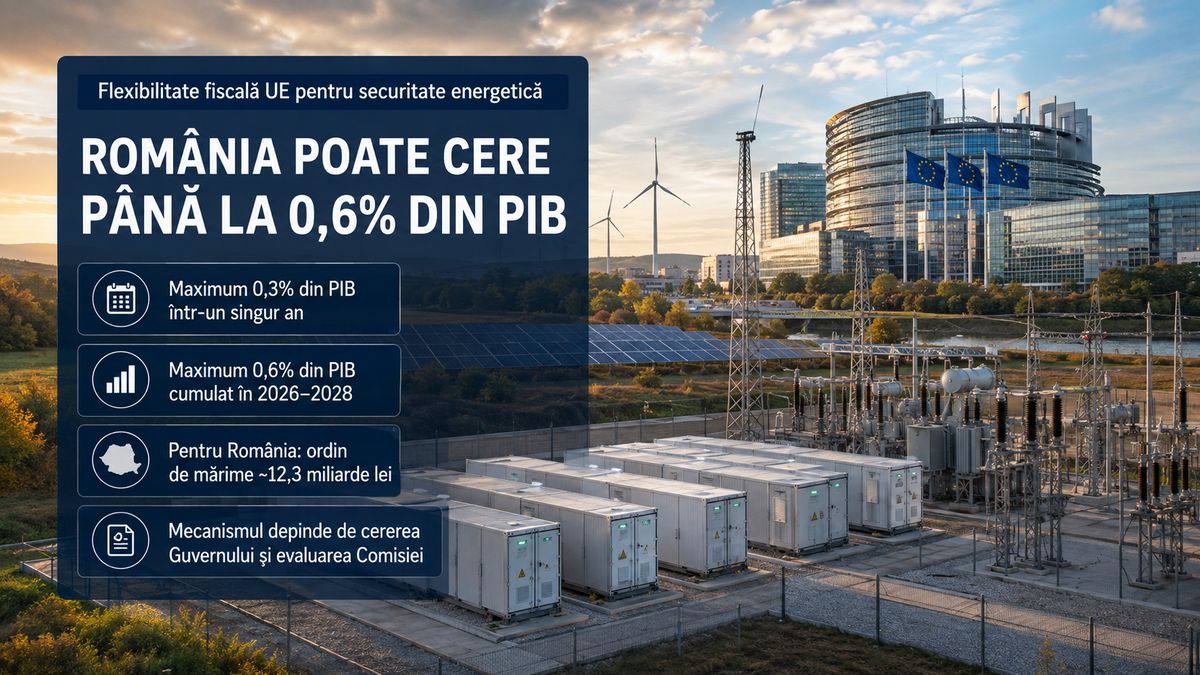
The European Commission has opened up the possibility for member states to use part of the European fiscal flexibility for energy security measures, with a cap of a maximum of 0.3% of GDP in a single year and 0.6% of GDP cumulatively over the 2026–2028 period . For Romania, applying this maximum cap to the nominal GDP of approximately RON 2,045 billion used in drafting the 2026 budget yields an order of magnitude of approximately RON 12.3 billion . However, this is not funding transferred from Brussels to Romania. The mechanism offers eligible states the possibility of a temporary deviation from the net expenditure path set by European fiscal rules for costs related to energy security measures. The spending remains nationally funded, and access is conditional on activating the escape clause and assessing the sustainability of public finances. The Commission announced the principle in the European Semester Spring Package on June 3, and on August 17, 2026 , it published the operational guidelines setting out how states can request this flexibility. For Romania, the next step lies with the Government: the Ministry of Energy is analyzing potentially eligible measures, while the fiscal decision and formal request primarily involve the Ministry of Finance. 0.6% of GDP is the three-year cap, not an annual limit The limits set by the Commission significantly alter the actual scale of the mechanism. The component dedicated to energy security can reach a maximum of 0.3% of GDP in a single year , but the total for 2026, 2027, and 2028 cannot exceed 0.6% of GDP . Therefore, the cap cannot be used as 0.3% of GDP in each of the three years to reach a total of 0.9%. If a member state were to use 0.3% of GDP in both 2026 and 2027, it would already exhaust the maximum energy flexibility available for the three-year period. Furthermore, the 0.6% component for energy security is included within the overall 1.5% of GDP cap of the National Escape Clause, a mechanism created in the context of rising defense spending. The Commission did not create a separate fiscal clause for energy, but rather allowed part of the existing flexibility to be used for measures contributing to energy security. For Romania, the equivalent in RON must be treated as an order of magnitude, not a reserved sum. Based on the nominal GDP of approximately RON 2,045 billion used in drafting the 2026 budget, 0.3% represents about RON 6.1 billion , and 0.6% is approximately RON 12.3 billion . The calculation base may change with GDP evolution and the methodology actually applied during the 2026–2028 period. Investments must structurally reduce energy vulnerability The guidelines published by the Commission link flexibility to measures that strengthen European energy security and contribute to reducing dependence on imported fossil fuels. However, eligibility does not stem simply from the fact that an expenditure belongs to the energy sector. The Commission will analyze measures individually, and the guidelines also establish a temporal condition: budgetary measures decided after February 28, 2026 , funded nationally and having a direct budgetary impact, can be considered. This architecture could open up significant space for Romania to make investments that structurally reduce the vulnerability of its energy system. Grids, storage, electrification, or other investments that reduce dependence on imported fossil fuels can become relevant for the mechanism, provided they meet the established criteria and are accepted by the Commission. The concrete selection of Romanian projects thus becomes one of the decisive stages. The Ministry of Energy must identify measures that align with the European objective, and the Government must decide which expenditures and budgetary values to include in a potential request. Romania does not currently have the escape clause activated Romania's situation differs from that of member states already utilizing the National Escape Clause. According to the Council of the European Union, the clause is currently activated for 18 member states . Romania is not among them. For Bucharest, accessing the flexibility intended for energy security first requires going through the activation procedure. The state requests the application of the clause, the Commission verifies whether the conditions are met and whether the deviation does not jeopardize medium-term public finance sustainability, and the Council decides on activation based on the Commission's recommendation. This condition is particularly relevant for Romania. The 2026 budget is built on a cash deficit target of 6.2% of GDP , following years in which the budget deficit placed the country under the European excessive deficit procedure. For this very reason, energy flexibility could be extremely valuable for Bucharest: it allows supporting additional investments without the entire eligible expenditure weighing in the same way on the European fiscal path. At the same time, the scale of…
Ioana Buzoaica — Independent Editorial Board
The NRG-IA newsroom continuously monitors Romanian energy markets, ANRE regulatory decisions, and national grid telemetry (SEN/SNT). We deliver independent intelligence anchored exclusively in official primary data.
Editorial Charter, Ethics & Verification Methodology →