EU alters CO2 market to curb power price spike risks — NRG-IA
Piața de Energie Author: Ioana BuzoaicaEU to stop cancelling excess carbon allowances until 2030, keeping a buffer to limit power price spikes—a key move for fossil-reliant grids.
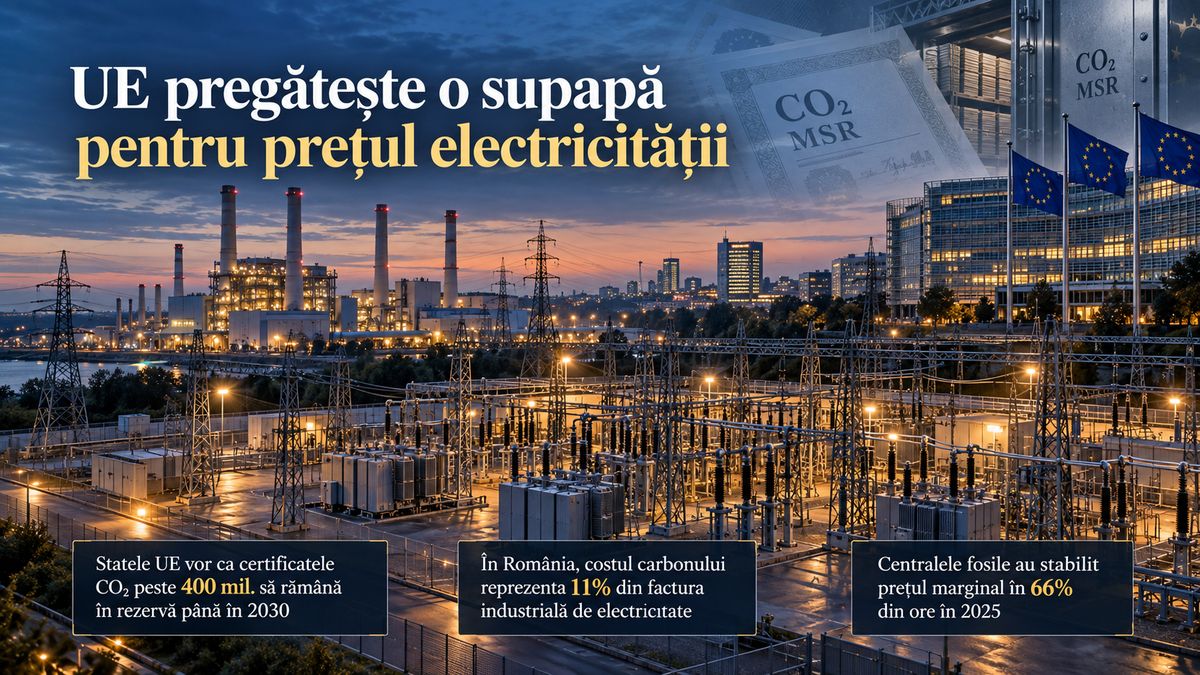
The European Union is preparing an amendment to the carbon market that could serve as a safety valve to limit future electricity price shocks. On September 23, member state ambassadors agreed that CO₂ allowances accumulated in the Market Stability Reserve above the 400 million threshold will no longer be cancelled until the end of 2030, but instead kept in the system to be used if the market becomes too tight. This change does not mean that Brussels is injecting additional allowances into the market right now, nor will bills drop immediately. However, it alters one of the rules governing future allowance supply in a system where CO₂ costs are passed directly to fossil fuel power plants and can heavily influence wholesale electricity prices. Europe wants to keep allowances it previously eliminated permanently The EU ETS operates with a capped number of allowances, each permitting the emission of one tonne of CO₂. Power plants and industrial installations covered by the system must hold enough allowances to cover their emissions, and this supply decreases over time to increase the cost of pollution and encourage lower-emission investments. To avoid major imbalances between supply and demand, the EU created the Market Stability Reserve (MSR). When there is an oversupply of allowances in circulation, a portion is absorbed from auctions and placed into the reserve; when the market becomes too tight, the mechanism can release allowances back into circulation. However, the current rule goes further: allowances in the reserve that exceed the 400 million threshold are permanently invalidated. Since 2023, more than 3 billion allowances have been eliminated through this procedure. The position now adopted by member states changes this exact step. Until the end of 2030, allowances exceeding the 400 million threshold would no longer be cancelled. They would remain in the reserve, forming a larger buffer for situations where supply might fall short in the coming years. From January 1, 2031, the invalidation mechanism would return, but the threshold would be raised to 800 million allowances, double the current level. The Council justifies the change by the need for greater liquidity and predictability in a carbon market that could become considerably tighter over the next decade. Allowances are not being injected into the market right now This distinction is important for the impact on energy bills. Europe currently continues to withdraw allowances from ongoing auctions when the market surplus is too high. For the period between September 2026 and August 2027, approximately 190.5 million allowances are set to be placed in the Market Stability Reserve, correspondingly reducing the volumes available for auction. The measure prepared by member states does not reverse this withdrawal. Instead, it changes what happens afterward to the allowances accumulated in the reserve. Instead of a portion of them disappearing permanently, they would remain available for the future. The immediate effect is therefore primarily on market expectations: participants know that the EU can draw on a larger pool of allowances if supply becomes too tight and carbon prices spike excessively. How CO₂ costs feed into electricity prices For consumers, the link between a carbon allowance and their electricity bill is not directly visible. Bills do not feature a separate line item for households to purchase ETS allowances. The cost arises earlier, during electricity generation. Gas, coal, and lignite plants must purchase allowances for the emissions they generate. The cost of carbon thus becomes part of their production cost. If such a plant is the marginal unit needed to cover demand in a given hour, its bid can set the marginal market price, which is then paid to all other producers cleared for that hour. The European Commission explains this mechanism by the fact that the market clearing price is determined by the marginal cost of the last power plant required to balance supply and demand. In this way, more expensive CO₂ allowances can drive up wholesale electricity prices, even in a system where a large share of energy is generated from sources with no direct carbon emissions. Romania is highly exposed to the marginal pricing mechanism For Romania, this relationship is particularly critical. The European Commission shows that the average wholesale electricity price in Romania was approximately €110/MWh in 2025 , compared to a European average of €85/MWh, representing the fourth-highest level in the Union. In the same year, fossil fuels accounted for only 29.4% of electricity generation, yet fossil fuel plants set the marginal price in approximately 66% of hours . This discrepancy highlights how strongly the costs of gas, coal, and carbon can influence the entire market, even when the majority of electricity comes from other sources. For industry, the impact of carbon is already measurable in final bills. For the first half of 2025, the Commission…