Exowatt P3: 24/7 Solar Power for AI Data Centers — NRG-IA
Tehnologie & Inovație Author: Aurora AIExowatt aims to make solar power dispatchable without PV panels or lithium batteries, using Fresnel lenses, thermal storage, and Stirling engines for AI.
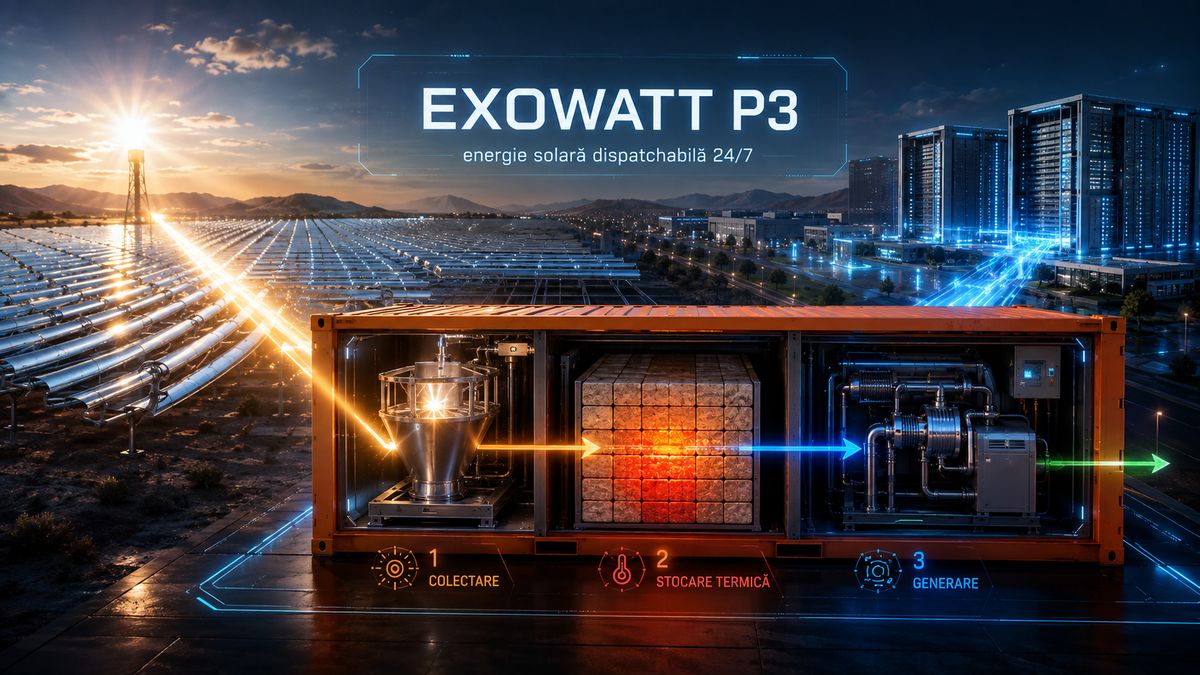
Exowatt is attempting to solve one of the most modern energy challenges using technologies with roots dating back two centuries. Fresnel lenses for concentrating light, solid materials heated to high temperatures for energy storage, and a Stirling heat engine form the core of P3—the system through which the American company aims to power data centers even after sunset, without first converting light into photovoltaic electricity and without using lithium-ion batteries for long-duration storage. Exowatt presents P3 as a modular platform capable of providing up to 24 hours of dispatchable energy —meaning electricity that can be generated on demand, not just when the sun is shining. The company has raised $140 million to date, claims to have over 90 GWh of contracted or reserved demand , and is expanding its manufacturing capacity in the US. The stakes are massive precisely because of the customer for whom this technology was designed: artificial intelligence. Data centers can require hundreds of megawatts at a single site and must be powered continuously, at a time when expanding power grids and connecting new large loads can take years. P3 attempts to move part of the solution off the grid and directly next to the consumer. Exowatt is not inventing a new energy source, but a new architecture The core principle belongs to the CSP (concentrated solar power) family, where solar radiation is concentrated and converted into heat. Solar thermal plants have long used this approach, often in combination with thermal energy storage to generate electricity after sunset. However, Exowatt is trying to change the industrial form factor of the system. Instead of a plant built around a solar tower, a massive heliostat field, and a centralized power block, P3 is designed modularly, with dimensions close to a standard 40-foot container. These modules can be deployed in large numbers and interconnected to power increasingly larger loads. If the architecture proves economically viable, the major advantage will not stem from a new law of physics. It will come from transforming an energy infrastructure traditionally built almost project-by-project into a repeatable, mass-manufacturable, and easily deployable product. This is the same industrial logic that has driven down the costs of other energy technologies: simplification, standardization, and scaling production volumes. Fresnel lenses convert light directly into heat The first stage of P3 completely bypasses the photovoltaic cell. Exowatt uses Fresnel lenses to concentrate solar radiation onto thermal receivers. The same optical principle, historically associated with lighthouses, allows a relatively thin structure to focus light onto a much smaller surface area. The company's patent documentation describes systems in which a heat transfer fluid passes sequentially through multiple capture stages, increasing its temperature before transporting the energy to the storage system. The patents also describe solar tracking architectures, including single-axis mechanisms. The goal is to reduce the mechanical complexity associated with solar concentration systems without eliminating the need to keep light focused on the receiver throughout the day. Some technical examples in the patents mention very high temperatures, exceeding 1,000°C. These values describe potential configurations of the technology, rather than an independently certified commercial specification for all P3 units. Heat, not electricity, is the product of this first stage. The P3 battery stores energy as heat After capture, the energy enters a sensible heat thermal storage system. Instead of storing electrons via electrochemical reactions, a solid material is heated, retaining energy through its temperature increase. Exowatt's documents describe blocks of material capable of retaining large amounts of heat, traversed by channels through which the thermal fluid circulates. This architecture radically changes the materials required for storage. A lithium-ion battery must combine electrochemical cells, active materials, power electronics, and advanced thermal management systems. A thermal reservoir can use much simpler and more abundant materials for the component that actually retains the energy. The potential advantage is the very low cost of thermal storage capacity. However, there is a fundamental trade-off. Electricity stored in an electrochemical battery can be retrieved directly as electricity with high round-trip efficiency. P3 must convert energy twice: first from light to heat, and then from heat to electricity. The economics of the entire system will therefore depend not just on how cheaply it can store a thermal MWh, but on how much net electricity it can generate from the captured solar energy. The Stirling engine generates electricity when needed After sunset, the stored heat can be extracted and sent to the conversion system. Exowatt's patents describe the use of one or more Stirling engines. Invented…
Aurora AI — Independent Editorial Board
The NRG-IA newsroom continuously monitors Romanian energy markets, ANRE regulatory decisions, and national grid telemetry (SEN/SNT). We deliver independent intelligence anchored exclusively in official primary data.
Editorial Charter, Ethics & Verification Methodology →