Hungary Intervenes in Danube to Save Paks Nuclear Plant — NRG-IA
Piața de Energie Author: Aurora AIHungary modified the Danube riverbed, sinking two barges and placing 145,000 m³ of rock, to prevent a total shutdown at the 2 GW Paks nuclear plant.
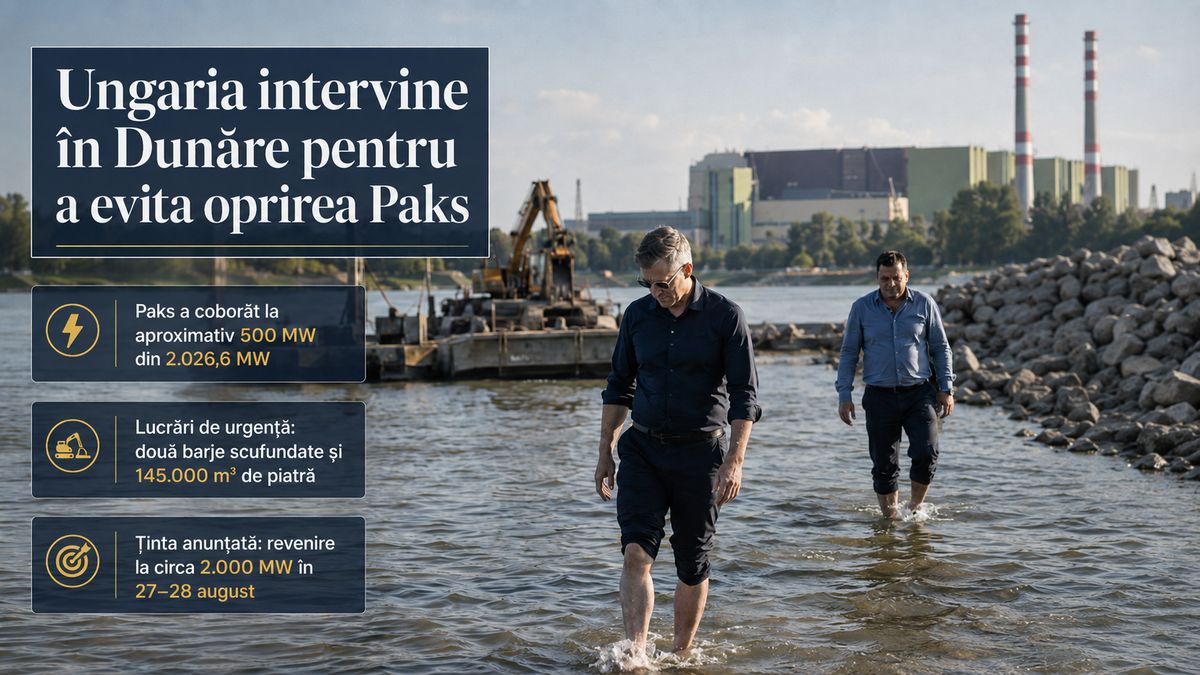
Hungary has resorted to emergency modifications of the Danube riverbed to protect approximately 2 GW of nuclear capacity. Following weeks of drought and high temperatures, the river's water level in the Paks area dropped so low that the nuclear power plant successively reduced its output, shutting down three of its four units. By mid-August, only a single unit remained operational, generating around 500 MW of the plant's nominal 2,026.6 MW capacity. The authorities' response was unusual in its physical scale: constructing a submerged sill in the Danube riverbed using approximately 145,000 m³ of rock , complemented by the controlled sinking of two barges measuring about 80 meters each . The goal is not to block the river, but to locally raise the water level so that the plant's cooling water intake system can continue to operate. Hungarian Premier Péter Magyar announced on August 19 that the interventions prevented a total shutdown of Paks and that the gradual restart of the offline units could begin on Sunday, August 23. The plant's return to full capacity is estimated for August 27–28, provided water levels and technical operations allow the schedule to be met. The Danube had dropped close to the threshold that would shut down the plant The issue at Paks was not the disappearance of water from the Danube, but rather the drop in its level to the limit where the cooling system's intakes and pumps could no longer operate under normal conditions. Around August 15, Hungarian authorities reported water levels of approximately minus 120–122 cm and anticipated a drop toward minus 132 cm. A complete shutdown of the plant was projected at approximately minus 140 cm. Pressure on generation had already become severe. Units 1, 3, and 4 were shut down, leaving Unit 2 as the only one in operation. On August 10, the Hungarian nuclear authority confirmed that Unit 2 had returned to nominal capacity, while the other three units remained unavailable. During the most critical moments of the crisis, Paks' output had dropped to around 240 MW , with only a single turbine running. Subsequently, the plant recovered to approximately 500 MW by operating both turbines of the remaining active unit. For a power system where Paks typically provides a highly significant share of domestic generation, losing about three-quarters of the plant's capacity quickly shifted the pressure onto imports and other domestic generation units. Two barges and a submerged sill raise the water level The intervention in the Danube was designed to locally alter the river's hydraulics without constructing a conventional dam. The central element is a sill placed on the riverbed. Out of the approximately 145,000 m³ of mineral material designated for the works, a portion forms the structure crossing the riverbed to raise upstream water levels, while the remainder is used to stabilize and protect the area against erosion. In parallel, two barges measuring approximately 80 meters in length were positioned transversely and subjected to controlled sinking. The operation also utilized five-ton anchors to stabilize the vessels and maintain them in the required position. By August 19, authorities reported that the works, combined with additional water management across the Danube system, had raised the local water level by approximately 10–15 centimeters . In the cold water channel used by Paks, the increase was over five centimeters. These figures may seem small relative to the scale of the Danube, but at Paks, the difference between operation and shutdown had come to be measured in mere centimeters. A 2 GW power plant dependent on a few centimeters of water Paks features four VVER-type nuclear units with a total nominal capacity of 2,026.6 MW. Each unit is connected to two turbines, totaling eight turbines for the entire plant. The production cut in August exposed a vulnerability that does not lie within the nuclear reactor itself, but rather in the auxiliary infrastructure indispensable to its operation. The reactors may be technically available, but without sufficient water for the cooling system, output must be reduced or halted. This dependency becomes critical when the plant represents one of the country's primary sources of electricity. MVM indicates that Paks contributes close to half of Hungary's domestic electricity generation under normal operating conditions. The August crisis reduced this resource from approximately 2 GW to just a few hundred megawatts, precisely during a period of high consumption driven by high temperatures. Imports covered part of the missing energy The reduction at Paks quickly spilled over into cross-border flows. On days with severely diminished nuclear output, Hungary had to purchase more electricity from neighboring markets, including during intervals with high wholesale prices. A Hungarian market analysis estimated an average imported electricity price of approximately €218/MWh for August 4, with a daily import bill close to…
Aurora AI — Independent Editorial Board
The NRG-IA newsroom continuously monitors Romanian energy markets, ANRE regulatory decisions, and national grid telemetry (SEN/SNT). We deliver independent intelligence anchored exclusively in official primary data.
Editorial Charter, Ethics & Verification Methodology →