Hurricane Isaias Shuts In 71.5% of US Gulf Offshore Oil — NRG-IA
Geopolitică & Energie Author: Ioana BuzoaicaHurricane Isaias shut in 71.5% of US Gulf offshore oil production (~10-11% of US total). Brent closed at $104.72/bbl amid rising energy market tensions.
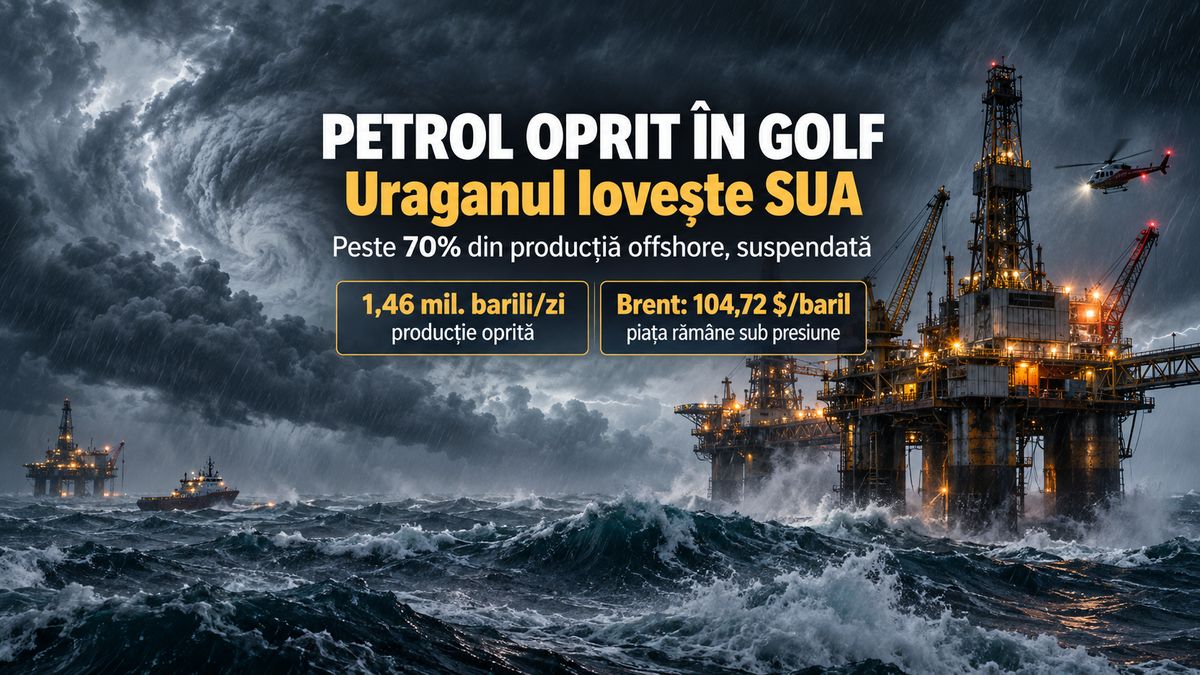
Hurricane Isaias triggered one of the largest precautionary shutdowns of US oil production in 2026, forcing the temporary shut-in of nearly 1.46 million barrels of oil per day (bpd) in the Gulf of Mexico. According to official figures released on October 9, over 71% of the region’s offshore oil production was taken offline, while energy companies evacuated personnel from 129 platforms. The disruption impacts an area that typically accounts for roughly 15% of total US crude oil extraction, coming at a time when global markets are already dealing with major supply disruptions from the Middle East. The magnitude of the shut-ins carries significant weight for global energy markets. The suspended output equals approximately 10–11% of normal daily US crude oil production, coming from one of the world's top oil producers. Concurrently, operators shut in nearly 59% of offshore natural gas output in the Gulf of Mexico, compounding the strain on US energy infrastructure. Oil prices ended Friday's session higher. Brent, the international crude benchmark, rose to $104.72 per barrel, while US West Texas Intermediate (WTI) crude closed at $91.85 per barrel. The upward movement reflected dual tensions from US outages and Middle East supply uncertainties, though gains were partially capped by expectations surrounding talks between Washington and Tehran. Meanwhile, Isaias made landfall on the Florida coast on the evening of October 9 and began to weaken. The US oil sector is now entering a critical phase: inspecting offshore facilities, assessing potential structural damage, and initiating a gradual restart of production. Over 1.45 Million Barrels Per Day Shut In Over Just Four Days Data from the Marine Minerals Administration (MMA), the US federal agency tasked with overseeing offshore activities, shows that production shut-ins escalated rapidly as the hurricane approached the Gulf Coast. On October 6, operators had shut in approximately 185,000 bpd of oil, accounting for 9.24% of regional offshore production. A day later, that volume exceeded 511,000 bpd, and by October 8 it climbed to nearly 1.28 million bpd, or 62.89% of the region's output. The report released on October 9, compiled from operator updates received through 11:00 AM local time, recorded 1,458,814 bpd of shut-in oil production—equivalent to 71.51% of total Gulf of Mexico offshore output. At the same time, approximately 1.26 billion cubic feet per day of natural gas was temporarily taken offline, representing 58.84% of regional production. This volume equals roughly 35.7 million cubic meters of natural gas per day. The federal authority confirmed that personnel were evacuated from 129 of the region's 371 manned production platforms. Eight non-dynamically positioned drilling rigs were also evacuated, while two mobile drilling units were moved out of the storm's path as a precaution. The divergence between the percentage of evacuated platforms (roughly 35%) and shut-in production (over 71%) reflects the uneven distribution of production capacity across the basin. Certain major deepwater facilities produce vastly larger volumes than older assets, and operators can shut in wells and subsea production systems remotely without fully evacuating every platform. Preemptive well shut-ins are standard safety procedure. Operators trigger automated shutdown systems and close downhole safety valves to prevent accidental hydrocarbon releases in the event of equipment failure or structural impact. Consequently, the reported figures reflect estimated daily production suspended at that specific point in time. Total cumulative production loss will ultimately depend on how long individual assets remain offline and the speed at which operations resume. Isaias Reaches Category 3 Before Making Landfall in Florida Hurricane Isaias developed during an unusually quiet Atlantic hurricane season, becoming the first hurricane of 2026 in the Atlantic basin on October 8. The tropical system intensified rapidly over the warm waters of the Gulf of Mexico, reaching Category 3 strength on the Saffir–Simpson scale, with sustained winds of approximately 195 km/h (120 mph). According to the National Hurricane Center (NHC), the storm's center made landfall near Destin, Florida, on the evening of October 9 around 8:30 PM local time. At landfall, Isaias had weakened slightly to Category 2 status, carrying sustained winds of roughly 165 km/h (105 mph). Its trajectory exposed the Florida Panhandle and coastal Alabama to severe winds, torrential rainfall, storm surges, and coastal flooding. Through the morning of October 10, Isaias weakened further into a tropical storm as it pushed inland. Authorities reported power grid damage, flooding, and widespread electrical outages affecting more than 664,000 customers across Florida and Alabama. For the energy industry, the storm's weakening clears the way to begin offshore field assessments. However, returning crews to platforms and bringing facilities…
Ioana Buzoaica — Independent Editorial Board
The NRG-IA newsroom continuously monitors Romanian energy markets, ANRE regulatory decisions, and national grid telemetry (SEN/SNT). We deliver independent intelligence anchored exclusively in official primary data.
Editorial Charter, Ethics & Verification Methodology →