Wind Shifts Romania's Energy Balance: 2.46 GW Surplus — NRG-IA
Piața de Energie Author: Ioana BuzoaicaRomania shifted to a power surplus on Saturday evening as wind output hit 2,460 MW, offsetting limited hydro and nuclear capacity after sunset.
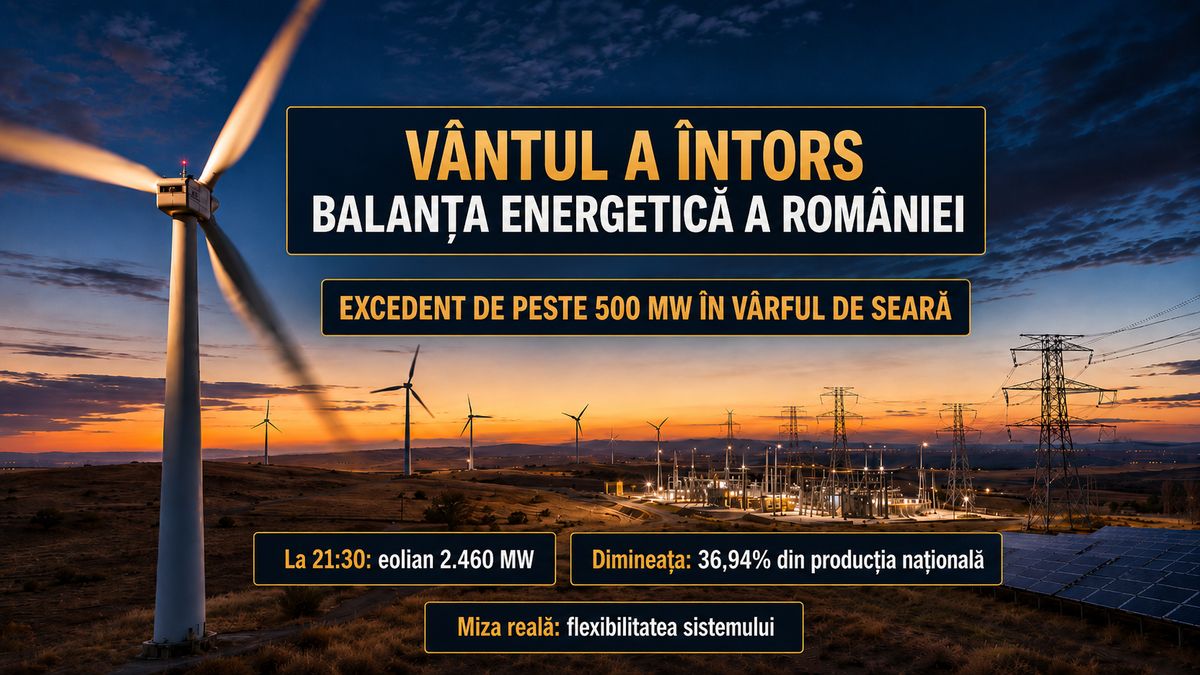
On Saturday evening, August 8, Romania entered its peak consumption period in a situation almost opposite to the massive import episodes of previous days. Around 21:30, domestic generation exceeded 7,000 MW, consumption was approximately 6,500 MW, and the system had a surplus of over 500 MW. The shift came mainly from Dobrogea: wind turbines were supplying about 2,460 MW, equivalent to around 35% of domestic generation at that moment. This moment is particularly relevant because solar power had practically disappeared from the mix after sunset. In recent weeks, the evening interval has become one of the major vulnerabilities of the Romanian power system: solar generation rapidly drops to zero, consumption remains high, and drought has simultaneously restricted the availability of hydropower and a portion of nuclear generation. On Saturday, wind covered a significant portion of this gap, shifting the balance from an import requirement to a surplus. Wind power surged from a few hundred to over 2,400 MW The difference compared to the beginning of the month is stark. Transelectrica's operational data for the first five days of August show daily wind generation averages ranging between just 113 and 258 MW: 113 MW on August 1, 173 MW on August 2, 167 MW on August 3, 258 MW on August 4, and 171 MW on August 5. By Saturday evening, instantaneous wind power had reached approximately 2,460 MW. While these two types of values measure different intervals—daily averages versus output at a specific moment—they clearly illustrate the meteorological shift over the weekend: after several days of low wind contribution, the wind returned on a scale capable of shifting the balance of the entire system. The phenomenon continued on Sunday morning. At 07:34, Romania was generating approximately 5,623 MW, of which 2,076 MW came from wind turbines. Wind power thus accounted for 36.94% of instantaneous national electricity generation , becoming the largest source in the mix at that moment. Nuclear generation stood at approximately 684 MW, while hydropower plants supplied only 579 MW. This difference highlights how crucial the wind's contribution has become in a system where two traditional baseload energy sources continue to be impacted by hydrological conditions. A single nuclear unit and reduced hydropower increase the value of every MW of wind Unit 1 of the Cernavodă nuclear power plant underwent a controlled shutdown on the morning of July 28. Nuclearelectrica reported to the Bucharest Stock Exchange that the measure was prompted by the extremely low level of the Danube River, amid severe drought conditions. With only one nuclear unit remaining in operation and river flows limiting hydro output, Romania's power balance has become more sensitive to renewable volatility. When the wind is weak, the remaining demand must be covered by other power plants and imports. When wind generation climbs toward 2,000–2,500 MW, that same balance can shift in just a few hours. This exact sensitivity had been identified by Transelectrica ahead of the summer. In its operational planning study for summer 2026, the transmission system operator modeled an evening peak scenario where wind and solar generation are zero, and one unit at Cernavodă is unavailable. With domestic generation at 5,400 MW and consumption at 7,400 MW, the import requirement reaches 2,000 MW . In a maximum summer consumption scenario, with 8,500 MW of demand and zero wind and solar generation, the import level analyzed by Transelectrica climbs to 2,500 MW . These values represent system operation scenarios, not forecasts for the August 8–9 weekend. However, they demonstrate the scale of the impact that wind availability can have on the national balance. The same system can import heavily or export just days apart Transelectrica also analyzed the opposite situation. In scenarios with high renewable generation, the operator modeled exports of approximately 800 MW during off-peak periods with strong wind, and up to 1,500 MW in a summer configuration with 2,650 MW of wind and 2,000 MW of solar. The current weekend provides an operational demonstration of this very mechanism. After periods in which Romania required imports of over 2,000 MW, the return of wind generation to approximately 2,500 MW allowed the system to reach a surplus even after sunset, when solar energy could no longer contribute. This alternation is not merely a matter of annual electricity volume. The system must have the necessary capacity at the exact hour the imbalance occurs. A MWh generated at noon cannot automatically cover consumption at 21:00. Shifting energy available during favorable hours to deficit periods requires storage capacity, flexible hydropower plants, fast-ramping generation assets, and sufficient cross-border interconnection capacity. Prices reveal the same disconnect between different times of day The day-ahead market provides an economic reflection of this same issue. For Sunday delivery,…
Ioana Buzoaica — Independent Editorial Board
The NRG-IA newsroom continuously monitors Romanian energy markets, ANRE regulatory decisions, and national grid telemetry (SEN/SNT). We deliver independent intelligence anchored exclusively in official primary data.
Editorial Charter, Ethics & Verification Methodology →