Norway Prepares 1.2 MW Airborne Wind Power Project — NRG-IA
Tehnologie & Inovație Author: Ioana BuzoaicaNorway's Kitemill flies autonomous wings up to 500m to generate power on the ground. The 1.2 MW NAWEP project will test this technology at scale.
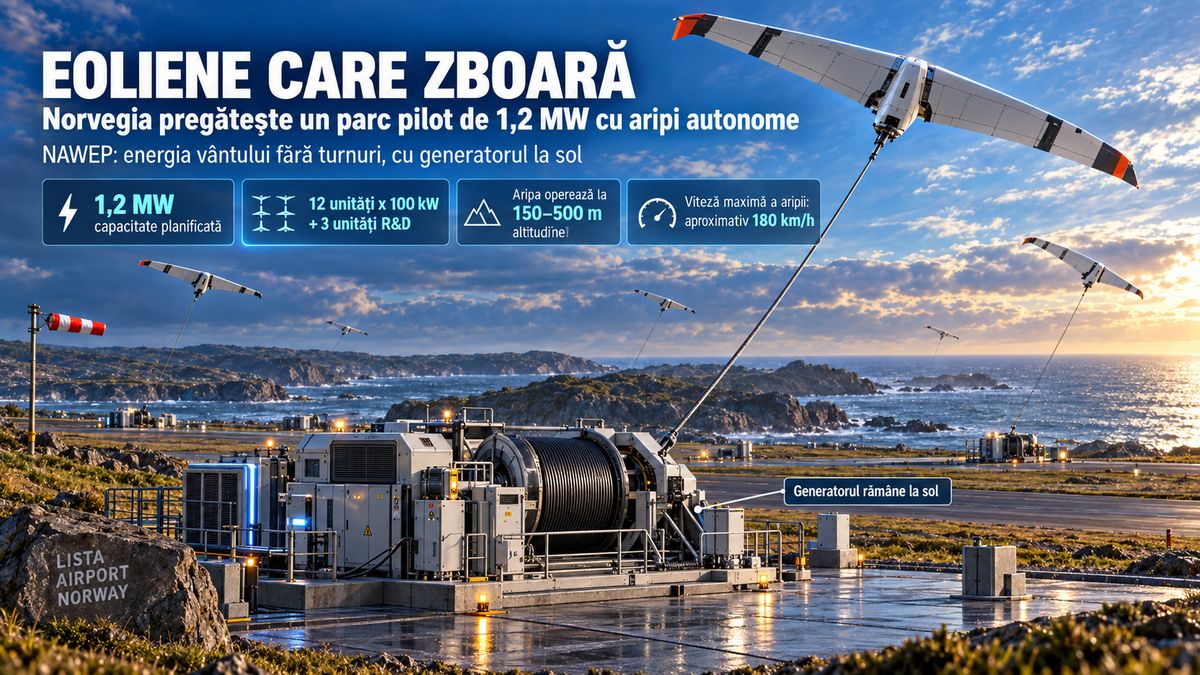
A towerless wind farm featuring autonomous wings that fly hundreds of meters above the ground, converting tether tension into electricity, is taking shape in Norway. The NAWEP project – Norwegian Airborne Wind Energy Pilot – at Lista Airport in Farsund, plans to install 12 production systems of 100 kW each, for a maximum grid injection capacity of 1.2 MW , plus three separate units dedicated to research and development. The concept radically redefines the traditional image of a wind turbine. The generator does not sit in a nacelle, there is no massive steel tower, and the wind-harvesting surface is not a giant rotor. Instead, an autonomously controlled rigid wing—closer to a glider than a traditional kite—takes to the air, tethered to the ground by a high-strength cable. During power generation, the wing flies across the wind in a high-speed circular path, pulling the tether. The tether unwinds from a drum, driving the ground-based generator. Upon reaching maximum length, the system reduces the wing's aerodynamic lift and reels the tether back in, consuming far less energy than was generated during the traction phase. The cycle then restarts automatically. The project's updated documentation outlines wing operations between approximately 150 and 500 meters above the ground , with a typical operating window between 200 and 400 meters. The wing's speed can reach around 50 m/s, equivalent to 180 km/h . This represents the flight speed of the aircraft itself, not the wind speed. Turbines Send Tons of Infrastructure into the Air. Kitemill Aims to Send Only the Wing The technological stakes stem from a simple structural difference. A conventional wind turbine must lift a heavy rotor, nacelle, and mechanical components high into the air, supporting them with a tower and foundation designed for extreme loads. As turbines grow, so do the sizes of the blades, towers, foundations, cranes, and the logistics required for installation. Airborne Wind Energy seeks to flip this equation. The generator, winch drum, and most of the mechanical system remain on the ground. Only the aerodynamic component needed to capture wind energy goes aloft. Kitemill estimates that this architecture can reduce the amount of structural materials by approximately 80–90% compared to equivalent conventional wind solutions. For the KM2 project, European documents also highlight a significant reduction in the levelized cost of energy as a primary goal. These figures represent targets and estimates for a technology still under development, rather than commercial results already achieved by a 1.2 MW farm. However, the physical advantage that makes them possible is real: the system aims to eliminate a substantial portion of the heavy structure built solely to reach the wind. The Wing Can Seek the Wind Instead of Waiting at a Fixed Height The difference is not just the amount of steel. The rotor of a conventional turbine operates strictly at the height at which it was built. In contrast, the wing of an airborne system can adjust its operating altitude, actively searching for the atmospheric layer that offers the most favorable conditions at any given moment. This flexibility does not guarantee that the wind is always stronger at higher altitudes. Measurements taken by Kitemill itself have encountered situations where the wind at around 300 meters was weaker than at lower levels. The advantage lies precisely in the system's ability to avoid being locked into a single vertical zone. Software thus becomes a direct component of energy production. A paper published in September 2026 in Wind Energy Science Discussions , based on a validated non-linear simulator for the KM1 prototype, analyzed the automatic adjustment of wing aerodynamics and operating altitude. In the simulation, speed-dependent flap control increased the average mechanical power during the traction phase from 7.56 kW to 11.10 kW . Combining this strategy with a higher minimum production altitude raised the value to 12.96 kW , approximately 71% above the baseline scenario. While this result comes from modeling and the paper was undergoing peer review at the time of publication, the technological direction is remarkable: for such a system, production gains can come not only from larger components but also from algorithms that optimize trajectory, altitude, and aerodynamic configuration. The wind turbine is thus increasingly borrowing from autonomous aviation technology. NAWEP Could Produce 4.2 GWh Annually If Systems Meet Design Performance For NAWEP's 12 commercial units, Kitemill estimates an annual production of approximately 4.2 GWh , calculated based on roughly 3,500 equivalent full-load hours. This is a projection for the mature operation of the project, based on modeling and experience gained with the KM1 prototype, rather than energy already generated by the Lista facility. The updated timeline schedules the testing of a limited number of research units in 2026, the installation of…